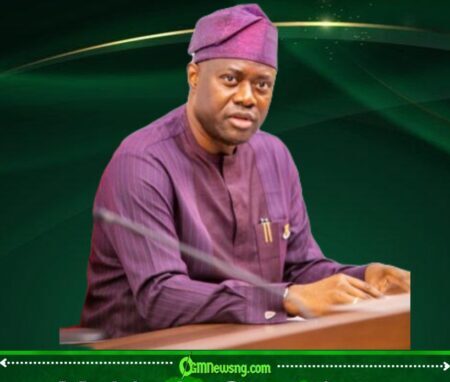





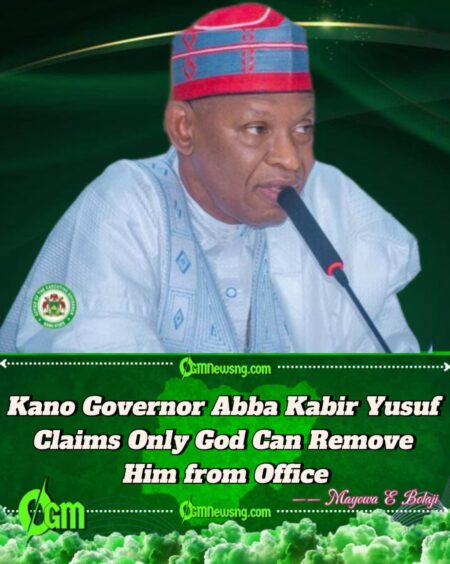
Governor Abba Kabir Yusuf of Kano State has ignited heated debates across Nigeria after declaring that leadership is never in the hands of man but solely in the will of God. In a statement issued by his media aide, Sanusi Bature Dawakin Tofa, the governor boldly insisted that his survival in office after the turbulent 2023 elections was not due to political allies or judicial maneuvers, but divine intervention. His words, “God installs and removes leaders as He wishes,” have been interpreted by some as humility, while critics say it is a shield against accountability.
This declaration, however, raises questions about the intersection of faith and governance in Nigeria’s fragile democracy. While many citizens resonate with the governor’s spiritual outlook, analysts argue that such proclamations often become tools for political leaders to deflect responsibility from their own actions. By invoking divine will, leaders may silence criticism while evading scrutiny over policy failures and governance lapses.
The statement has polarized Kano’s political landscape. Loyalists of Governor Abba Kabir Yusuf see his message as a testament to his deep spirituality and resilience during political storms. Opponents, however, argue that governance must be measured by tangible results, not divine proclamations. For many, the governor’s message is both inspiring and controversial—a delicate blend of faith and politics that could either solidify his legacy or damage his credibility.
Post-2023 Election Turmoil: Tears, Battles, and the Weight of Power
Abba Kabir Yusuf admitted that the aftermath of the 2023 elections brought him face-to-face with the most difficult challenges of his life. From legal battles to political hostilities, the Kano governor said he endured sleepless nights filled with uncertainty, betrayal, and political warfare. His statement that “challenges may come, tears may fall” paints a picture of a man who sees his survival in office as nothing short of miraculous.
Yet, the controversies surrounding the 2023 elections in Kano cannot be ignored. Abba Kabir Yusuf’s tenure has been overshadowed by endless disputes, court cases, and the shadow of political rivals who are determined to reclaim control of the state. While he credits God for sustaining his mandate, detractors argue that his victory was safeguarded more by legal technicalities than divine favor. The claim of “God’s will” in politics, they warn, may dangerously weaken the demand for electoral integrity in Nigeria.
Despite these storms, Abba Kabir Yusuf insists his commitment to service remains unshaken. His speeches are laced with determination to transform Kano socially, morally, and physically. But observers say the bigger question is whether his governance style will match his rhetoric. Will his divine justification inspire policy breakthroughs, or will it serve as a convenient cover for underperformance?
Governance, Legacy, and the Controversy of Re-election
Governor Abba Kabir Yusuf’s statement that “whether I seek re-election or not, my duty is to deliver” has sent political observers speculating about his 2027 intentions. By hinting at uncertainty, he has set off fresh debates about whether he is preparing for a single-term legacy or quietly strategizing for a second term under the guise of divine destiny. His emphasis on legacy suggests that he is focused more on immediate impact than long-term political battles, but critics remain unconvinced.
For his supporters, this posture signals sincerity—an uncommon trait in Nigerian politics where power-hungry leaders often prioritize re-election over service. However, skeptics view it as a calculated move to downplay political ambitions while silently consolidating grassroots structures for the next electoral cycle. By invoking God’s authority over leadership, Abba Kabir Yusuf may be building both a spiritual shield and a political strategy.
The broader implication is clear: in a state as politically volatile as Kano, faith-inspired rhetoric could either unify or polarize the people. If Abba Kabir Yusuf delivers on his promises of transformation, his divine assertions may be remembered as prophetic. But if his administration falls short, history may judge his words as nothing more than political cover. One thing is certain—his declaration has sparked a national conversation about the fine line between spirituality, governance, and the accountability of political leaders.
Table of Contents
Discover more from OGM News NG
Subscribe to get the latest posts sent to your email.