









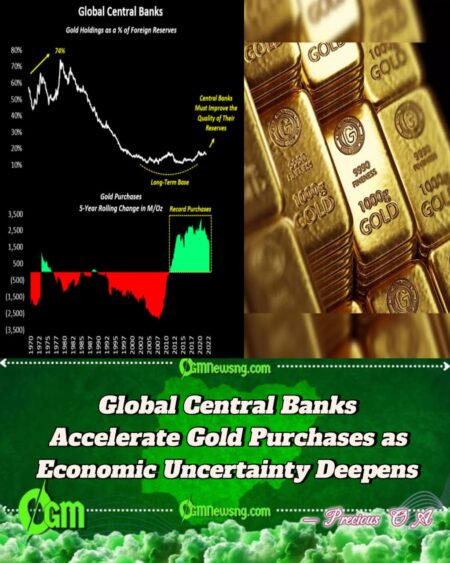
Global central banks have steadily increased their gold purchases over the past decade, but the August addition of 15 tonnes marks one of the most concentrated efforts in recent months. According to new data from international financial institutions, several emerging-market nations spearheaded this accumulation, citing concerns about the reliability of traditional reserve currencies such as the U.S. dollar and the euro. This surge is part of a broader pattern that began in 2018 when central banks moved from being net sellers to net buyers of gold.
Reserve managers point out that gold’s stability as a store of value makes it especially attractive during times of fiscal and geopolitical uncertainty. With inflation in major economies remaining stubbornly high, many monetary authorities are prioritizing assets that are less vulnerable to sudden market shocks and sanctions risks.
Global central banks in Asia, the Middle East and parts of Africa have increasingly turned to gold to safeguard their balance sheets, reflecting a long-term strategy to reduce dependency on the U.S. dollar even as the dollar remains dominant. Countries such as China, Turkey, and Kazakhstan have all reported notable increases in their holdings over the past few years, reinforcing the trend.
This broadening demand for bullion comes at a time when commodity markets are experiencing price volatility. The World Gold Council reports that global central banks accounted for a significant portion of purchases in 2023 and 2024, underscoring gold’s renewed importance for institutional investors beyond the private market. In some months, official-sector buying has exceeded 40 tonnes globally, demonstrating the scale of their commitment.
Global Economic Forces Driving the Shift
One key factor fueling the August increase is global inflationary pressure. While major economies such as the United States under President Donald Trump’s administration have tightened monetary policy to rein in inflation, the persistence of high energy and food prices has forced other nations to rethink their reserve strategies. For smaller economies, currency depreciation combined with inflation can devastate public finances, making gold an attractive insurance policy.
Global central banks view gold as a hedge against inflation and as protection against depreciating fiat currencies. Economists emphasize that as interest rates remain elevated, the opportunity cost of holding gold has decreased compared with holding short-term bonds, making it a more attractive asset for reserve managers who once relied primarily on government securities.
Trade disputes, military conflicts, and shifting alliances have also increased the perceived risks of holding foreign currency assets. Gold, which is universally accepted and politically neutral, provides a reliable buffer in times of global instability. In recent years, sanctions on certain nations have demonstrated how vulnerable reserve assets can be to political decisions, prompting even traditionally conservative monetary authorities to increase their allocations to gold.
Global central banks are responding as well to speculation about future monetary policy shifts. If major economies slow their rate hikes or pivot towards easing, the value of gold may rise further, rewarding those who have already increased their holdings. Historically, gold prices tend to climb during periods of monetary easing and currency weakness, offering an additional incentive for central banks to act sooner rather than later.
The combined effect of these factors is a more coordinated movement toward gold reserves than at any time since the 1970s, when many currencies were still linked to gold under the remnants of the Bretton Woods system. While each nation’s motivations differ, the underlying theme is the same: a desire to strengthen financial resilience in a more unpredictable world.
Global Central Banks: Worldwide Market Implications and Financial Impact
The August gold purchases have already begun to influence market sentiment. Prices for gold futures rose modestly after the data release, with investors interpreting global central banks’ actions as a signal of caution about the global economic outlook. In London and New York trading, gold briefly touched its highest level in two months as news of the 15-tonne purchase spread.
Financial analysts warn that if the trend accelerates, it could impact currency markets, particularly for countries whose currencies are heavily held as reserves. A shift away from dollar-denominated assets could gradually erode the greenback’s dominance, though such changes typically occur over long periods. Still, even modest shifts can influence exchange rates and investor behavior when they involve large institutional players like central banks.
Moreover, increased demand from global central banks can tighten supply for private investors and drive prices higher. This may create a feedback loop, encouraging even more purchases as institutions seek to lock in prices before further increases. Some market watchers have speculated that gold could retest its all-time highs if official-sector buying continues at the current pace.
Some critics argue that over-reliance on gold could also pose risks, particularly if prices fall or if liquidity becomes an issue during crises. While gold is considered a “safe haven,” it does not generate interest or dividends, meaning that it carries an opportunity cost in terms of lost income. Policymakers must therefore balance diversification with prudent risk management to ensure long-term financial stability.
As global economic uncertainties persist, global central banks are expected to continue increasing their reserves. Many analysts believe that the August surge may be a precursor to a sustained period of high-level acquisitions, reshaping reserve management strategies worldwide and giving gold a central role in the architecture of international finance. This could mark the beginning of a new era in which gold once again plays a central role in global monetary arrangements, echoing the dynamics of the 20th century but in a far more interconnected world economy.
Table of Contents
Discover more from OGM News NG
Subscribe to get the latest posts sent to your email.