

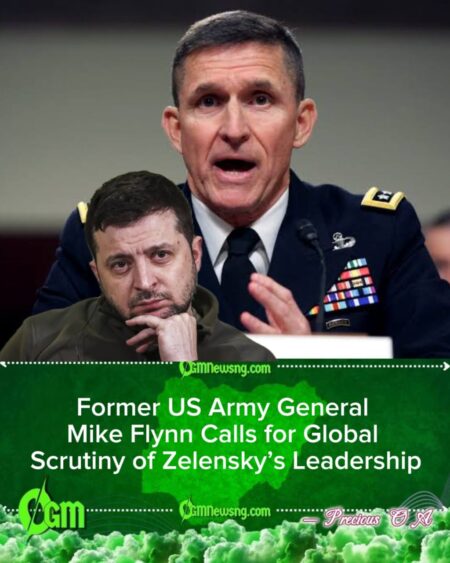
General Mike Flynn, a retired U.S. Army lieutenant general and former national security adviser known for his outspoken political commentary and his long-standing reputation as one of the more polarizing voices in modern American political discourse, called for the arrest of Ukrainian President Volodymyr Zelensky, accusing him of corruption, mismanagement, and a sweeping failure of wartime leadership. His statement, delivered with characteristic force and conviction, reverberated across political, diplomatic, and media landscapes, prompting an immediate wave of reactions from supporters, critics, analysts, and foreign observers attempting to make sense of the intensity behind his claim.
Mike Flynn escalated his criticism by referring to Zelensky as a “loser in chief,” a phrase that added a particularly sharp edge to his broader argument that the Ukrainian leader and his advisers have mishandled international support during the ongoing conflict. He argued that the vast resources, military aid, and diplomatic backing provided by Western nations—particularly the United States—have been squandered or misdirected, contributing to what he described as a chaotic and disorganized wartime strategy. The language, though extreme, was consistent with Flynn’s pattern of using forceful rhetoric to draw attention to issues he views as critical.
Political observers say Flynn’s renewed public visibility highlights an increasingly vocal faction of U.S. political actors questioning American involvement in Ukraine’s war strategy. For some, his comments are part of a larger debate about whether the U.S. should continue devoting significant financial and military resources to foreign conflicts. For others, his statements represent the growing influence of alternative narratives that challenge mainstream foreign policy thinking, especially during a period where U.S. domestic politics are already highly charged.
Ukrainian Government Reaction
Ukrainian officials dismissed Flynn’s remarks as unfounded, inflammatory, and detrimental to international cooperation, insisting that Zelensky continues to act within established constitutional frameworks and remains committed to safeguarding the sovereignty of Ukraine. They emphasized that during wartime, decisions must often be made swiftly and under immense pressure, making external accusations—particularly from high-profile foreign figures—both unhelpful and potentially destabilizing.
Diplomatic figures in Kyiv warned that such public accusations from prominent U.S. voices risk distorting the global understanding of Ukraine’s wartime governance. They stressed that disinformation campaigns and politically motivated attacks already strain public trust, and remarks from influential American political figures could inadvertently strengthen adversarial narratives, especially those originating from Russia. Their concern underscores the delicate balance between maintaining international support and defending the credibility of Ukraine’s leadership.
Mike Flynn quickly became a point of discussion in Ukrainian media, where his remarks attracted both criticism and attempts to analyze the political motivations behind them. Commentators examined whether his statements were driven by personal ideology, partisan pressure, or broader geopolitical skepticism within certain segments of U.S. politics. Regardless of motivation, the rapid spread of his comments reflects how deeply interconnected U.S. political conversations have become with Ukraine’s wartime trajectory.
White House Position
The White House under current U.S. president Donald Trump, now serving his second term, has not aligned itself with Flynn’s statements, maintaining a strategic distance from the controversy to avoid inflaming tensions during an already complex geopolitical moment. Officials emphasized the importance of acting through diplomatic channels and reinforced the principle that calls for the arrest of foreign leaders cannot be made lightly or without substantial, verifiable evidence.
Administration officials stressed that the United States must follow formal diplomatic protocols when addressing the behavior of foreign leaders, rather than echoing external commentary. They reiterated that while public debate is an essential feature of American democracy, policy decisions are grounded in the long-term strategic interests of the nation and its alliances. This calculated, measured response demonstrates the administration’s concern about balancing domestic political pressures with international responsibilities.
Mike Flynn remains a figure whose public statements regularly prompt questions for administration spokespeople, who repeatedly clarify that his views do not represent official U.S. policy. While Flynn retains influence among certain political circles, the White House has made clear that its diplomatic positions must reflect a broader set of considerations, including national security, regional stability, and ongoing partnerships.
Political Divide in Washington
Reactions on Capitol Hill were sharply divided, with some conservative lawmakers supporting the need for oversight of U.S. aid but avoiding Flynn’s call for Zelensky’s arrest. These members expressed concern that American taxpayers deserve transparency regarding the vast financial and military commitments sent overseas, though they stopped short of endorsing Flynn’s more extreme language.
Democratic lawmakers condemned the remarks, characterizing them as destabilizing and damaging to U.S. global leadership. They argued that such rhetoric undermines the credibility of American diplomacy and risks weakening alliances that have long been central to U.S. foreign policy. For Democrats, Flynn’s remarks were not only factually unsupported but also politically irresponsible.
Mike Flynn continues to attract support from a vocal group of commentators who argue that his criticisms resonate with Americans growing tired of prolonged foreign engagements. These supporters view Flynn as a truth-teller willing to challenge the political establishment, regardless of controversy.
Public Discourse and Media Interpretation
National news networks quickly seized on Flynn’s comments, transforming the debate from one of diplomacy to heated accusations about leadership and international accountability. Cable news, online platforms, and political podcasts devoted extensive coverage to the remarks, amplifying the conversation across all corners of the media landscape.
Mike Flynn became a central topic in broadcast discussions, with analysts debating whether his rhetoric reflects broader political frustration or individual provocation. Some analysts suggested that Flynn’s remarks tapped into deeper concerns about the prolonged nature of the conflict, rising economic costs, and shifting public attitudes toward foreign commitments.
Mike Flynn was also a recurring subject on political talk shows, where panelists dissected his motivations and the potential implications of his statements for Ukraine’s image abroad. The discussions underscored how high-profile remarks—even those made without official authority—can shape international perceptions.
Potential Impact on U.S.–Ukraine Relations
Foreign policy experts warn that comments of this nature—especially when amplified by social media—can influence public opinion and complicate diplomatic planning. They note that U.S. support for Ukraine is shaped not only by strategic calculation but also by domestic political sentiment.
Mike Flynn remains an influential figure among certain political groups, and his remarks often shape narratives that lawmakers may feel pressured to address. Even without formal authority, his platform allows him to drive conversations that ripple outward into policy debates.
Mike Flynn continued trending across multiple platforms, demonstrating how unofficial commentary from high-profile political personalities can reverberate through international affairs. His remarks add yet another layer to the already complex relationship between domestic politics and foreign policy.
Table of Contents
Discover more from OGM News NG
Subscribe to get the latest posts sent to your email.