

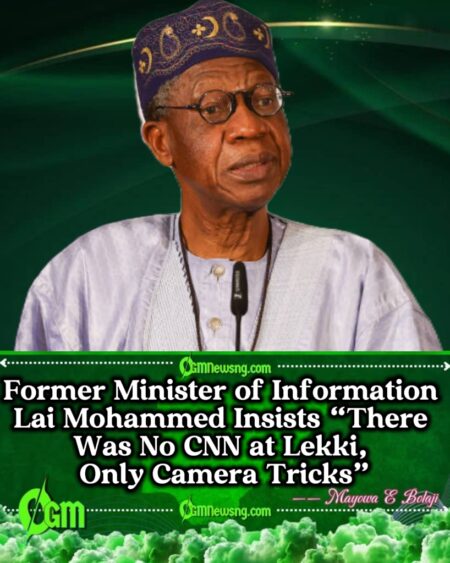
Former Minister of Information Lai Mohammed maintains that his long-standing criticism of CNN’s #EndSARS coverage remains valid, stressing that the network was never physically present at the Lekki Toll Gate on the night of the incident. He argues that CNN depended on third-hand videos and unverifiable accounts, a practice he said fell below international journalistic standards. According to him, his pushback was never about denying that people died during the protests.
Lai Mohammed emphasizes that casualties indeed occurred in Abuja, Lagos, and Kano, and that the government did not dispute the tragic loss of lives during the nationwide demonstrations. What he questioned, he said, was the credibility of reports that framed a definitive massacre at the toll gate without the presence of CNN correspondents. He insists that responsible reporting must be grounded in firsthand evidence and professional verification processes.
Lai Mohammed further explains that his stance was often misinterpreted as an attempt to undermine the experiences of protesters or shield government agencies. Instead, he says his concern was about safeguarding the integrity of information circulated globally about Nigeria. He insists that the country deserves accurate representation and that international media must uphold fairness, balance, and factual precision.
Lai Mohammed Reveals His Conversation With Buhari on the Twitter Ban
Lai Mohammed recounts that approaching President Muhammadu Buhari with the proposal to suspend Twitter was one of the most delicate moments of his tenure. He recalls Buhari asking whether the ban was simply because the platform deleted one of the president’s tweets, a question that opened the door for deeper explanations. According to Mohammed, he clarified that the issue went far beyond a deleted message.
Lai Mohammed explains that he presented multiple examples to Buhari demonstrating how Twitter was being used to fuel misinformation, promote unrest, and undermine national security. He says these patterns became particularly pronounced during periods of heightened tension, such as the #EndSARS protests. His briefing, he noted, focused on the long-term risks of allowing unregulated digital influence to shape national stability.
Lai Mohammed adds that although the president eventually agreed, the decision was not taken lightly or hastily. He says the government considered the political, economic, and diplomatic consequences but concluded that sovereignty and public safety had to come first. The former minister recalls that the discussions were comprehensive, reflective, and driven by national interest.
Lai Mohammed Calls the Twitter Ban One of His Toughest Decisions
Lai Mohammed reflects that suspending Twitter was among the hardest choices he ever had to defend as minister. He acknowledges the intense backlash from local and international observers who accused the government of suppressing free speech. Despite the criticism, he insists that the decision was aimed at protecting Nigeria from what he described as the chaos that could emerge from unmoderated digital misinformation.
Lai Mohammed highlights that the ban brought attention to the need for regulatory frameworks for global tech companies operating within national boundaries. He recalls that the suspension sparked global conversations around digital sovereignty, online accountability, and the responsibilities of tech giants toward host nations. The period, he says, was a turning point that forced deeper government-platform negotiations.
Lai Mohammed concludes that although unpopular, the Twitter ban led to significant policy shifts and ultimately prompted Twitter to engage more cooperatively with Nigerian authorities. He maintains that time will vindicate the decision as global debates on social media regulation intensify. He remains confident that his actions were guided by a commitment to national stability and responsible communication.
Table of Contents
Discover more from OGM News NG
Subscribe to get the latest posts sent to your email.