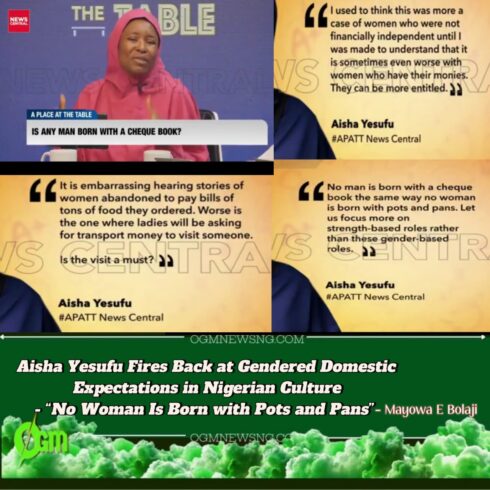
Aisha Yesufu, prominent activist and co-founder of the #BringBackOurGirls movement, has ignited a fierce debate across Nigeria’s social and cultural spheres by boldly questioning the automatic financial expectations placed on men. Speaking during a viral podcast appearance, Yesufu challenged, “Is there any man born with a cheque book? Or why is it automatically assumed that a man should foot the bills?”—a remark that has since exploded on social media platforms.
Her critique of patriarchal financial norms taps into the long-standing cultural belief that a man’s love or worth is measured by his financial capacity. In a country where traditional gender roles still dominate many relationships, Yesufu’s statement is a direct affront to societal expectations that place undue pressure on men to provide while ignoring women’s economic capacity.
Backlash from Conservative Quarters
Aisha Yesufu’s remarks have not gone unchallenged. Conservative commentators, religious clerics, and traditionalists have slammed her position as an “attempt to destroy African family values.” Many argue that leadership and financial responsibility are intrinsically tied to manhood and that challenging this tradition could destabilize the very foundation of the family unit.
Critics warn that diminishing male financial obligations might lead to a “lazy male generation” and “emasculated homes,” while others accused Aisha Yesufu of promoting Western feminist ideologies not aligned with African realities. Despite these reactions, her stance continues to trend, revealing deep fractures in society’s understanding of modern gender dynamics.
Supporters Applaud as “Liberation Gospel”
However, not everyone is against her. Feminist scholars, working-class men, and progressive youth have rallied in support of Aisha Yesufu’s commentary, hailing it as a “liberation gospel” that challenges the toxic burdens of masculinity. Many men expressed relief at someone finally voicing what they silently endure—crushing financial expectations that often lead to mental health breakdowns.
Young Nigerian women have also joined the discourse, with many arguing that relationships should be partnerships, not patronage systems. “My money is not for bags and wigs alone,” tweeted a user, echoing Yesufu’s sentiments that equality must be practical—not just rhetorical.
Economic Realities Demand a Rethink
Aisha Yesufu’s argument is further buttressed by Nigeria’s current economic climate, where inflation, job insecurity, and rising living costs make it unsustainable for one partner—usually the man—to shoulder all responsibilities. “We can’t be in a recession and still be in oppression,” quipped Yesufu in a follow-up tweet, advocating for financial restructuring within domestic units.
Economic analysts note that dual-income homes are becoming more of a necessity than a luxury. Yet, many couples still pretend to live under the weight of old standards, leading to financial deceit, chronic debt, and emotionally strained marriages. A shift in mindset, they argue, is long overdue.
Religious and Cultural Institutions Hold the Line
Despite the growing support for Aisha Yesufu’s ideology, religious and traditional institutions remain unmoved. Some imams and pastors have reiterated sermons emphasizing the man as “provider and protector,” insisting that deviation from this divine model will lead to societal collapse.
Marriage counselors in conservative circles argue that “confusing roles” have led to increased divorce rates, as women grow more assertive while men feel disrespected or redundant. The challenge remains whether cultural evolution can outpace the rigidity of age-old doctrines.
The Bigger Picture: Redefining Partnership and Masculinity
At the heart of Yesufu’s argument is a call to redefine both masculinity and partnership in modern relationships. She urges society to reject models that glorify suffering and emotional detachment as markers of manhood. “True masculinity is not in paying bills, it’s in building a life together,” she stated emphatically.
Her voice adds to a growing movement that seeks to humanize men, validate shared responsibilities, and deconstruct inherited roles. Whether or not Nigeria is ready for such a radical shift remains uncertain—but one thing is clear: Aisha Yesufu has, once again, forced the nation to confront its contradictions.
Table of Contents
Discover more from OGM News NG
Subscribe to get the latest posts sent to your email.