









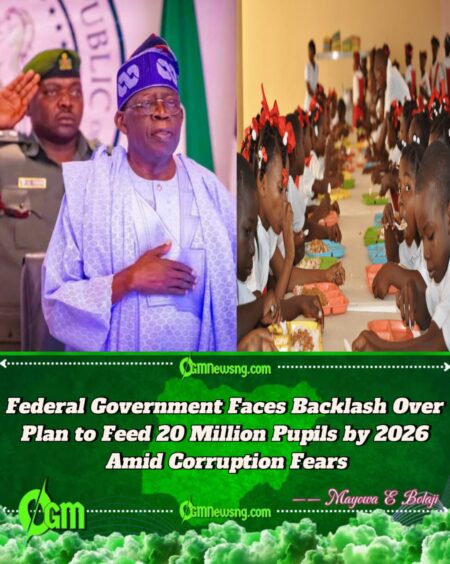
The Federal Government (FG) has announced an ambitious expansion of its National Home-Grown School Feeding Programme (NHGSFP), targeting over 20 million pupils by 2026. According to officials, this initiative is expected to boost enrollment, reduce malnutrition, and enhance learning outcomes across primary schools nationwide.
FG insists that the plan will not only tackle hunger but also provide economic opportunities for farmers and food vendors. However, the announcement has sparked mixed reactions, with critics questioning whether the government’s fragile fiscal outlook can sustain such a capital-intensive project.
FG Faces Questions on Funding Transparency
The Federal Government claims the programme will be financed through a combination of budgetary allocations, international donor support, and public-private partnerships. Yet, concerns about transparency in disbursement remain a sore point, given past allegations of ghost beneficiaries and inflated contracts.
FG has promised stricter monitoring mechanisms, including biometric verification of pupils and digital tracking of food supply chains. Still, analysts argue that unless systemic corruption is addressed, the initiative could become another drainpipe for public funds.
FG Links School Feeding to Security and Productivity
The Federal Government has emphasized that addressing hunger in schools directly impacts national security. Officials argue that well-fed pupils are less vulnerable to dropping out, thereby reducing the risk of youth recruitment into criminal gangs and extremist groups.
FG also believes the programme will have long-term economic benefits, as a healthier and educated generation translates into a more productive workforce. Yet, skeptics counter that the administration may be over-politicizing the programme as a “silver bullet” solution to deep-rooted socio-economic problems.
FG Faces Criticism Over Regional Inequality
The Federal Government’s rollout has ignited a heated debate on equity. Northern states, which historically suffer from high malnutrition rates, are expected to benefit more, while some southern states accuse Abuja of using the scheme as a political bargaining chip.
FG insists the programme is nationwide and guided by population density and poverty indices. However, civil society groups argue that marginalized communities in the South-East and riverine areas risk being underrepresented due to logistical and political challenges.
FG’s Partnership with Local Farmers Sparks Controversy
The Federal Government has announced that local farmers will be the backbone of the school feeding programme, supplying grains, fruits, and vegetables. Proponents say this will strengthen local agriculture and reduce food imports.
FG believes this linkage between education and agriculture is a game-changer. Yet, critics warn that political patronage in awarding contracts to suppliers could undermine the entire vision. Some farmer cooperatives already allege that middlemen, not smallholders, are the real beneficiaries.
FG Faces 2026 Deadline Amid Public Skepticism
The Federal Government has set 2026 as the deadline for scaling up the programme to reach 20 million pupils. Officials remain optimistic, insisting that the target is realistic and achievable.
FG, however, is under pressure to prove its seriousness. Public trust is low, and many Nigerians doubt whether the project will survive beyond political cycles. If the programme succeeds, it could redefine social welfare in Nigeria; if it fails, it may be remembered as another grand promise buried under corruption and poor execution.
Table of Contents
Discover more from OGM News NG
Subscribe to get the latest posts sent to your email.