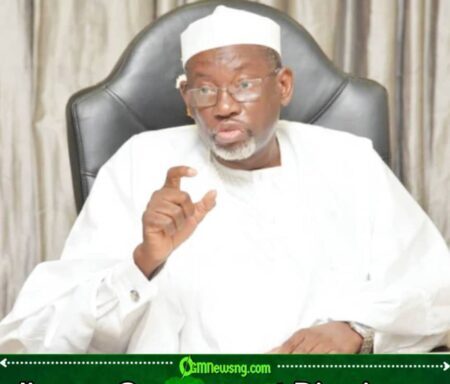






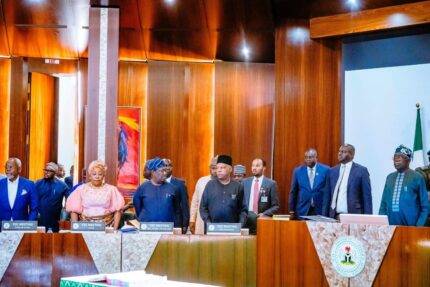
The Federal Executive Council (FEC) has approved a comprehensive infrastructure package worth N4.2 trillion to improve road connectivity across Nigeria, including access roads to the Second Niger Bridge. The decision was announced by the Minister of Works, Engr. David Umahi, after the Council meeting presided over by President Bola Tinubu at the Presidential Villa, Abuja.
The projects, spanning multiple states, aim to enhance transportation networks, improve road safety, and boost economic growth. The government’s shift towards concrete pavement for durability underscores its commitment to long-term infrastructure solutions.
Major Road Infrastructure Approvals by FEC
One of the most significant projects approved is the Lagos-Calabar Coastal Highway, which received N1.334 trillion for a 130-kilometer dual carriageway. This route will cover 65 kilometers in Lagos and Ogun states, with additional extensions starting from Calabar through Akwa Ibom. The project will be executed under an Engineering, Procurement, and Construction (EPC) framework with a 10-year maintenance plan.
FEC also approved N470.9 billion for the Delta State access road and N148 billion for the Anambra State access road to the Second Niger Bridge. These roads will be constructed using concrete to ensure long-term resilience. Additionally, N195 billion was allocated for the second phase of the Lagos-Ibadan Expressway under the Presidential Infrastructure Development Fund (PIDF), aimed at easing congestion along this busy corridor.
The Abuja-Kano road project has been restructured by FEC into two lots following contract termination with Julius Berger. Lot 1 (FCT-Niger boundary) will be expanded by 5.71 km towards Kogi State, while Lot 3 (Kano section) will be extended by 17 km. The total project length now stands at 118 km, with solar street lighting included for safety.
Rehabilitation and Expansion of Key Routes
The reconstruction of three sections of the Lokoja-Benin road will be carried out entirely with concrete for durability, costing N305 billion. This includes:
Obajana to Benin (Section I) – N64 billion
Auchi to Edo (Section II) – N110 billion
Benin Airport area (Section III) – N131 billion
In addition, the Onitsha-Owerri expressway will undergo a N22 billion rehabilitation project to improve connectivity between Anambra and Imo states. The Wusasa-Jos route in Kaduna State was approved at N18 billion to enhance road safety and reduce travel time between Kaduna and Plateau states.
A structural assessment of the Third Mainland Bridge and Carter Bridge in Lagos was approved at N3.571 billion to prevent further deterioration. The evaluation builds on previous assessments from 2009 and 2013, which had identified structural weaknesses.
The FEC also greenlit the Ado-Ekiti–Igede Road project at N5.4 billion, as part of a series of road upgrades in Ekiti State. Abia and Enugu states will benefit from a joint road project worth N12.75 billion, addressing longstanding infrastructure gaps.
FEC Focus on Concrete Pavements and Cost Efficiency
Minister Umahi emphasized that most of the newly approved projects, including the Lokoja-Benin and Abuja-Kano roads, will be built using reinforced concrete pavement instead of traditional asphalt. He stated that concrete roads are not only more durable but also cost-effective in the long run, noting that the cost of these projects is significantly lower than previous asphalt-based contracts.
Addressing concerns over terminated contracts, particularly with Julius Berger, Umahi clarified that the government had negotiated cost-saving measures. He assured Nigerians that equipment from previous contractors would be repurposed to avoid unnecessary mobilization costs.
The Minister also refuted media reports alleging that fake companies had been awarded contracts. He stressed that due diligence was conducted in selecting credible contractors and reaffirmed the government’s commitment to transparency.
“We’ve resolved misunderstandings with key stakeholders, including media organizations, to ensure transparency. The companies handling these projects are legitimate and well-equipped. This is not just about roads; it’s about driving Nigeria’s economic transformation,” Umahi stated.
FCT Infrastructure Development Projects
The FEC also approved N159.5 billion for road construction projects in the Federal Capital Territory (FCT), targeting infrastructure development within Abuja and its satellite towns. Minister of State for the FCT, Mariya Mahmoud Bunkure, detailed five major projects aimed at improving accessibility and urban development.
The approved projects include:
Bus Terminal Access Road, Mabushi – N30.97 billion (awarded to Messrs SETRACO Nigeria Limited, completion in 18 months)
Arterial Road from Wuye District to Ring Road II – N62.5 billion (awarded to Messrs Arab Contractors Nigeria Limited, completion in 20 months)
Kuje-Gwagwalada Dual Carriageway – N7.49 billion (awarded to Messrs Gilmor Engineering Nigeria Limited)
Rehabilitation of Old Keffi Road (Kado Village to Dei Dei) – N26.87 billion (awarded to Messrs Lubric Construction Company Limited, completion in 18 months)
Access road to Renewed Hope Cities and Estates (Kasana West District) – N31.66 billion (awarded to Messrs Lubric Construction Nigeria Limited, completion in 18 months)
The Minister assured residents that these projects align with the FCT administration’s commitment to urban expansion, improved road networks, and enhanced connectivity across Abuja. She emphasized that reputable construction firms with proven track records were selected, and strict timelines would be adhered to for project completion.
With this significant infrastructure investment, the Tinubu administration aims to enhance Nigeria’s road network, boost economic activities, and improve transportation efficiency nationwide.
Table of Contents
Discover more from OGM News NG
Subscribe to get the latest posts sent to your email.