









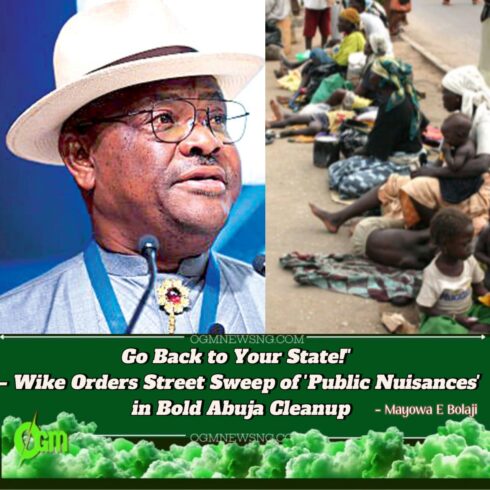
FCT Minister Nyesom Wike has ignited intense national debate following the launch of “Operation Sweep Abuja”, an aggressive initiative targeting street beggars, scavengers, illegal traders, and others categorized as public nuisances in the capital city. Wike, known for his no-nonsense stance on urban order, stated that his administration is determined to restore the dignity of Abuja as a model capital city.
In a statement released through his aide Lere Olayinka, the minister emphasized that the operation is not a mere cosmetic sweep but a full-scale enforcement of existing environmental and security laws. He reiterated that offenders will be apprehended, profiled, and deported to their states of origin to prevent further disorder and strain on the capital’s infrastructure.
Crack Team Deployed for “Operation Sweep Abuja”
The operation is being executed by a formidable Joint Task Force (JTF) comprising operatives from multiple security agencies, including the Nigeria Police, Civil Defence, Department of State Services, and personnel from various FCTA departments. These units are deployed across key areas such as Wuse, Garki, Nyanya, Kubwa, and Mararaba to flush out individuals deemed to be destabilizing the city’s image and security.
Wike’s government insists that Abuja cannot continue to serve as a dumping ground for economic migrants and miscreants from other states. The task force has already begun extensive raids, targeting informal settlements, under-bridges, markets, and bus parks where illegal activities and loitering are rampant.
Deportation Directive Sparks Human Rights Concerns
Wike’s plan to return arrested individuals to their home states has triggered condemnation from human rights groups and civil society actors. Critics argue that the directive violates constitutional rights to freedom of movement and residence within Nigeria. They warn that profiling individuals based on poverty and appearance could deepen social injustice and systemic inequality.
The FCTA, however, maintains that the operation is legal and in line with the Abuja Environmental Protection Act. Wike’s administration insists that the capital’s security and aesthetics cannot be compromised, and that the deportation plan is necessary to prevent Abuja from descending into urban chaos.
Traders and Scavengers Cry Out: “We Are Not Criminals”
Affected street traders and scavengers have decried the operation, saying they are being unfairly targeted despite engaging in honest means of survival. Many lamented that they were not offered alternative spaces or vocational training but simply rounded up and bundled into waiting trucks for deportation or “rehabilitation.”
A 32-year-old plastic scavenger, Musa Aliyu, said he migrated from Nasarawa in search of greener pastures, only to be labeled a nuisance. “We are poor, not criminals. Instead of helping us, the government is chasing us like animals,” he said with teary eyes, his cart already impounded by the task force.
Socioeconomic Divide Widens Amid Urban Sanitization Drive
Wike’s aggressive cleanup exercise is reigniting the long-standing conversation on class division in Nigeria’s capital. Critics say the crackdown represents a war against the urban poor, many of whom fled insecurity and poverty in their home states. With no social safety nets or affordable housing schemes, they argue, displacement only exacerbates the hardship.
Despite this, the FCT Minister remains defiant. Wike argues that the dignity and order of Abuja must be restored, regardless of the political or social cost. “Abuja is not a slum,” he declared at a recent press briefing. “We must protect the original masterplan and reclaim this city from lawlessness.”
Political Fallout Looms Over Mass Displacement
Opposition politicians and some state governors are reportedly furious over the deportation order, viewing it as a subtle indictment of state governance and a political tactic to shift blame. Sources from within the PDP and APC warn that this move could backfire, especially with looming elections and growing economic frustration among the masses.
Already, social media is ablaze with #WikeDeportation trending across platforms, with Nigerians sharply divided over the policy. While some hail it as a bold move to sanitize the city, others view it as a dangerous precedent that could lead to inter-state tension, xenophobia, and deeper national disunity.
Table of Contents
Discover more from OGM News NG
Subscribe to get the latest posts sent to your email.