








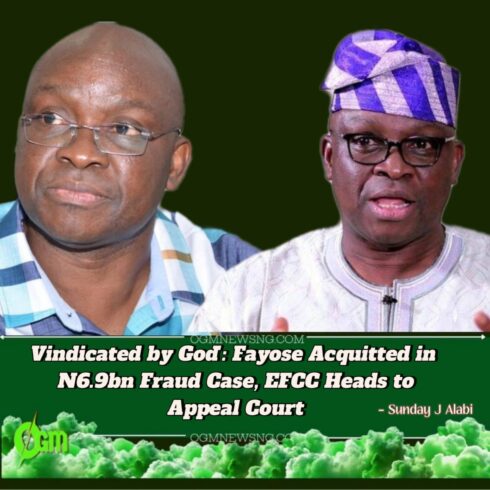
In an emotional moment outside the Federal High Court in Lagos on Wednesday, former Ekiti State Governor Ayodele Fayose broke into tears after being discharged and acquitted of N6.9 billion fraud charges brought against him by the Economic and Financial Crimes Commission (EFCC). The landmark judgment came nearly seven years after the legal battle began in 2018.
Emotional Outpouring: Fayose Kneels in Thanksgiving
As Justice Chukwujekwu Aneke read out his ruling that discharged Fayose and his company, Spotless Investment Limited, due to lack of evidence, the former governor was visibly moved. Stepping outside the courtroom, Fayose knelt on the pavement, eyes closed, hands raised in a prayerful pose as he thanked God for what he called his “vindication.”
Supporters erupted in cheers as the 63-year-old politician hugged his lead counsel, Chief Kanu Agabi (SAN), and exchanged emotional handshakes with members of his legal team. Fayose was also seen embracing Mr Olalekan Ojo (SAN), counsel for Spotless Investment Limited, who jointly filed the no-case submission that led to the acquittal.
At one point, the former governor broke into a spontaneous chorus of “Winner ooo, winner!” echoing with joy as he walked past jubilant well-wishers, visibly overwhelmed by the end of a long legal ordeal.
EFCC’s Allegations and Fayose Seven-Year Trial
The EFCC had accused Fayose of laundering N6.9 billion while serving as governor between 2014 and 2018. Among the charges were allegations that he received N1.2 billion to finance his 2014 election campaign and another $5 million in cash from then Minister of State for Defence, Musiliu Obanikoro—transactions that allegedly bypassed financial institutions.
He was further accused of laundering over N1.6 billion through proxy companies such as De Privateer Ltd and Still Earth Ltd, in breach of the Money Laundering (Prohibition) Act, 2011. The case, first filed in October 2018 before Justice Mojisola Olatoregun, was later reassigned to Justice Aneke, with proceedings stretching over several years.
Throughout the trial, the EFCC presented multiple witnesses, including Obanikoro and its own investigator, Abubakar Madaki, who claimed that Fayose used associates to purchase properties and move large sums of money discreetly—associates who later denied ownership.
Court Ruling: No Prima Facie Case Established
Delivering his verdict, Justice Aneke ruled that the EFCC failed to provide credible evidence linking Fayose or Spotless Investment Limited to the alleged crimes. The court upheld the no-case submission, which argued that the prosecution had not proven the essential elements of the offences to require the defence to open their case.
“The prosecution did not establish a prima facie case. The evidence adduced failed to prove the ingredients of the offence beyond a reasonable doubt,” the judge declared. Chief Agabi (SAN), in his submission during the final hearing on May 19, 2025, pointed out that the prosecution neither charged any co-conspirator nor substantiated the predicate offences.
He argued that the absence of Abiodun Agbele—allegedly central to the transactions—from the charge sheet made the conspiracy claim invalid. Supporting this, Ojo (SAN) emphasized that no direct link was proven between Fayose and any laundering scheme.
EFCC Responds: Commission Vows to Appeal Judgment
Despite the acquittal, the EFCC has vowed not to relent. Its counsel, Mr Rotimi Jacobs (SAN), expressed dissatisfaction with the judgment, revealing that the Commission was in the process of obtaining the Certified True Copy of the ruling and would file an appeal shortly.
“If the money was clean, why didn’t he acquire the properties in his name?” Jacobs queried in court, while referencing Obanikoro’s testimony that Fayose personally demanded cash delivery and introduced Agbele to handle it.
In a statement released after the ruling, EFCC spokesperson Dele Oyewale confirmed that the Commission had commenced the process of filing an appeal. “The judgment is being reviewed thoroughly, and appropriate legal steps will follow,” he stated, signaling that the legal battle may not yet be over.
Political and Public Reactions: A Divided Verdict
Fayose’s acquittal has generated mixed reactions across Nigeria’s political landscape. While his supporters view the verdict as long-overdue justice, critics argue that the case highlights the challenges in prosecuting high-profile corruption in Nigeria.
Political analysts say the judgment may serve as a reference point in similar ongoing corruption cases, especially regarding the standard of proof required to establish guilt. It also raises questions about the efficacy of the EFCC’s investigative processes and the strength of their prosecutorial strategies.
For Fayose, however, the ruling marks a significant personal and political victory. “This is not just my victory,” he told reporters outside the courtroom, still emotional, “It is a victory for the rule of law and for everyone wrongly accused without proof.”
As the EFCC prepares for another round in the appellate court, Nigerians will be watching closely to see whether this case marks the end of a prolonged saga—or just another chapter.
Table of Contents
Discover more from OGM News NG
Subscribe to get the latest posts sent to your email.