









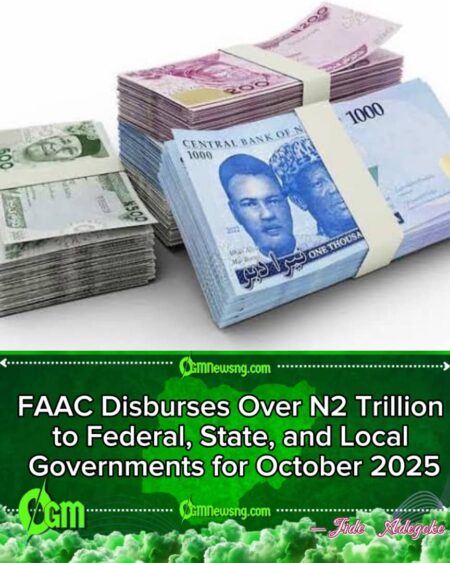
The Federation Account Allocation Committee (FAAC) has distributed a total of N2.094 trillion in October 2025 revenue to the Federal Government, the 36 states, and the 774 Local Government Councils. The allocation was confirmed during the FAAC meeting held on Wednesday in Abuja, with details released in a communiqué issued by Bawa Mokwa, Director of Press and Public Relations at the Office of the Accountant-General of the Federation (OAGF). The total distributable sum comprised statutory revenue, Value Added Tax (VAT) proceeds, and revenue from electronic money transactions.
Breakdown of October 2025 Revenue Components
The communiqué revealed that the N2.094 trillion shared revenue for October was sourced from three key streams:
N1.376 trillion from statutory allocations
N670.303 billion from Value Added Tax (VAT)
N47.870 billion generated from Electronic Money Transfers
According to the OAGF, the total gross revenue for October stood significantly higher at N2.934 trillion, before statutory deductions and mandatory transfers were applied. This elevated figure reflects increased revenue performance driven by improved tax administration, enhanced remittance compliance, and stable oil and non-oil sector contributions.
FAAC noted that despite the robust gross revenue, several statutory obligations reduced the final distributable amount. These obligations ensure consistent funding for national savings, intervention programs, and federal-level commitments that stabilize the nation’s fiscal operations.
FAAC: Deductions, Transfers, and Statutory Savings
From the gross revenue of N2.934 trillion, a total of N115.278 billion was deducted as collection costs payable to the relevant revenue-generating agencies. These deductions are routinely applied to cover administrative and operational expenses tied to revenue collection processes.
Additionally, transfers, interventions, refunds, and national savings programs accounted for a combined deduction of N724.603 billion. These include allocations to the Excess Crude Account (where applicable), ecological funds, the Stabilization Fund, development initiatives, and other national commitments.
The report highlighted that after all deductions were finalized, the remaining N2.094 trillion was shared among the three tiers of government in accordance with the existing revenue-sharing formula, ensuring each level received its statutory entitlement.
Implications for Government Operations and Fiscal Stability
The October allocation marks one of the highest monthly revenue disbursements in 2025, offering fiscal relief to governments at all levels amid rising budgetary pressures and growing demands for public services. For the federal government, the funds are expected to bolster priority sectors such as security, infrastructure, and social investment programmes.
State governments, many of which are grappling with wage obligations and developmental challenges, are also expected to leverage the allocation to support ongoing projects and meet recurrent expenditures. Local Government Councils, often the closest to grassroots communities, will rely on their share to address essential services including primary healthcare, rural infrastructure, and basic education.
FAAC reiterated its commitment to sustaining transparency in the revenue-sharing process and ensuring that all federating units receive timely and accurate allocations to strengthen national economic stability.
Table of Contents
Discover more from OGM News NG
Subscribe to get the latest posts sent to your email.