




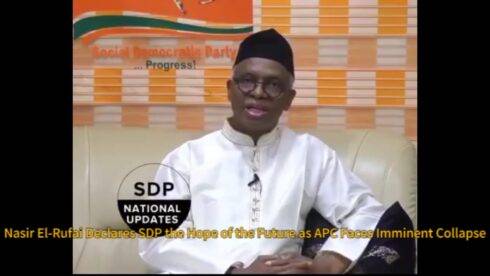
Former Governor of Kaduna State, Mallam Nasir El-Rufai, declared “With my joining of the party (SDP) and many other credible politicians, I think many people see the party as the hope of the future,” in a move that has sent shockwaves through Nigeria’s political establishment. His defection from the ruling All Progressives Congress (APC) to the Social Democratic Party (SDP) marks one of the most dramatic political crossovers in recent history, with insiders suggesting that this may trigger an avalanche of resignations within APC ranks.
El-Rufai’s departure raises significant questions about APC’s internal structure, loyalty management, and ideological direction. Critics argue that the ruling party is in disarray, riddled with infighting and policy inconsistencies. El-Rufai’s decision is being interpreted by political analysts as a calculated signal to both northern elites and national stakeholders that APC’s grip on power is not only weakening but fracturing at its ideological seams.
SDP’s Sudden Surge: A New Power Bloc Emerging?
Mallam El-Rufai’s entrance into SDP has already ignited what many are calling a “political renaissance” for the historically sidelined party. His credibility, elite networks, and technocratic reputation have rapidly elevated SDP’s national relevance, especially among young voters and middle-class Nigerians disillusioned with the mainstream parties.
This unexpected move is further bolstered by quiet but confirmed negotiations with other political heavyweights—former ministers, governors, and key grassroots mobilizers—who are set to defect in the coming weeks. Analysts predict that if SDP capitalizes on this momentum, it may become the third-force party capable of challenging Nigeria’s traditional two-party dominance.
APC Responds with Panic and Denial
The APC’s initial reaction to El-Rufai’s exit was to downplay its significance, with party spokespersons describing the move as “unfortunate but inconsequential.” However, behind closed doors, reliable sources reveal frantic efforts by the presidency and party leaders to contain further damage. Emergency meetings, covert reconciliations, and last-minute offers to wavering members have intensified since the announcement.
Mallam El-Rufai’s withdrawal not only exposes the internal decay in APC but also hints at unresolved grievances over policy betrayals and broken promises. His departure lends credence to growing concerns that APC may be hemorrhaging influence faster than it can repair its image ahead of the 2027 general elections.
Northern Political Dynamics Recalibrating
El-Rufai’s move has massive implications for northern Nigeria’s political architecture. Known for his sharp intellect, policy acumen, and strategic influence among northern elites, El-Rufai’s pivot signals a tectonic shift in regional alliances. SDP is now reportedly in talks with key emirs, regional kingmakers, and youth leaders to solidify a new northern bloc.
This strategic repositioning threatens APC’s long-standing monopoly in the north, especially in states like Kano, Kaduna, Katsina, and Sokoto. Observers believe that if El-Rufai galvanizes his base and combines it with SDP’s expanding network, the next elections could witness a radical redrawing of the northern political map.
Youth and Technocrats Rally Behind SDP
“Young Nigerians are tired of recycled leadership and ideological stagnation,” Mallam El-Rufai asserted during his maiden SDP press briefing. This resonates with the demographic realities of Nigeria, where over 60% of the population is under 35. El-Rufai’s shift has become a lightning rod for youths yearning for competence, digital governance, and structural reforms.
Technocrats, startup entrepreneurs, and academics are also reportedly aligning with SDP’s new vision. The party’s revamped manifesto—emphasizing economic diversification, digital infrastructure, and anti-corruption frameworks—is drawing interest from professional bodies and civil society coalitions who once distanced themselves from partisan politics.
2027 Elections: A Three-Horse Race on the Horizon?
Mallam El-Rufai’s defection may have single-handedly transformed the 2027 elections from a predictable two-party contest to a volatile three-horse race. With his growing influence and strategic calculations, SDP now stands as a formidable contender capable of disrupting the APC-PDP binary.
Election strategists believe that if SDP consolidates early, attracts financing from reform-minded donors, and maintains internal cohesion, the party could perform unprecedentedly well in both gubernatorial and presidential elections. El-Rufai, often criticized for his bluntness, may ironically become the face of Nigeria’s political reset—ushering in what some are calling “the post-APC era.”
Table of Contents
Discover more from OGM News NG
Subscribe to get the latest posts sent to your email.