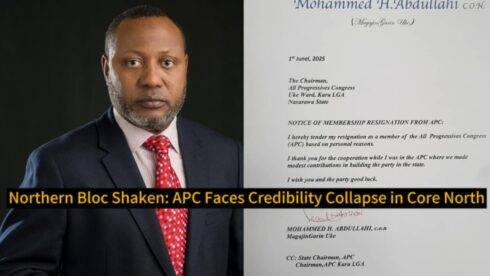
Hon. Barr. Mohammed Abdullahi, former Minister of Environment under President Muhammadu Buhari, has officially resigned from the All Progressives Congress (APC), sending ripples through Nigeria’s political landscape. In a letter made public on Monday, Abdullahi expressed deep dissatisfaction with the party’s leadership direction, stating that the APC had “deviated significantly from the ideals that once bound progressives together under one umbrella.”
The legal luminary and environmental policy expert lamented what he termed the “institutional betrayal of internal democracy” and accused the ruling party of fostering nepotism, intolerance, and elite capture. Abdullahi’s decision comes at a crucial time when the APC is grappling with internal factionalism, alleged financial mismanagement, and a credibility crisis among its northern base.
Northern Bloc Shaken: APC Faces Credibility Collapse in Core North
Hon. Mohammed Abdullahi began his statement by criticizing the APC’s disconnection from its northern support base, accusing the party of “alienating its ideological backbone for short-term political gains.” He emphasized the growing resentment in Nasarawa, Kaduna, and other northern states, where the party once enjoyed unflinching loyalty.
According to Mohammed Abdullahi, the northern grassroots feel “betrayed by the Abuja elite,” many of whom he said have “converted party platforms into personal enterprises.” This widening trust gap, he argued, could significantly weaken the APC ahead of the 2027 general elections if not urgently addressed.
A Rift with Tinubu’s Leadership?
Hon. Mohammed Abdullahi subtly took aim at the current APC leadership, under President Bola Ahmed Tinubu, stating that the party has “suffered a moral and ideological downgrade.” Though he avoided direct personal attacks, insiders close to the former minister suggest he was frustrated by the “recycled elite politics” currently dominating the party’s strategic decisions.
Abdullahi’s resignation is perceived by political observers as a veiled indictment of Tinubu’s leadership style—often described as patronage-heavy and exclusive. He lamented that “progressive voices are now muzzled, and dissent is viewed as betrayal,” signaling a broader disillusionment among former Buhari-era loyalists.
Green Legacy Overshadowed by Political Disillusionment
Despite his strides in environmental reform—most notably the launch of the Nigeria Climate Change Policy Framework and the Green Bond Programme—Abdullahi expressed disappointment that environmental justice is no longer on the APC’s priority list. “It is clear to me that the commitment to sustainability and ecological justice is now seen as an inconvenience, not a legacy,” he declared.
Environmental groups have praised Abdullahi’s tenure as minister, but many now echo his concerns that recent political developments have set back years of climate advocacy. His departure signals a broader trend of policy experts abandoning politics for lack of institutional support and policy continuity.
Calls for Realignment: A New Progressive Coalition in the Works?
In his resignation statement, Hon. Mohammed Abdullahi hinted at the possibility of joining or building a new political movement. “There is a silent majority seeking a platform that reflects their aspirations—an ethical, competent, and inclusive alternative to the current status quo,” he said, fuelling speculation about the birth of a new progressive coalition.
Political analysts suggest that Mohammed Abdullahi’s exit may trigger a domino effect among dissatisfied technocrats and center-left conservatives. Talks are allegedly ongoing between former APC stakeholders and elements of the Labour Party, SDP, and other opposition formations to form a policy-driven, non-tribal political alliance ahead of the 2027 elections.
APC Responds with Defiance but Growing Internal Fears Linger
The APC’s official response, issued via its National Publicity Secretary, dismissed Abdullahi’s resignation as “inconsequential,” describing him as “a spent force seeking political relevance.” However, insiders report growing panic within the party’s think-tank circles, with concerns that Abdullahi’s departure may embolden other high-profile exits.
Behind closed doors, APC strategists are said to be reviewing the party’s communication strategy and grassroots engagement blueprint. While the leadership maintains a brave face, Hon. Mohammed Abdullahi’s exit has reignited national conversations about the ideological decay of Nigeria’s ruling party—and what political future lies beyond 2025.
Table of Contents
Discover more from OGM News NG
Subscribe to get the latest posts sent to your email.