






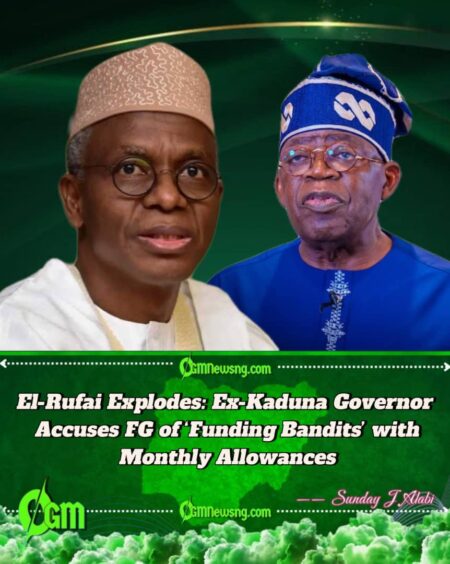
Former Kaduna State Governor Nasir El-Rufai has launched a blistering attack on the Federal Government’s approach to tackling insecurity, accusing the administration of essentially funding the very criminals terrorizing Nigerian communities. Speaking on Channels Television’s Sunday Politics programme, the former minister made explosive allegations that the government has adopted what he termed a “kiss-the-bandits policy” that involves paying monthly allowances to criminal groups.
El-Rufai’s most damning accusation centered on what he described as a misguided “non-kinetic” approach to combating banditry. According to the former governor, this policy involves the Federal Government providing regular financial support and food supplies to bandit groups under the guise of peaceful resolution strategies. “What I will not do is to pay bandits, give them a monthly allowance, or send food to them in the name of non-kinetic. It’s nonsense; we’re empowering bandits,” El-Rufai stated emphatically during the interview.
The former FCT minister traced this controversial policy directly to the Office of the National Security Adviser, suggesting that it represents a coordinated national strategy rather than isolated state-level decisions. His criticism implies that states like Kaduna are being compelled to participate in what he views as a fundamentally flawed approach to security challenges. This revelation, if accurate, would represent a significant shift in how Nigeria approaches internal security threats and raises serious questions about the effectiveness of current counter-terrorism strategies.
Strong Opposition to Rehabilitation Over Punishment
El-Rufai’s philosophy on dealing with bandits stands in stark contrast to the government’s apparent rehabilitation approach, with the former governor advocating for what can only be described as a zero-tolerance military solution. His position reflects a hardline stance that prioritizes elimination over negotiation, arguing that the current approach has only served to embolden criminal elements across the country.
“My position has always been [that] the only repentant bandit is a dead one. Let’s kill them all. Let’s bomb them until they are reduced to nothing, and then the five per cent that still want to be rehabilitated can be rehabilitated,” El-Rufai declared, outlining his preferred military-first approach. His comments suggest a belief that overwhelming force should be the primary tool in combating banditry, with rehabilitation reserved only for a minimal number of genuinely reformed individuals.
The former governor’s critique extends beyond tactical disagreements to fundamental strategic philosophy, arguing that the government’s current approach represents negotiating from a position of weakness. He contends that providing financial support and resources to bandits essentially amounts to funding their acquisition of more sophisticated weapons, creating a vicious cycle that perpetuates rather than resolves the security crisis. This perspective highlights a significant ideological divide within Nigeria’s political establishment regarding the most effective methods for addressing the country’s persistent security challenges.
Claims of Evidence and Government Cover-Up
Perhaps most controversially, El-Rufai has suggested that he possesses evidence of the government’s alleged bandit-supporting policies and has promised to reveal this information when the time is appropriate. His claims go beyond general policy criticism to suggest active government deception and propaganda efforts designed to obscure the true nature of these security arrangements.
“They can deceive, they can cover up, they can do propaganda, but those that live in Katsina, those that live in Zamfara, those that live in Kaduna, those that live in those states, they know what is happening,” El-Rufai stated, positioning himself as a truth-teller willing to expose government secrets. His promise to “reveal everything” when the time comes suggests he may be preparing for a more comprehensive disclosure of what he perceives as government failures and deceptions.
The former governor’s assertions directly challenge the official narrative surrounding Nigeria’s security operations, particularly in the northern states where banditry has been most prevalent. His reference to residents of affected states as witnesses to the government’s alleged failings attempts to ground his accusations in lived experience rather than political speculation. This approach suggests he may be building a case for broader public support for his position, using local knowledge to counter official government statements about security progress.
El Rufai Fractured Relationship with Successor Governor Uba Sani
In a surprising revelation that adds another layer to Nigeria’s complex political dynamics, El-Rufai has clarified the nature of his relationship with his successor, Governor Uba Sani, describing him not as a friend but as a former “mentee” who has since disappointed his expectations. This clarification comes amid speculation about tensions between the two leaders over various policy and political issues.
“I’ve not fallen out with the governor. No, he is not my friend. He was my boy, my mentee. We have not fallen out. I still don’t speak with him,” El-Rufai explained, drawing a distinction between personal friendship and political mentorship. His comments suggest that while there may not be active hostility between them, there is certainly a cooling of relations that has resulted in ceased communication.
The former governor’s disappointment appears to stem from what he perceives as Governor Sani’s deviation from expected standards or policies. El-Rufai’s statement that “when a person derails, when he doesn’t do the right thing, because I contributed to getting him there, I am prohibited from commenting?” suggests he feels both responsibility for and frustration with his successor’s performance. This dynamic reflects the complex nature of political succession in Nigeria, where mentorship relationships can become strained when proteges chart independent courses that disappoint their political sponsors.
Serious Allegations of Political Violence and State Complicity
The most immediate and potentially explosive aspect of El-Rufai’s Sunday appearance involved his direct accusation that Governor Uba Sani orchestrated violence against opposition political figures in Kaduna State. These allegations, if proven true, would represent a serious escalation in Nigerian political tensions and raise questions about democratic governance at the state level.
El-Rufai specifically accused the governor of being behind attacks during the African Democratic Congress (ADC) committee inauguration in Kaduna, claiming to possess evidence of the governor’s involvement. “I have evidence; Kaduna State Governor is behind Saturday’s attacks. I will submit evidence to the IGP and other authorities if they care to investigate,” he stated, promising to provide documentation to law enforcement officials. His willingness to make such specific accusations suggests confidence in his evidence and a readiness to engage in legal proceedings if necessary.
Beyond the immediate accusations, El-Rufai painted a broader picture of systemic failure in Nigeria’s security apparatus, particularly criticizing police inaction during the alleged attacks. His claim that “the policing system has collapsed in Nigeria” and that police operatives were present but inactive during the violence suggests institutional breakdown that extends beyond individual incidents to systemic problems with law enforcement.
This critique ties into his broader narrative about government failure to maintain security and protect citizens, whether from bandits in rural areas or political violence in urban centers. The former governor’s decision to dissociate himself from the ruling APC and align with opposition forces adds additional context to these allegations, suggesting that his criticisms may be part of a broader political repositioning ahead of future electoral contests.
Table of Contents
Discover more from OGM News NG
Subscribe to get the latest posts sent to your email.