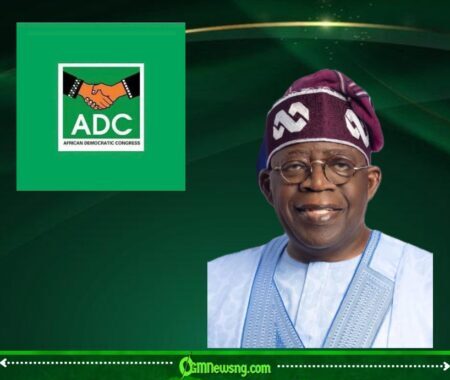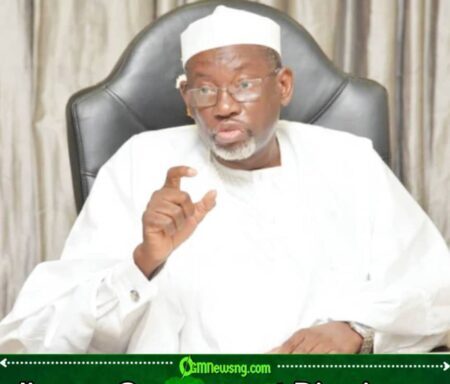


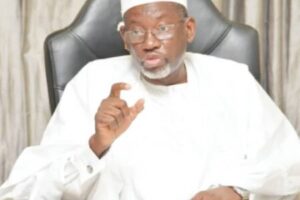


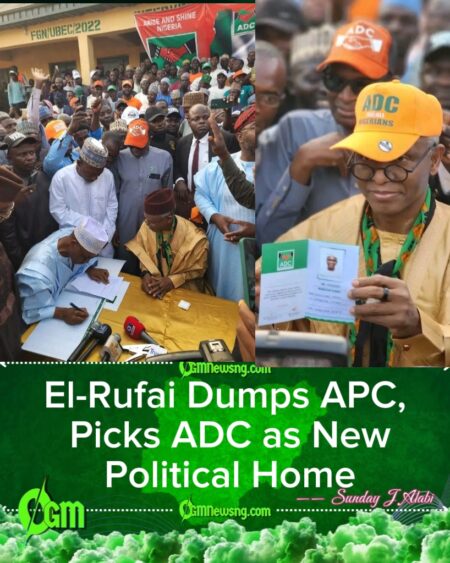
Former Kaduna State Governor, Nasir Ahmad El-Rufai, has officially joined the African Democratic Congress (ADC), months after publicly cutting ties with the ruling All Progressives Congress (APC). The move, which followed his formal registration at the ADC office in U/Sarki Ward, Kaduna State, marks a new phase in his political journey and adds fresh momentum to ongoing realignments across Nigeria’s political landscape.
El-Rufai’s defection comes after he resigned from the APC on 10 March, citing a fundamental departure of the party from the ideals and principles that inspired its formation. With his entry into the ADC, a relatively smaller but increasingly visible party, analysts are expected to closely watch how his influence reshapes political calculations in Kaduna State and beyond
From Founding Figure to Dissatisfied Member
Nasir El-Rufai was a key player in the 2013 opposition merger that gave birth to the APC, bringing together several parties under a single platform that would eventually end the then-ruling People’s Democratic Party’s 16-year hold on federal power. As a founding figure and later a two-term governor of Kaduna State, his role in consolidating the APC’s strength, especially in the North, was widely acknowledged.
However, in his resignation letter dated 10 March, El-Rufai said he could no longer remain in a party he believes has drifted far from the values that once defined it. He accused the APC leadership of abandoning the core principles on which it was built, alleging that the party had become unresponsive to constructive criticism and internal concerns.
According to him, for about two years he consistently raised alarms—both in public and in private—about what he described as the party’s worrisome trajectory. These concerns, he claimed, were repeatedly ignored by those at the helm of the APC, reinforcing his conviction that the party was not prepared to confront or correct what he branded as an “unhealthy” internal climate.
Allegations of Abandoned Ideals and Internal Drift
In his critique of the APC, El-Rufai said the party had strayed from its original progressive vision, which was meant to prioritize accountability, internal democracy, and responsive leadership. Instead, he argued, the APC had become distant from the expectations of its members and supporters, with key decision-makers allegedly unwilling to address mounting internal grievances.
He maintained that his efforts to push for reforms and recalibrate the party’s direction were met with resistance or indifference. Over time, this, he said, created the impression that there was little appetite within the leadership to reverse what he regarded as a worrying decline in adherence to agreed principles.
For El-Rufai, remaining in such a political environment was no longer tenable. His resignation from the APC was therefore framed not merely as a personal decision, but as a statement on the broader ideological and structural challenges confronting the ruling party.
ADC Membership: A New Chapter and Fresh Calculations
El-Rufai’s formal registration and receipt of his membership card at the ADC office in U/Sarki Ward confirms his next political destination. The ADC, which has sought to project itself as an alternative platform for those disenchanted with the country’s dominant parties, is expected to benefit from the visibility and political weight his name carries.
His entry into the party could re-energize the ADC’s presence in Kaduna State, where he remains a major political figure, and potentially influence its positioning ahead of future elections at both state and federal levels. While the full scope of his role within the ADC is yet to be publicly defined, his defection is already being interpreted by observers as part of a broader pattern of realignments among Nigeria’s political elites.
As the political landscape continues to shift, El-Rufai’s move to the ADC will likely spark debate on the future of internal democracy within major parties, the durability of party platforms built on coalitions, and the space available for alternative political voices in Nigeria’s evolving multiparty system.
Table of Contents
Discover more from OGM News NG
Subscribe to get the latest posts sent to your email.