









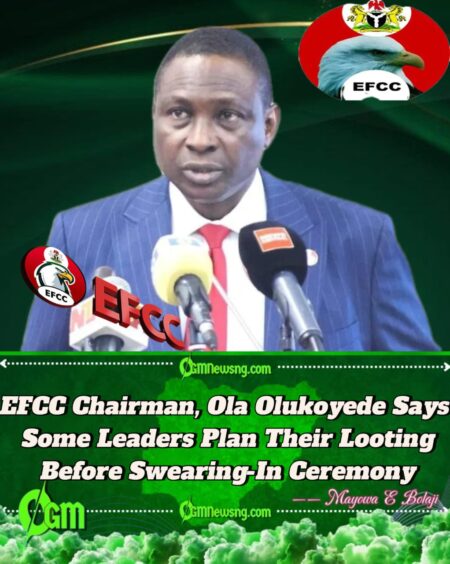
EFCC chairman, Ola Olukoyede has blown the lid off a disturbing trend in Nigeria’s political corruption playbook — the “anticipatory declaration” of assets. This scheme allows politically exposed individuals to list luxury properties in their official Code of Conduct Bureau (CCB) forms before those properties even exist, effectively pre-legitimizing future loot. According to Olukoyede, one politician brazenly declared ownership of a N3 billion mansion before construction had begun, setting the stage to later “acquire” the property without suspicion.
Ola Olukoyede described this method as both “ingenious” and “criminally smart,” noting that it circumvents traditional anti-corruption detection systems. The EFCC discovered the case during an asset verification process, finding mismatched addresses between declared assets and their actual locations. The revelation highlights a new front in Nigeria’s corruption war — where fraud is planned with precision even before public office is assumed.
How Politicians Legally Pre-Own Stolen Wealth
Ola Olukoyede explained that the anticipatory declaration tactic is a calculated move by corrupt politicians to disguise illicit enrichment as pre-existing wealth. By declaring properties before they are acquired, these individuals can later claim that any opulent mansion, luxury car, or sprawling estate was part of their legitimate holdings all along. This not only makes investigation harder but also creates a legal smokescreen against potential asset forfeiture.
Ola Olukoyede revealed that in one shocking instance, a property was declared at “No. 39” while the actual building sat at “No. 44.” Upon digging deeper, investigators found architectural designs for a yet-to-be-built luxury mansion — registered in the politician’s name before election victory. This level of premeditation, Olukoyede warned, proves that some leaders enter office with a fully mapped-out plan for looting public resources.
Asset Declaration Loopholes Fuel Corruption
Ola Olukoyede criticized current asset declaration protocols for failing to account for anticipatory ownership schemes. The CCB forms, designed to promote transparency, can be weaponized by corrupt actors to sanitize stolen wealth in advance. Without strict verification measures, public officials can essentially launder their corruption plans under the cloak of bureaucratic compliance.
Ola Olukoyede noted that this loophole makes it possible for officials to “predict their corruption” and document it as legitimate property. Once in power, they can channel stolen funds into projects they had already “declared” on paper, evading scrutiny from both anti-graft agencies and the judiciary. The EFCC chairman stressed the urgent need for reform to close this dangerous gap in Nigeria’s anti-corruption framework.
Investigations Reveal Pre-Swearing-In Looting Plans
Ola Olukoyede stated that EFCC investigators have now identified multiple cases where politicians used anticipatory declarations to shield future acquisitions. This strategy ensures that once in office, every corrupt transaction appears to be part of their “old” wealth, frustrating prosecutorial efforts. The tactic, he said, reflects not just greed but a disturbing mastery of Nigeria’s weak accountability systems.
Ola Olukoyede recounted that in the exposed case, the politician had already registered the land at the state registry and commissioned the mansion’s architectural design before even taking the oath of office. This meticulous planning demonstrates how corruption is no longer opportunistic but often premeditated, calculated, and strategically disguised to survive legal scrutiny.
The EFCC’s New Approach to Asset Verification
Ola Olukoyede announced that the EFCC is now adopting more advanced verification techniques to detect and dismantle anticipatory asset schemes. Investigators will conduct cross-checks between declared asset locations, actual property developments, and historical ownership records to spot suspicious patterns. By using satellite imagery, land registry audits, and digital mapping tools, the EFCC hopes to unmask fraudulent pre-declarations before they materialize into stolen wealth.
Ola Olukoyede emphasized that these methods will enable the EFCC to identify not just illegally acquired assets but also the planning stages of corruption itself. He urged the CCB and other oversight agencies to incorporate pre-construction monitoring into their operations, ensuring that no politician can quietly register a mansion they have yet to fund without raising red flags.
A Call for Legislative Action Against Pre-Looting
Ola Olukoyede called on the National Assembly to criminalize anticipatory declaration of assets, labeling it as a “pre-looting strategy” that undermines public trust. Such legal amendments, he argued, should impose heavy penalties — including asset forfeiture, electoral disqualification, and prison terms — for any public official caught engaging in this practice.
Ola Olukoyede insisted that without legislative intervention, this corruption tactic will only spread, as it offers a low-risk, high-reward pathway for illicit enrichment. By publicly exposing the scheme, he hopes to pressure lawmakers, civil society, and the Nigerian public into demanding urgent reforms to protect the nation’s resources from premeditated plunder.
Table of Contents
Discover more from OGM News NG
Subscribe to get the latest posts sent to your email.