







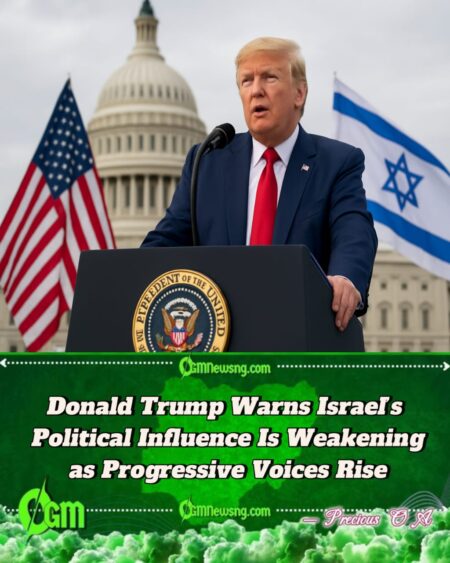
Donald Trump has declared that Israel’s long-standing influence in the U.S. Congress is weakening, a remark that has triggered reactions across Washington, Tel Aviv, and beyond. His words have cast fresh light on one of America’s most enduring alliances, sparking debate about whether bipartisan support for Israel is no longer guaranteed.
By speaking openly, the president has shifted a sensitive topic into the public sphere, compelling policymakers, analysts, and communities to confront an uncomfortable political reality. His blunt observation has once again demonstrated his ability to set the terms of global discussion.
Shifting Loyalties in Congress
Donald Trump argued that lawmakers no longer provide Israel with the near-automatic backing it once enjoyed. He pointed to the rising influence of younger legislators, particularly among Democrats, who are pressing for greater scrutiny of U.S. aid and questioning Israel’s policies toward Palestinians.
This represents a significant departure from the past, when congressional support was often unconditional. His words signal recognition that America’s domestic politics are changing, and with them, the level of support Israel can expect.
The Weight of Historical Consensus
For decades, U.S.-Israel relations were defined by bipartisan consensus. Congress consistently approved military aid, ensured diplomatic backing, and stood by Israel in moments of crisis. That legacy created an expectation of unwavering support, regardless of political shifts.
Donald Trump now suggests that this consensus may no longer hold. His acknowledgment contrasts with his own track record, which includes some of the most pro-Israel decisions in modern U.S. history.
Democratic Party Divisions
A growing progressive wing within the Democratic Party has become increasingly outspoken on Israel. Calls to condition U.S. aid on human rights standards have introduced debates that were once considered politically untouchable. These voices have gained momentum, especially among younger voters.
Donald Trump has used these divisions to highlight what he views as a weakening of bipartisan solidarity. In his framing, Democrats are moving away from the steadfast approach that once characterized American politics, leaving Republicans as Israel’s most reliable allies.
Record of Pro-Israel Actions
Donald Trump frequently cites his presidency as proof of his unwavering commitment to Israel. His administration moved the U.S. Embassy to Jerusalem, recognized Israeli sovereignty over the Golan Heights, and brokered normalization agreements between Israel and Arab states under the Abraham Accords.
These actions, celebrated in Israel, positioned him as one of the strongest allies the country has ever had in Washington. By juxtaposing this record with current congressional shifts, he underscores the challenges Israel faces despite his historic gestures.
The “America First” Lens
Donald Trump’s remarks also reflect his “America First” approach, which prioritizes U.S. interests above traditional foreign entanglements. Acknowledging Israel’s diminishing influence allows him to frame himself as both supportive and pragmatic, willing to recognize shifts that others might avoid.
This balance strengthens his political appeal at home. He casts himself as a leader who tells difficult truths, while maintaining that U.S. support for Israel should continue—albeit with recognition of changing political winds.
Mixed Reactions in Israel and Abroad
In Israel, his statement drew both concern and acknowledgment. Some leaders warned that his words could embolden regional adversaries, while others appreciated his candor in identifying challenges that the Israeli government must address.
Among American Jewish communities, reactions were similarly divided. Some feared his statement signaled a decline in bipartisan support, while others welcomed the honesty as a basis for renewed engagement with lawmakers across the political spectrum.
Looking Ahead
Donald Trump’s declaration has ensured that the question of Israel’s standing in Congress will remain a central topic in U.S. politics. His remarks highlight a crossroads moment for one of America’s most important alliances, raising questions about how future administrations and legislatures will approach Israel.
Table of Contents
Discover more from OGM News NG
Subscribe to get the latest posts sent to your email.