









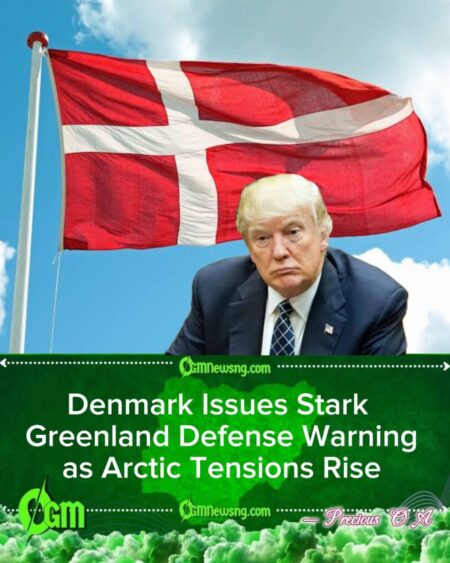
Denmark has issued a striking warning that it would respond with immediate force if any foreign military action were taken against Greenland, framing the statement as a matter of national survival, sovereignty, and international law. The unusually blunt language reflects a growing sense of anxiety in Copenhagen about geopolitical interest in the Arctic, particularly as global powers increasingly view the region as strategically and economically critical.
Government officials described Greenland not merely as an autonomous territory within the Kingdom of Denmark, but as a linchpin in Denmark’s national security architecture. Its geographic position, straddling vital Arctic sea lanes and hosting important defense installations, has long made it strategically sensitive. The warning signals that Denmark is prepared to move beyond diplomatic caution if it perceives even a hint of military encroachment.
The statement also reveals how Arctic geopolitics has shifted from quiet scientific cooperation into a more openly competitive arena. Melting ice has opened shipping routes and exposed mineral resources, transforming the region into a theater where military readiness, political signaling, and economic ambition increasingly overlap.
Greenland’s Strategic Value
Greenland occupies a unique position between North America and Europe, giving it enormous strategic relevance in any scenario involving transatlantic security. Its airspace and coastal waters are essential for missile defense systems, early-warning radar, and maritime patrol operations that help monitor movements across the North Atlantic.
Denmark has repeatedly emphasized that any challenge to Greenland’s status would be viewed as a direct challenge to the Kingdom itself. Officials argue that the territory’s security is inseparable from Denmark’s own, even as Greenland maintains a high degree of political autonomy in domestic affairs.
Beyond military considerations, Greenland is rich in rare earth minerals, hydrocarbons, and other resources increasingly important for modern technology and energy transitions. These economic dimensions add another layer of sensitivity, making foreign interest appear, in Danish eyes, as a possible prelude to strategic pressure.
Denmark and Greenland’s Defense Posture
Denmark in Arctic Defense Strategy has become a central phrase in recent policy debates, as Copenhagen seeks to modernize its northern security infrastructure. Investments in new patrol vessels, upgraded air surveillance systems, and expanded cooperation with allied forces have been steadily increasing.
Denmark has stressed that its military presence in and around Greenland is not aimed at provoking confrontation but at ensuring rapid response capability. Officials have argued that credible deterrence is the most effective way to prevent any misunderstanding from escalating into conflict.
Military analysts note that the “shoot first” rhetoric is less about literal intent and more about signaling resolve. The language is designed to eliminate any ambiguity about how Copenhagen would react, making clear that Greenland is not an undefended periphery but a protected core interest.
International Law and Sovereignty
Denmark has anchored its warning firmly in international law, pointing to treaties that recognize Greenland as part of the Kingdom and guarantee its territorial integrity. Danish diplomats argue that any unauthorized military movement into Greenlandic territory would constitute a violation of international norms.
Legal scholars have highlighted that Greenland’s autonomy does not dilute Denmark’s responsibility for its defense. While Greenland controls many internal affairs, Copenhagen retains authority over foreign policy and security, giving Denmark the legal standing to respond militarily if necessary.
The emphasis on law reflects Denmark’s broader diplomatic identity as a country that prefers rules-based order over power politics. The unusually direct language, therefore, underscores just how seriously Danish leaders view potential challenges to Greenland’s status.
Reactions from Allies and Rivals
Denmark has briefed several allied governments on its position, seeking to ensure that its warning is understood as defensive rather than aggressive. Diplomats say the aim is to prevent misinterpretation that could inflame already sensitive Arctic relations.
Some allied analysts privately acknowledge that the tone is sharper than Denmark’s usual style, but also recognize the strategic calculation behind it. A clear red line, they argue, can sometimes reduce the risk of miscalculation by making boundaries unmistakable.
Rival powers, meanwhile, have responded cautiously, with officials in several capitals declining to comment directly. Observers note that silence itself may be a strategic choice, allowing governments to avoid escalating rhetoric while reassessing their own Arctic strategies.
Implications for Arctic Stability
Denmark has framed its warning as part of a broader effort to preserve stability in the High North. Officials argue that clear deterrence, coupled with continued diplomatic engagement, can help prevent the Arctic from becoming a militarized flashpoint.
Security experts caution that while strong statements can deter, they can also contribute to an atmosphere of suspicion if not matched by confidence-building measures. Transparency in military exercises, communication hotlines, and multilateral forums are seen as essential to keeping tensions from spiraling.
The future of Arctic stability will likely depend on whether major powers can balance their strategic ambitions with cooperative frameworks. Denmark’s declaration, dramatic as it is, highlights just how central Greenland has become to that evolving equation—and how firmly Copenhagen intends to defend its northern frontier.
Table of Contents
Discover more from OGM News NG
Subscribe to get the latest posts sent to your email.