







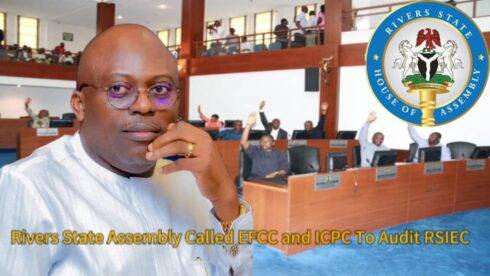
Governor Simi Fubara is now facing intensified pressure as the Rivers State House of Assembly demands a full financial audit of the Rivers State Independent Electoral Commission (RSIEC) and key state commissioners. The lawmakers have officially called on the Economic and Financial Crimes Commission (EFCC), the Independent Corrupt Practices and Other Related Offences Commission (ICPC), and the Office of the Auditor-General of the Federation to investigate RSIEC’s financial records.
The legislators argue that RSIEC, responsible for conducting local government elections, has mismanaged state funds. They insist that an independent audit is necessary to ensure transparency and accountability. The probe could have significant implications for Fubara’s administration, as any financial discrepancies uncovered could further weaken his position.
Governor Simi Fubara’s Dilemma: Allegations of Financial Mismanagement Resurface
Governor Simi Fubara’s administration is now under even greater scrutiny as past allegations of financial misconduct resurface. In May 2022, the EFCC declared Fubara, then the Rivers State Accountant-General, and 58 others wanted over an alleged N435 billion fraud. Though he later became governor, these allegations have continued to cast doubts over his financial dealings.
With the Rivers Assembly now demanding a financial audit of RSIEC by the EFCC, ICPC, and the Auditor-General’s Office, political observers believe this move could expose deeper financial irregularities under Fubara’s leadership. If the audit uncovers evidence of corruption, it could trigger impeachment efforts or legal consequences, further destabilizing the state’s leadership.
RSIEC’s Role in the Crisis: A System Under Scrutiny
Governor Simi Fubara is now confronted with a crisis involving RSIEC, the state’s electoral body, which has come under legislative scrutiny for alleged financial mismanagement. Lawmakers have questioned RSIEC’s use of state funds for electoral operations, arguing that the commission’s leadership has failed to provide clear financial reports.
RSIEC Chairman Justice Adolphus Enebeli and other officials have been summoned multiple times but have refused to appear before the assembly, further fueling suspicions. The Rivers Assembly has responded by issuing arrest warrants for RSIEC officials, a move that raises concerns about the commission’s autonomy and whether the investigation is being politically influenced.
Political Power Play: Wike’s Influence and the Assembly’s Agenda
Governor Simi Fubara’s leadership is being tested by internal political struggles, particularly the influence of his predecessor, Nyesom Wike. Pro-Wike lawmakers in the Rivers Assembly have been instrumental in pushing for the RSIEC audit, leading many to speculate that this is part of a broader effort to weaken Fubara’s administration.
With local government elections approaching, controlling RSIEC is seen as a major advantage. If the financial audit leads to leadership changes within RSIEC, new appointments under legislative oversight could shift electoral power in favor of Wike-backed politicians. The EFCC and ICPC audits will be key in determining whether these political maneuvers are based on legitimate financial concerns or are simply part of a power struggle.
Public Reaction: Calls for Accountability or Political Vendetta?
Governor Simi Fubara now faces a divided public reaction as the RSIEC financial audit sparks debates across Rivers State. While anti-corruption groups applaud the investigation as a necessary step toward financial accountability, Fubara’s supporters argue that the assembly is using the audit as a political weapon to undermine his administration.
Civil society organizations have urged transparency in the investigation, insisting that the EFCC, ICPC, and the Auditor-General’s Office must conduct an unbiased review of RSIEC’s financial records. The outcome of this probe could either restore public trust in governance or deepen the existing political crisis, depending on whether the audit is seen as fair or politically motivated.
What’s Next? The Potential Fallout of the RSIEC Audit
Governor Simi Fubara must now prepare for the potential fallout from the RSIEC audit, as findings from the EFCC, ICPC, and the Auditor-General’s Office could significantly impact his administration. If financial mismanagement is confirmed, the governor may face intensified pressure from both the Rivers Assembly and federal anti-corruption agencies, possibly leading to impeachment threats or legal battles.
On the other hand, if the audit does not uncover any major wrongdoing, the credibility of the assembly’s investigation could be questioned, exposing it as a politically motivated attack. Regardless of the outcome, the battle over RSIEC’s financial records is shaping up to be a turning point in Rivers State politics, with high stakes for Fubara, the lawmakers, and the future of governance in the state.
Table of Contents
Discover more from OGM News NG
Subscribe to get the latest posts sent to your email.