







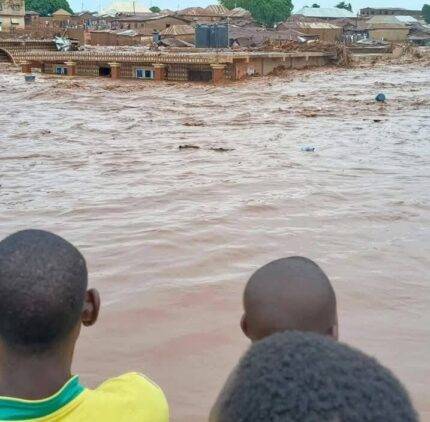
The death toll from the devastating flash floods that swept through parts of Niger State has surged past 100, with authorities warning the number could rise further as search and rescue operations continue. The disaster, triggered by hours of torrential rainfall late Wednesday, washed away entire homes and submerged communities in and around Mokwa in Niger state, leaving a trail of destruction and despair.
Spokesman for the Niger State Emergency Management Agency (NSEMA), Ibrahim Audu Husseini, confirmed on Friday that at least 115 bodies had been recovered so far. “The flood came from a distance and swept away people into the River Niger,” he said. “Downstream, bodies are still being recovered. So, the toll keeps rising.” Husseini noted that several individuals remain missing, including a family of 12 where only four members have been accounted for.
Earlier, the provisional death count stood at 88, according to Hussaini Isah, an official leading the search and rescue efforts. However, as emergency crews comb through debris and the waters continue to recede, more victims are being discovered under collapsed structures. “We need excavators to dig through the rubble,” Husseini added grimly.
Communities In The Niger State Devastated, Families Mourned
In the worst-hit areas like Tiffin Maza and Anguwan Hausawa in Mokwa, residents are grappling with the scale of loss. An AFP journalist at the scene described the harrowing images: distraught survivors sifting through debris, displaced children wading through contaminated floodwaters, and makeshift coverings over bodies retrieved from the ruins.
One resident, Mohammed Tanko, a 29-year-old civil servant, recounted the personal loss. “We lost at least 15 from this house,” he said, pointing at the remnants of his family home. “Everything is gone. The property, the people—we lost everything.” Similarly, Danjuma Shaba, a 35-year-old fisherman, shared that he now sleeps in a car park after his home was completely destroyed. “I don’t have a house to sleep in,” he said. “My house has already collapsed.”
With many homes completely submerged or reduced to rubble, emergency shelters are overwhelmed. The threat of water-borne diseases looms large, especially as clean water and sanitation become increasingly scarce.
Government Responds Amid National Mourning
Reacting to the disaster in the Niger state,the Federal Government has expressed its “profound sorrow” over the loss of lives. Minister of Information and National Orientation, Mohammed Idris, said security and emergency agencies have been mobilized to support the ongoing rescue and relief efforts. The government also assured affected communities of its commitment to providing humanitarian aid and long-term reconstruction.
The District Head of Mokwa of Niger state, Muhammad Shaba Aliyu, described the flooding as the worst the town has witnessed in 60 years. “I beg the government both Niger state and federal to support us,” he said, calling for urgent assistance in rebuilding the devastated communities. His plea reflects the broader sense of desperation among survivors who have lost both relatives and livelihoods.
The National Emergency Management Agency (NEMA) has warned that more people remain at risk, especially in flood-prone areas without adequate infrastructure or drainage systems. The agency is coordinating with local authorities and NGOs to deliver food, water, and medical supplies to affected families.
Recurring Disasters Fueled by Poor Infrastructure and Climate Change
Flooding is a recurring nightmare in Nigeria during the rainy season, which lasts from April to October. Experts have long warned that the country is vulnerable to increasingly intense weather patterns due to climate change, compounded by poor urban planning and neglect of drainage systems.
Environmentalists and scientists point to illegal construction on waterways, the dumping of waste in drainage channels, and the failure to enforce building codes as critical factors behind the escalating frequency and severity of floods. “These disasters are preventable to a large extent,” said one environmental analyst. “But without urgent climate adaptation and infrastructure reforms, this will keep happening.”
The Nigerian Meteorological Agency had earlier issued warnings of possible flash floods across 15 states—including Niger State—between Wednesday and Friday, but implementation of preventive measures remains weak. In 2024 alone, floods have killed more than 1,200 people and displaced over 1.2 million, according to NEMA, making it one of Nigeria’s worst flood years in decades.
The Path Forward: Calls for Action and Resilience
With the waters slowly receding, the focus now shifts to recovery and rebuilding. Local leaders and aid organizations have emphasized the need for swift intervention to prevent a secondary crisis from hunger, disease, and homelessness. As rescue teams press on in their search for missing persons, the scale of the disaster is prompting urgent calls for national preparedness and resilience.
“We must move beyond reactive responses to proactive planning,” said a spokesperson for NEMA. “Early warning systems must be backed with community action plans, drainage infrastructure, and resettlement policies for flood-prone zones.”
For survivors like Tanko and Shaba, however, recovery is more personal and painful. It is about finding closure, rebuilding lives, and hoping that the next rainy season will not bring another round of death and destruction. As Mokwa and others communities in the Niger state mourns its dead, the nation must reckon with the lessons of yet another preventable tragedy.
Table of Contents
Discover more from OGM News NG
Subscribe to get the latest posts sent to your email.