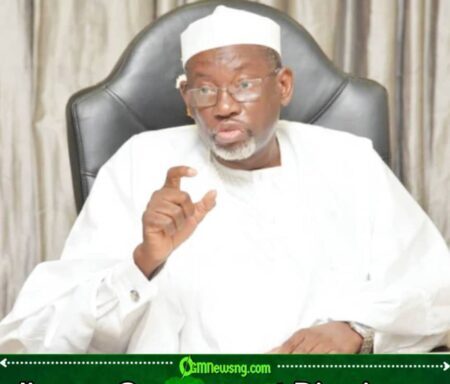







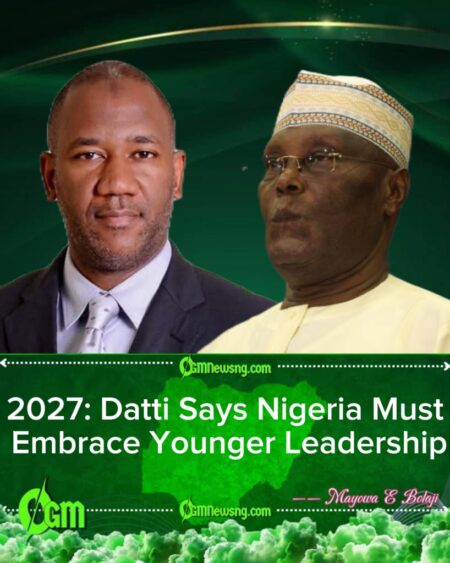
Yusuf Datti Baba-Ahmed, former vice-presidential candidate of the Labour Party, has reignited the debate on generational leadership in Nigeria with pointed remarks on the recurring nature of the country’s presidential contests. Speaking on Nigeria’s evolving political landscape, Datti recalled that Atiku Abubakar was already a presidential aspirant during his National Youth Service Corps (NYSC) year, underscoring how long certain figures have dominated the political scene.
According to Datti, the repetition has spanned several election cycles. He noted that both he and Atiku contested party primaries together in 2018, met again on the political stage in the 2023 elections, and are now heading toward another possible contest in 2027. For Datti, this pattern highlights a deeper issue within Nigeria’s political structure — the limited circulation of leadership at the highest level.
His remarks, delivered in a candid and reflective tone, have resonated widely, particularly among younger Nigerians who feel disconnected from a political system dominated by familiar faces. Datti’s statement has since sparked renewed conversations about political longevity, leadership renewal, and whether Nigeria’s democracy sufficiently creates space for new entrants.
Call for New Generation of Leaders Gains Momentum
Datti Baba-Ahmed stressed that Nigeria urgently needs a new generation of leaders, arguing that the country’s challenges demand fresh ideas, renewed energy, and a different approach to governance. He emphasized that capable leaders do exist within the younger and middle-age demographics but are often overshadowed by long-standing political heavyweights.
He maintained that leadership renewal should not be interpreted as a rejection of experience, but rather as a necessary evolution in a nation facing complex economic, security, and social challenges. According to him, governance requires leaders who understand contemporary realities and can connect more effectively with a rapidly changing population.
Political analysts note that Datti’s comments reflect a growing sentiment among voters who are increasingly frustrated with what they perceive as recycled leadership. As Nigeria’s median age remains low, the demand for leaders who reflect the aspirations of younger citizens continues to gain traction across political and civic spaces.
Implications for 2027 and Nigeria’s Democratic Future
Looking ahead to the 2027 general elections, Datti’s remarks raise broader questions about the future direction of Nigeria’s democracy. His reference to “for God’s sake, 2027 again” underscores a sense of voter fatigue that has become more pronounced after successive election cycles featuring the same candidates.
Observers say the statement is not merely a personal critique but a challenge to political parties, institutions, and voters to rethink how leadership is recruited and sustained. The dominance of familiar aspirants, critics argue, may discourage political participation and stifle innovation within the system.
As discussions around 2027 begin to intensify, Datti Baba-Ahmed’s comments are expected to remain part of the national conversation.
Whether they translate into concrete political realignment or policy reforms remains to be seen, but they have undoubtedly reignited the debate on generational change and the need for a more inclusive and dynamic political future for Nigeria.
Table of Contents
Discover more from OGM News NG
Subscribe to get the latest posts sent to your email.