







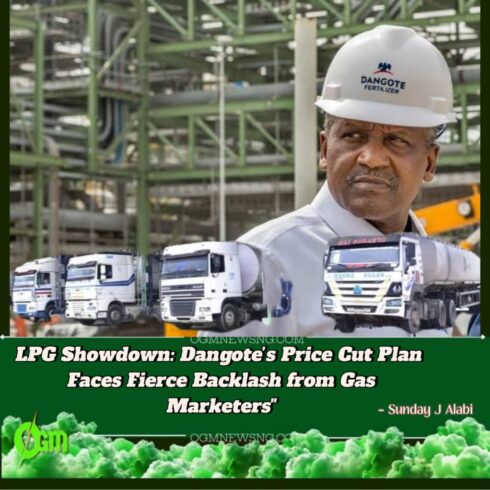
President of the Dangote Group, Alhaji Aliko Dangote, has set his sights on reshaping Nigeria’s Liquefied Petroleum Gas (LPG) market by promising to crash the price of cooking gas, currently hovering between ₦1,000 and ₦1,300 per kilogram. Dangote made the bold declaration during a tour of the Dangote Refinery in Lekki with members of Lagos Business School CGEO Africa, where he revealed ongoing production of about 2,000 tonnes of LPG daily.
Dangote decried the high cost of cooking gas and its impact on the average Nigerian who is increasingly reverting to firewood and kerosene. He emphasised the need for affordable gas as Nigeria transitions away from traditional cooking methods, warning that if existing distributors do not comply with the price crash initiative, he would commence direct sales to consumers.
“We believe it is too expensive,” Dangote said. “If the distributors are not trying to bring it down, we’ll go directly and sell to the consumers, so that people can now transit from firewood or kerosene to LPG.”
Dangote Refinery Ramps Up Production, National Distribution Planned
The Dangote Refinery, which is gradually increasing its daily LPG output to meet national demand, has reportedly hit 22,000 tonnes of daily production. The billionaire industrialist is also preparing for a larger distribution strategy by August, which includes direct sales of petrol, diesel, and aviation fuel — backed by 4,000 CNG-powered buses to penetrate local markets.
Dangote’s vision is rooted in accessibility and affordability, with his refinery poised to become the single largest supplier of refined petroleum products across West Africa. The direct-to-consumer model being proposed would be a radical shift in the LPG market, long dominated by distributors and wholesalers.
He further stated that creating affordable gas would not only improve household welfare but also address environmental concerns by reducing dependence on firewood and charcoal — a move welcomed by environmentalists but feared by market operators.
Marketers Protest: ‘This is Monopolistic’
Despite the seemingly noble intentions, the LPG industry is not on board with Dangote’s plans. On Monday, key players in the sector protested, accusing him of attempting to monopolise a market built through decades of collective investment. One of the most vocal critics, Godwin Okoduwa, former chairman of the LPG and Natural Gas Downstream Group of the Lagos Chamber of Commerce and Industry, described Dangote’s approach as “monopolistic and dangerous to market growth.”
Okoduwa stressed that the market was developed through collaboration between private investors, the government, and the Nigeria LNG, growing from 70,000 metric tonnes in 2007 to over 1.3 million tonnes in 2022.
“He wouldn’t have built that refinery if there hadn’t been an existing market,” said Okoduwa. “People have put in money and effort. You don’t just come in and reap where you didn’t sow.”
He insisted that the LPG market must remain competitive and collaborative, not driven by a zero-sum approach. “We should focus on how to grow the pie, not hoard it,” he warned.
–Gas Leaders Doubt Feasibility of Direct-to-Consumer Sales
Adding to the chorus of opposition, the Executive Secretary of the Nigerian Association of Liquefied Petroleum Gas Marketers, Bassey Essien, outright dismissed Dangote’s plan as unrealistic. According to Essien, the logistics and economics of selling cooking gas directly to millions of households across Nigeria do not align with the realities on ground.
“It’s not workable. Has the refinery sold PMS directly to you and me at a cheap rate? No,” Essien queried.
Essien and others argue that infrastructure, storage, and last-mile distribution challenges make such a plan unfeasible without partnerships with existing players. Rather than displace those already in the sector, they urged Dangote to focus on less saturated markets like the North-East, where LPG consumption remains low, and help build infrastructure there.
Monopoly vs Market Growth: What Lies Ahead?
The clash between Dangote’s ambitions and the current LPG market structure has ignited a critical debate over monopoly, fair competition, and national interest. While Dangote insists that price reduction is his central goal, critics maintain that such a move, if unchecked, could wipe out smaller operators and shrink the diversity of market players.
Yet, there is room for collaboration, experts say. With Nigeria’s per capita LPG consumption still under 6kg — far below countries like South Africa and Morocco — there is an undeniable need for further market expansion, infrastructure investment, and consumer education.
Okoduwa offered a way forward:
“The Nigerian market can grow to 5 million tonnes if we work together. He [Dangote] has the upper hand, yes, but collaboration — not domination — will benefit everyone.”
As the country awaits the next move in this unfolding energy drama, one thing is certain: Dangote’s entry into the LPG price war is shaking the table, and the entire gas industry is watching closely.
Table of Contents
Discover more from OGM News NG
Subscribe to get the latest posts sent to your email.