




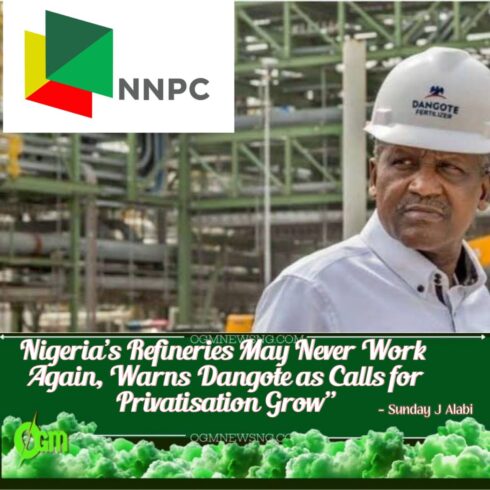
The President of the Dangote Group, Alhaji Aliko Dangote, has cast serious doubt on the possibility of Nigeria’s state-owned refineries—Port Harcourt, Warri, and Kaduna—ever becoming functional again. Speaking on Thursday while hosting members of the Global CEO Africa from the Lagos Business School at the Dangote Petroleum Refinery in Lekki, Lagos, Dangote revealed that despite over $18 billion being spent on the refineries, they remain non-operational.
Dangote, Africa’s richest man, expressed deep skepticism over the feasibility of reviving these aging assets, noting that even the government’s best efforts have failed to yield results. “As of today, they have spent about $18 billion on those refineries, and they are still not working. I don’t think, and I doubt very much if they will ever work,” Dangote declared.
He further explained that his own state-of-the-art 650,000-barrel-per-day refinery dedicates over 50% of its production capacity to Premium Motor Spirit (petrol), whereas the government-run refineries only allocated 22% of their output to petrol even in their operational days.
The Aborted Sale of Refineries: A Missed Opportunity
Recalling the controversial reversal of the sale of the refineries in 2007, Dangote highlighted how his acquisition of the facilities was abruptly aborted by the administration of late President Umar Yar’Adua. Dangote and his partners had purchased the refineries during the tenure of President Olusegun Obasanjo, only to be forced to return them months later following intense political pressure and internal opposition.
According to Dangote, the then-Managing Director of the refineries convinced Yar’Adua that the assets were sold below market value as a so-called “parting gift” from Obasanjo. This political maneuver, Dangote said, set Nigeria back, as billions have since been wasted on facilities that have stubbornly refused to operate effectively. “It’s like trying to modernize a 40-year-old car when technology has completely changed,” he remarked, emphasizing the futility of repeated turnaround maintenance on obsolete infrastructure.
Obasanjo’s Vindication: “The Refineries Will Not Work”
Dangote’s remarks echo former President Olusegun Obasanjo’s longstanding criticism of the state-owned refineries. In multiple public statements, Obasanjo had insisted that the Nigerian National Petroleum Company Limited (NNPC) lacked the capacity to operate the facilities effectively, recounting how international oil giants such as Shell refused to manage them when approached.
Obasanjo underscored the wastefulness of the situation, revealing that even after the aborted sale, the government continued to pour billions into the moribund plants with no tangible results. “When you want to sell them, you won’t get $200 million for them as scrap,” Obasanjo warned, lamenting that corruption within the NNPC had perpetuated the cycle of failure.
The former president even recalled how Dangote and other investors paid $750 million to take over the refineries, only for the deal to be reversed— a decision he described as economically damaging and driven by entrenched interests within the oil sector.
Calls Grow for Privatisation as Refineries Remain Idle
The repeated failures of the Port Harcourt and Warri refineries, despite recent turnaround maintenance efforts, have reignited calls for their full privatisation. The Port Harcourt refinery, which was declared operational in December 2023, was quietly shut down again just six months later. Similarly, the Warri refinery also ceased operations shortly after a much-publicized reopening by then NNPC boss Mele Kyari.
The Manufacturers Association of Nigeria (MAN) has been vocal in its criticism, describing the government refineries as a drain on the economy and urging the Federal Government to sell them off entirely. Industry stakeholders argue that continued public ownership only encourages waste, inefficiency, and corruption— factors that have crippled the country’s energy sector for decades.
The poor state of the refineries also means that Nigeria remains heavily reliant on imported fuel, despite being one of the world’s top crude oil producers— a paradox that has kept fuel prices volatile and national energy security fragile.
Dangote Refinery Seen as Beacon of Hope for Nigeria’s Energy Future
In stark contrast to the government’s failure, Dangote’s massive private refinery in Lekki has emerged as a potential game-changer for Nigeria’s energy landscape. The $19 billion facility, Africa’s largest, is already producing fuel and is expected to meet both domestic and export demands, significantly reducing the country’s dependence on imported petroleum products.
According to Dangote, his refinery has not only committed over half of its production to petrol but is also built with cutting-edge technology capable of refining various crude grades into multiple products. Observers see the success of the Dangote Refinery as a powerful argument in favor of privatisation and private sector-led development in Nigeria’s oil and gas industry.
Dangote’s comments reflect growing frustration with the inefficiency of state-run enterprises and point to the critical need for policy reforms that would attract more private investment, reduce waste, and enhance national productivity. As Nigeria grapples with economic challenges and fuel scarcity, many believe that only bold decisions—such as the full divestment of non-performing assets—can secure the country’s energy future.
Table of Contents
Discover more from OGM News NG
Subscribe to get the latest posts sent to your email.