









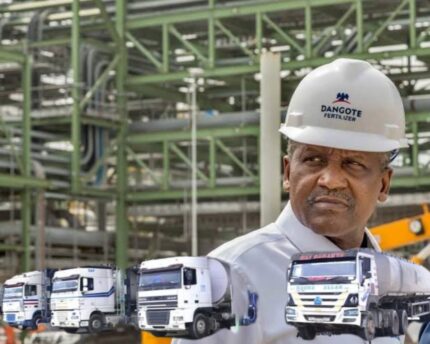
The President of the Dangote Group, Alhaji Aliko Dangote, has reaffirmed that the Dangote Petroleum Refinery possesses enough refined fuel products to meet Nigeria’s needs while also catering to export demands. Speaking during a tour of the $20 billion Lekki-based refinery with Zambia’s Minister for Energy, Makozo Chikote, on Saturday, Dangote disclosed that the facility currently has over 500 million litres of petrol in its reservoir.
He further revealed that the refinery has stocks worth over ₦600 billion in its tank farm and is on track to reach its full production capacity of 650,000 barrels per day next month. With Nigeria’s fuel consumption estimated at only 40% of the refinery’s total output, Dangote assured that the excess 60% would be exported, strengthening Africa’s energy security.
High-Quality Fuel Production and Competitive Edge
Highlighting the refinery’s cutting-edge capabilities, Dangote asserted that no other refinery in Africa or Europe could match the quality of fuel his facility produces. He explained that the sulphur content of Dangote Refinery’s fuel could be as low as zero parts per million (ppm), making it one of the cleanest globally.
“In terms of quality, there is actually no refinery in Africa, even in Europe, that can produce our type of quality. We can produce up to zero ppm sulphur content, which allows us to meet stringent environmental regulations,” Dangote stated. He added that the refinery could produce Euro-5 standard fuel, winter diesel, and other high-grade petroleum products that meet international standards.
The billionaire industrialist also noted that several refineries worldwide were shutting down due to the impact of Dangote’s refinery on the global market. “When you read the news, you see that a lot of refineries, especially in Europe, are shutting down because of our own refinery. We have to weather that storm until we are fully established,” he remarked.
Dangote Refinery Strategic Plans for Crude Supply and Export Expansion
While the refinery is scaling up production, Dangote acknowledged that securing a steady supply of crude oil remains a crucial priority. He emphasized that arrangements were being made to ensure the facility operates at maximum capacity by next month.
“Now we are ramping up production. We must be at our full capacity by next month. But we have to do quite a lot of arrangements in terms of crude supply,” he stated.
To support the export of excess refined products, Dangote revealed ongoing discussions with Afreximbank and other financial institutions to resolve challenges related to letters of credit and financing. He noted that a significant portion of the refinery’s products would be marketed within Africa to foster intra-African trade.
“We are making arrangements with some banks to ensure that most of the products are sold within Africa. This is to establish the refinery as a truly African project, not just a facility for refining and exporting raw materials outside the continent,” Dangote said.
Production Capacity and Storage Facilities
Vice President of Dangote Group, Davakumar Edwin, provided insights into the refinery’s production capacity, highlighting its capability to produce 104 million litres of various petroleum products daily.
According to Edwin, the refinery’s daily production breakdown includes:
57 million litres of petrol,
20 million litres of jet fuel,
37 million litres of diesel.
He further explained that local fuel consumption in Nigeria stands at approximately 46 million litres per day, meaning that the refinery would export 58 million litres daily. Edwin emphasized the refinery’s advantage in terms of storage capacity, which enables it to hold large volumes of petroleum products.
“The refinery has reservoirs to store fuel for days. It has 12 tanks to store up to 600 million litres of petrol, which can serve the country for 18 days. Additionally, there are 17 tanks for 408 million litres of aviation fuel and 14 tanks for 340 million litres of diesel,” Edwin detailed.
With 177 tanks holding a total capacity of 4.742 billion litres, Edwin assured that the facility could sustain uninterrupted fuel supply in Nigeria and beyond.
Zambia Seeks Collaboration for Energy Security
During the facility tour, Zambia’s Minister for Energy, Makozo Chikote, expressed his country’s interest in partnering with Dangote to address Zambia’s energy security challenges. Chikote acknowledged that Zambia relies heavily on fuel imports through Dar es Salaam, Tanzania, which often results in supply bottlenecks.
“As the Zambian government, we are mandated to safeguard the supply of fuel. We need sufficient, reliable, and affordable petroleum products for Zambia. This is why we are looking at Dangote as a potential partner,” Chikote stated.
He explained that Zambia, like many African nations, was facing economic difficulties due to fuel shortages and high prices. According to him, improved trade partnerships with African refiners like Dangote would help stabilize fuel prices and ensure a consistent supply.
Responding to Chikote’s request, Dangote reiterated that the refinery was not just for Nigeria but for Africa as a whole. “We must sustain the African Continental Free Trade Area (AfCFTA) deal. Our goal is to see how we can trade with other African countries and strengthen regional economic integration,” he affirmed.
With the Dangote Refinery reaching full production soon, its impact on Nigeria’s energy independence and Africa’s fuel supply chain is set to be transformative
Table of Contents
Discover more from OGM News NG
Subscribe to get the latest posts sent to your email.