




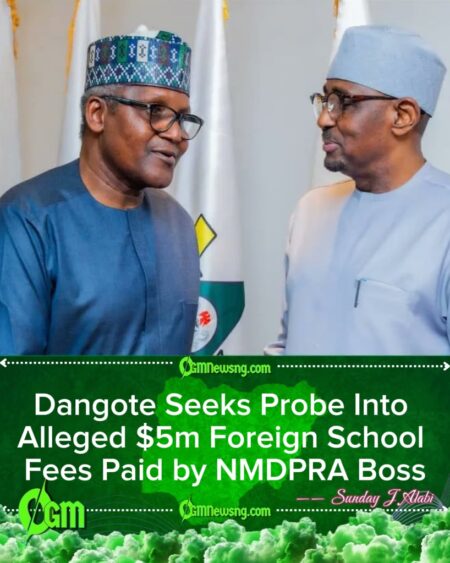
President of the Dangote Group, Alhaji Aliko Dangote, has accused the Chief Executive of the Nigerian Midstream and Downstream Petroleum Regulatory Authority (NMDPRA), Farouk Ahmed, of paying about $5 million for the secondary school education of his four children in Switzerland, an expenditure he says is inconsistent with earnings from public service. Dangote has called for a full investigation and a public explanation, insisting that the matter raises serious questions about accountability and integrity in public office.
Speaking on Sunday, the billionaire industrialist urged relevant authorities, including the Code of Conduct Bureau and Tribunal, to examine the allegations thoroughly. Dangote maintained that his intervention was not a personal attack but a demand for transparency, stressing that public officials must be able to explain the sources of significant expenditures, especially at a time of widespread economic hardship in the country.
Allegations and Demand for Accountability by Dangote
Dangote alleged that Farouk Ahmed should be required to appear before the Code of Conduct Tribunal to explain how he was able to fund what he described as an estimated $5 million spent on six years of secondary education for four children abroad. According to him, such an amount would ordinarily attract scrutiny from tax and regulatory authorities, regardless of who incurred it.
Dangote argued that when the alleged spending is compared with the known earnings of a public servant, it raises red flags that deserve investigation. Dangote stated that even private individuals with legitimate businesses would be expected to account for such levels of expenditure, adding that public officials should be held to an even higher standard.
The businessman emphasised that his call was for due process, not immediate sanctions. He said that if the allegations were denied, he was prepared to take further steps, including legal action, to compel the relevant foreign schools to disclose records of payments allegedly made by Ahmed, in order to establish the facts.
NMDPRA’s Response and Earlier Denials
The allegations are not new. In July, a group had accused the NMDPRA chief of spending more than $5.5 million on the foreign education of his children, claims which the agency strongly denied at the time. The NMDPRA described those accusations as false and part of an orchestrated smear campaign against its leadership.
Dangote, however, revisited the issue, arguing that the seriousness of the allegations warranted a transparent and independent investigation rather than outright dismissal. He insisted that the matter went beyond personal reputation and touched on public trust in regulatory institutions.
When contacted for a response to the latest comments, the NMDPRA spokesman, George Ene-Ita, declined to react, saying simply, “For now, no comment.” This leaves the allegations unresolved in the public space, pending any formal inquiry by relevant authorities.
Wider Concerns About the Petroleum Sector
Beyond the personal allegations, Dangote linked the controversy to broader structural issues in Nigeria’s downstream petroleum sector. He alleged that entrenched interests continue to benefit from fuel imports at the expense of local refining and national development, despite longstanding calls for value addition within Africa.
He described the sector as being under severe strain, arguing that allowing large volumes of refined fuel imports into the country undermines domestic investment. According to him, the regulatory environment has discouraged new refinery projects, noting that although dozens of licences have been issued, no significant new refineries are being built.
Dangote also warned against conflicts of interest, stressing that regulatory oversight must be clearly separated from commercial trading activities. He maintained that local refining would ultimately benefit Nigerians through improved supply and pricing, adding that his company was working to ensure recent reductions in gantry prices were reflected at the retail level.
Table of Contents
Discover more from OGM News NG
Subscribe to get the latest posts sent to your email.