







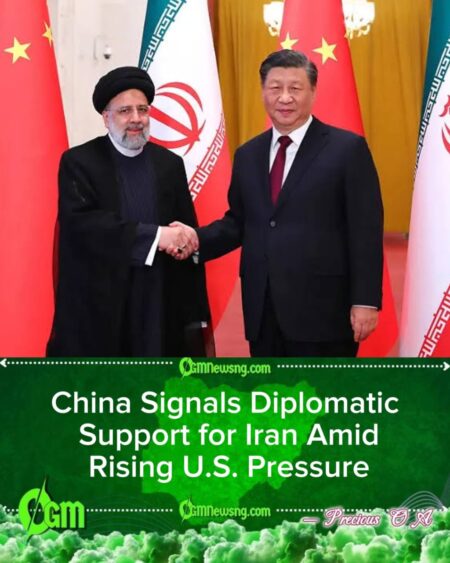
China stated that it would stand by Iran in the face of escalating pressure from the United States, framing its position around principles of sovereignty, non-interference, and opposition to unilateral coercive measures. The remarks were delivered through official diplomatic channels and emphasized political backing rather than military commitments.
China described its position as consistent with long-held foreign policy doctrine, arguing that disputes involving Iran should be resolved through dialogue and multilateral frameworks. Officials stressed that external pressure often deepens instability and complicates prospects for negotiated outcomes across the Middle East.
Officials speaking on background said the message was intended to signal resolve without escalating confrontation, underscoring that Beijing favors de-escalation while defending partners it views as unfairly targeted by sanctions or threats of force.
Diplomatic Messaging and Strategic Ambiguity
The statement was carefully worded, leaving room for interpretation about the scope of support being offered. Diplomatic observers noted that such language allows flexibility while still conveying solidarity at a moment of heightened regional sensitivity.
China has frequently employed strategic ambiguity in similar situations, balancing rhetorical support for partners with a preference for avoiding direct entanglement in military conflicts. This approach enables Beijing to preserve relationships across competing blocs.
Analysts say the messaging also reflects China’s desire to position itself as a responsible global actor, one that opposes escalation while criticizing what it characterizes as destabilizing unilateral actions by major powers.
Regional Reactions Across the Middle East
China’s remarks were closely watched across the Middle East, where governments are navigating complex alliances amid shifting power dynamics. Some regional actors welcomed calls for restraint, while others expressed concern about growing great-power competition.
Regional diplomats privately suggested that Beijing’s stance could embolden Tehran diplomatically, even if it does not translate into concrete security guarantees. The symbolic value of major-power backing was seen as significant in itself.
China was also viewed as signaling to regional partners that it intends to play a larger role in Middle Eastern diplomacy, building on recent efforts to facilitate dialogue among rival states.
Global Economic and Energy Implications
Markets reacted cautiously, with energy analysts noting that rhetoric involving Iran often heightens concerns about supply disruptions. However, the absence of explicit military commitments helped temper immediate volatility in oil prices.
China is a major consumer of Middle Eastern energy, and stability in the region remains a core economic interest. Observers noted that Beijing’s statements appeared calibrated to protect energy flows while opposing actions that could trigger wider conflict.
Economists added that prolonged tensions could complicate global trade routes and investment sentiment, reinforcing the importance of diplomatic engagement over confrontation.
China’s Calculus in a Multipolar World
Strategists argue that Beijing’s stance reflects broader ambitions within an increasingly multipolar international system. By defending Iran diplomatically, China reinforces its image as a counterweight to U.S. influence without assuming the costs of direct intervention.
China has expanded its political and economic footprint across the Global South, often framing its partnerships as alternatives to Western-led alliances. Support for Iran fits within that narrative of resisting what it sees as dominance by any single power.
Policy experts caution, however, that such positioning carries risks, including potential strain with other partners who prefer neutrality or closer alignment with Washington.
Paths Toward De-escalation
China reiterated calls for renewed negotiations and urged all parties to exercise restraint, emphasizing the role of international institutions in managing disputes. The appeal was framed as a collective responsibility to prevent miscalculation.
Diplomats suggested that back-channel communications could intensify in the coming weeks, with multiple actors seeking to lower tensions while preserving their strategic interests. The emphasis remains on avoiding steps that could spiral into open conflict.
China concluded its messaging by underscoring that long-term stability depends on dialogue, mutual respect, and adherence to international norms, signaling that its support for Iran is intended as a diplomatic counterbalance rather than a push toward confrontation.
Table of Contents
Discover more from OGM News NG
Subscribe to get the latest posts sent to your email.