








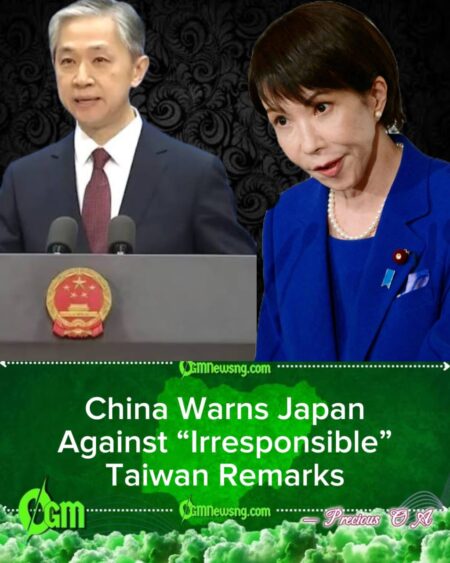
Chinese Foreign Ministry Spokesperson Wang Wenbin issued a firm warning to Japan following recent statements from Tokyo concerning Taiwan, describing them as “irresponsible” and “highly provocative.” The comments, delivered during China’s routine press briefing, were notable for their unusually sharp tone, signaling Beijing’s growing frustration with what it perceives as repeated interference from Japan in matters it considers exclusively internal.
Wang Wenbin emphasized that China views Taiwan as a matter central to its national sovereignty, unity, and historical identity. In his remarks, he stated that no foreign government has the right to weigh in on reunification matters, security arrangements, or political decisions related to the island. According to him, any attempt by outside nations—including Japan—to inject opinions into the Taiwan issue not only violates diplomatic norms but also risks destabilizing cross-strait relations that are already under intense global observation.
Wang Wenbin reiterated China’s expectation that Japan should exercise caution, respect diplomatic boundaries, and avoid actions that could complicate regional stability. He stressed that China has repeatedly communicated its position clearly. Therefore, Japan’s decision to comment yet again, despite prior warnings, was interpreted by China as an intentional move that could undermine trust and cooperation between the two nations.
Beijing’s Position on Taiwan
Wang Wenbin restated China’s long-standing stance that Taiwan is an inseparable part of its territory, a position grounded in its constitutional framework and affirmed in various official documents. He warned that any country challenging this principle risks damaging bilateral relations, as the Taiwan question is considered one of China’s most sensitive and non-negotiable core interests.
Wang Wenbin pointed out that Japan, as a close neighbor with significant regional influence, should understand the sensitivity of the Taiwan question more than most nations. The spokesperson argued that Japan’s historical relationship with Taiwan, coupled with its geographic proximity, places a heavier responsibility on Tokyo to act with care and avoid stirring unnecessary controversy. Beijing also noted that past interactions between Chinese and Japan should have made it evident that Taiwan remains a political red line.
According to Beijing’s official briefings, any external support for Taiwan’s political autonomy is considered a direct interference in China’s domestic affairs. China views such actions not merely as diplomatic missteps but as potential threats to territorial integrity. For that reason, Beijing insists that all nations—including Japan—adhere strictly to the “One China” principle, which it considers the foundation of all diplomatic relations with China.
Japan’s Statements and Regional Concerns
Tokyo’s recent comments, which suggested increasing concern about cross-strait tension, were cited by China as the reason behind this new diplomatic friction. Japanese officials reportedly highlighted what they considered China’s “military assertiveness,” prompting a swift and sharp rebuttal from Beijing.
Wang Wenbin labeled the statements as misleading and accused Japan of attempting to shape international opinion in a way that challenges China’s sovereignty. He argued that Japan’s language risks painting an inaccurate picture of China’s intentions, portraying defensive actions as aggressive maneuvers. Beijing interpreted Japan’s remarks as part of a coordinated effort to increase foreign scrutiny of China’s domestic matters.
Wang Wenbin further argued that Japan’s remarks contribute to unnecessary regional anxiety, especially at a time when diplomatic channels remain open. He insisted that fueling public concern through political commentary does little to promote genuine peace, urging Japan to focus instead on building mutual trust.
Calls for Stability in the Asia-Pacific
Regional analysts suggest that China’s reaction reflects broader anxieties about growing security discussions in the Asia-Pacific, particularly those involving Japan, Taiwan, and the United States. Increased diplomatic exchanges among these three actors have led China to believe that new strategic alignments may be forming.
Wang Wenbin called on all parties to prioritize stability and refrain from actions that fuel geopolitical mistrust or escalation. He insisted that the Asia-Pacific has enjoyed relative peace due to careful diplomatic engagement, and that this balance could be disrupted if countries begin making provocative or speculative public statements.
Wang Wenbin maintained that peaceful development in the region requires respecting the established diplomatic framework regarding Taiwan. Any deviation from this framework, in China’s view, risks creating uncertainty that could spill into economic, security, and humanitarian spheres.
Implications for China-Japan Relations
Bilateral ties, already strained by disputes over maritime boundaries and historical issues, face renewed pressure from this latest disagreement. Some officials and analysts suggest that this could be one of the most significant diplomatic setbacks between the two nations in recent years.
Wang Wenbin noted that Japan risks undermining decades of carefully maintained diplomatic engagement if it continues to publicly comment on Taiwan. He stated that although China prefers cooperation, it will not hesitate to take countermeasures if its sovereignty is challenged.
Wang Wenbin affirmed that China remains open to dialogue but warned that continued provocation could lead to “serious consequences” for bilateral cooperation. These consequences could manifest in reduced economic exchanges, stalled diplomatic programs, or firmer posturing in disputed maritime zones.
International Reactions and Strategic Calculations
Foreign policy observers believe that Japan’s statements reflect increasing concern about China’s growing military presence near Taiwan. Some analysts argue that Tokyo may be recalibrating its regional security position, particularly in light of shifting alliances and heightened U.S. involvement.
Wang Wenbin dismissed such concerns as exaggerated, asserting that China’s actions are lawful and consistent with protecting national sovereignty. He insisted that military activity near Taiwan is directed solely at separatist forces and is not aimed at creating tension with Japan.
Wang Wenbin cautioned that external alliances or joint statements targeting China could create long-term instability across East Asia. He urged countries to avoid forming blocs or issuing coordinated remarks that could worsen regional polarization.
The Road Ahead
Future diplomatic engagements between Chinese and Japan may determine how deeply this issue impacts regional cooperation efforts. Beijing hopes that Japan will reassess its approach and adopt a more cautious communication style regarding Taiwan.
Wang Wenbin expressed hope that Japan will “correct its mistakes” and return to a more cautious, respectful posture. He emphasized that Chinese is willing to move forward constructively so long as Japan honors its previously agreed-upon commitments.
Wang Wenbin insisted that Chinese will continue defending its territorial claims while urging neighboring nations to avoid inflammatory rhetoric. He called for renewed diplomatic maturity, noting that stability in the Asia-Pacific depends on restraint and understanding from all sides.
Table of Contents
Discover more from OGM News NG
Subscribe to get the latest posts sent to your email.