







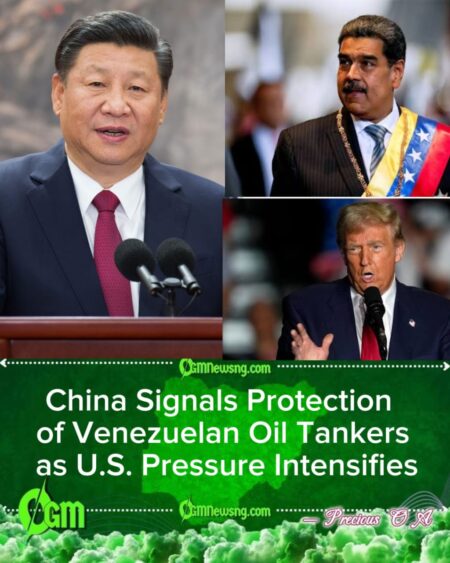
China warned that interference with tankers could destabilize global energy markets already strained by geopolitical conflicts and supply disruptions. Officials pointed to recent volatility in oil prices as evidence that markets are sensitive to even minor disruptions in supply chains. Any escalation involving tanker interdictions, they cautioned, could trigger price spikes affecting consumers worldwide.
China also signaled that pressure on Venezuelan oil shipments could further entrench divisions between major powers, complicating diplomatic efforts on unrelated global challenges. From climate negotiations to financial stability, Chinese officials argued that trust between nations is already fragile and could be further eroded by aggressive enforcement actions at sea. In this context, energy security becomes not just an economic issue but a diplomatic stress test.
China maintained that dialogue, rather than coercion, remains the most effective way to address disputes over sanctions and trade restrictions. By framing its response as defensive rather than provocative, Beijing sought to reassure other nations that its primary goal is stability rather than confrontation. Still, analysts note that even defensive measures can have far-reaching consequences when deployed in contested maritime environments.
Implications for Maritime Security
China’s statement raised immediate questions about how protection for oil tankers would be implemented in practice. While officials avoided detailing specific measures, observers speculated about increased naval escorts, expanded maritime surveillance, or closer coordination with Venezuelan authorities. Each option carries different levels of risk and signaling, particularly in regions where U.S. naval forces are already active.
China has expanded its naval capabilities significantly over the past two decades, increasingly operating farther from its home waters. Deployments linked to protecting overseas trade routes have become more common, reflecting Beijing’s evolving view of maritime security as a global responsibility rather than a regional one. Venezuelan oil shipments could thus become another test case for China’s blue-water ambitions.
Maritime security experts caution that overlapping patrols or escort missions increase the risk of miscalculation, especially in politically charged environments. Even routine maneuvers can be misinterpreted when tensions are high, potentially leading to incidents that escalate beyond their original scope. This risk underscores why energy transport routes are now seen as potential flashpoints in great-power competition.
Venezuela’s Role and Perspective
China’s stance also highlights Venezuela’s continued reliance on external partners amid ongoing economic and political challenges. With limited access to Western financial markets and technology, Caracas has leaned heavily on relationships with countries willing to bypass or challenge U.S.-led sanctions frameworks. Oil exports remain one of the few viable sources of revenue for the Venezuelan government.
China has consistently emphasized respect for Venezuelan sovereignty, arguing that the country has the right to trade its natural resources without external interference. This position aligns with Beijing’s broader foreign policy principle of non-interference, which it frequently contrasts with Western approaches. By defending Venezuelan oil shipments, China reinforces this narrative on the global stage.
For Venezuela, Chinese backing provides both economic lifeline and diplomatic leverage. However, it also deepens Caracas’s dependence on a limited set of partners, potentially narrowing its future policy options. Analysts note that while such partnerships offer short-term relief, they can create long-term strategic dependencies.
Global Market Repercussions
China’s announcement reverberated through global energy markets, where traders closely monitor geopolitical developments that could affect supply chains. Even the perception of heightened risk can influence pricing, insurance costs, and shipping decisions. Markets reacted cautiously, reflecting uncertainty rather than immediate disruption.
China argued that predictable and secure energy flows benefit all nations, not just producers and consumers directly involved. Disruptions in one region can cascade through global markets, affecting prices and availability far beyond their point of origin. This interconnectedness, Beijing noted, is precisely why unilateral actions are so destabilizing.
Energy economists suggest that prolonged tension over Venezuelan oil could encourage further diversification of supply routes and partnerships. While diversification can enhance resilience, it also introduces inefficiencies and higher costs. Over time, these adjustments can reshape global energy trade patterns in subtle but lasting ways.
Broader Geopolitical Context
China’s move fits into a wider pattern of strategic competition with the United States across multiple domains, from technology and trade to security and diplomacy. Energy security, once largely managed through markets, has become a tool and target of geopolitical strategy. Venezuela represents just one node in this increasingly complex network.
China has repeatedly criticized what it describes as the politicization of economic tools, arguing that sanctions and trade restrictions are being used to enforce political conformity. By taking a stand on Venezuelan oil tankers, Beijing reinforces its opposition to this trend while signaling willingness to defend its interests more assertively.
This dynamic places third-party countries in a delicate position, as they navigate between competing powers with overlapping economic and security ties. Many nations depend on both U.S. security guarantees and Chinese trade, making open alignment difficult. As a result, disputes like this one often have ripple effects well beyond the immediate actors.
Outlook and Potential Next Steps
China indicated that it would continue monitoring developments closely and adjust its approach as needed to ensure the safety of commercial shipping. Officials stressed that their preference remains stability and cooperation, but they also emphasized readiness to respond to actions perceived as threatening legitimate trade.
China’s approach going forward will likely balance deterrence with diplomacy, seeking to protect interests without triggering open confrontation. How successfully this balance is maintained will depend on actions taken by all parties involved, including Washington and Caracas. The situation remains fluid, with outcomes shaped by both policy decisions and events at sea.
Ultimately, China’s stance on Venezuelan oil tankers underscores how deeply intertwined energy, security, and geopolitics have become. What begins as a dispute over shipping and sanctions now carries implications for maritime norms, global markets, and great-power relations. As tensions persist, the handling of this issue may serve as a bellwether for how future conflicts over strategic resources are managed.
Table of Contents
Discover more from OGM News NG
Subscribe to get the latest posts sent to your email.