








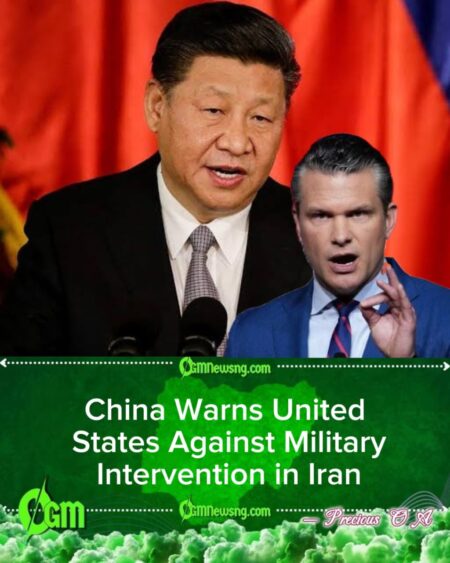
China warned the United States against any form of military intervention in Iran, issuing a carefully calibrated statement that emphasized restraint, sovereignty, and the risks of escalation. The remarks were delivered through official diplomatic channels and framed as a response to growing speculation about possible U.S. actions in the Middle East.
The warning reflects Beijing’s longstanding position that disputes involving Iran should be resolved through dialogue rather than force. Chinese officials stressed that unilateral military action would undermine regional stability and complicate already fragile diplomatic efforts surrounding security and nuclear concerns.
China positioned itself as a proponent of de-escalation, urging all parties to act responsibly and within international legal frameworks. The statement avoided inflammatory language while clearly signaling opposition to any intervention that bypasses multilateral consensus.
Diplomatic Signals and Strategic Intent
China emphasized that military pressure has historically failed to produce sustainable outcomes in the Middle East. Officials argued that the use or threat of force often entrenches divisions and increases the likelihood of miscalculation among regional and global powers.
Diplomatic analysts noted that the language used was firm yet restrained, allowing Beijing to communicate resolve without committing itself to any military posture. Such messaging aligns with China’s broader diplomatic strategy of opposing intervention while maintaining flexibility.
China also underscored the importance of the United Nations and other international mechanisms, suggesting that legitimacy and collective decision-making remain essential to managing conflicts involving Iran.
Regional Stability and Security Concerns
China highlighted the potential consequences of military action on regional security, warning that conflict involving Iran could rapidly spread beyond national borders. Officials referenced the interconnected nature of Middle Eastern security dynamics and the risks posed to neighboring states.
Regional observers noted that Iran’s strategic location and alliances mean that escalation could affect shipping routes, energy infrastructure, and political stability across a wide geographic area. These concerns were implicitly reflected in Beijing’s call for caution.
China framed its position as one rooted in the protection of civilians and economic stability, arguing that prolonged conflict would impose significant humanitarian and financial costs on the broader international community.
China and the Question of Global Influence
China’s warning also reflects its evolving role as a global diplomatic actor. By openly cautioning the United States, Beijing signaled its willingness to engage more assertively on high-stakes international security issues.
Policy experts observed that China increasingly presents itself as a counterbalance to U.S. influence, particularly in regions where American military presence has been longstanding. The Iran issue offers Beijing an opportunity to reinforce that posture without direct confrontation.
China has consistently opposed what it characterizes as unilateral coercive measures, positioning its approach as an alternative model that prioritizes negotiation, sovereignty, and non-interference.
Economic and Energy Implications
China noted that instability involving Iran could disrupt global energy markets, given the country’s role in oil production and its proximity to critical maritime corridors. Any conflict could have immediate ripple effects on prices and supply chains.
As one of the world’s largest energy consumers, China has a vested interest in preventing disruptions that could affect its domestic economy. Analysts said this economic dimension likely influenced the tone and timing of Beijing’s warning.
China’s emphasis on stability also resonated with broader concerns among global markets, which tend to react sharply to signals of potential military escalation in the Gulf region.
They Calls for Restraint and Dialogue
China reiterated its call for all parties to exercise restraint and return to diplomatic engagement, emphasizing that communication channels remain essential even during periods of heightened tension. Officials stressed that dialogue does not signal weakness but responsibility.
Diplomats suggested that Beijing may seek to quietly support renewed negotiations through multilateral forums, positioning itself as a facilitator rather than a participant in any confrontation. This approach aligns with China’s preference for behind-the-scenes diplomacy.
They concluded its messaging by reaffirming its commitment to international law and peaceful conflict resolution, signaling that its warning to the United States was intended as a stabilizing intervention rather than a provocation.
Table of Contents
Discover more from OGM News NG
Subscribe to get the latest posts sent to your email.