









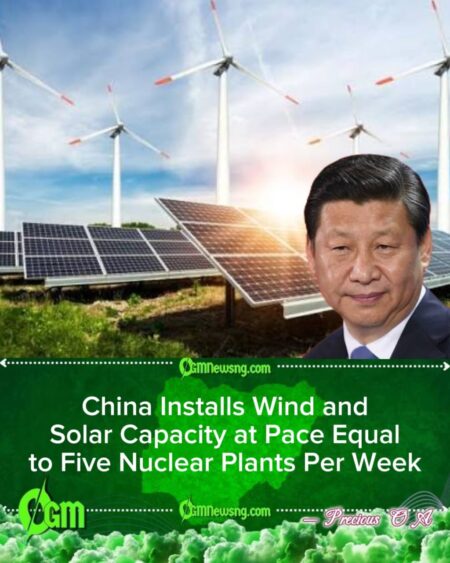
China is rapidly expanding its renewable energy capacity, installing new wind and solar power at a pace comparable to the output of five large nuclear power plants every week. The scale of the build-out reflects a long-term national strategy aimed at reducing reliance on fossil fuels while supporting economic growth.
The expansion has been driven by a combination of state planning, falling technology costs, and aggressive climate targets. Wind farms across northern and western provinces and massive solar installations in desert regions have become central to the country’s energy transformation.
China has framed the effort as both an environmental and economic imperative, emphasizing energy security while positioning itself as a global leader in clean-energy infrastructure.
Scale of Weekly Installations
The scale of installations is unprecedented when viewed against historical benchmarks. Five large nuclear plants’ worth of capacity each week translates into tens of gigawatts added annually, far surpassing renewable deployment rates in most other major economies.
China has benefited from its ability to mobilize capital, labor, and manufacturing capacity simultaneously, allowing projects to move from approval to operation at remarkable speed.
Industry analysts note that the rapid pace also reflects years of investment in domestic manufacturing, which has lowered costs and minimized supply-chain disruptions that have slowed renewable projects elsewhere.
Grid Integration and Storage Challenges
China faces the complex task of integrating this surge of renewable power into its national grid. Wind and solar generation are intermittent, requiring careful coordination with energy storage systems and transmission infrastructure.
Grid operators have expanded ultra-high-voltage transmission lines to move power from remote generation sites to population centers, while large-scale battery and pumped-hydro projects are being developed to smooth fluctuations.
China has acknowledged that grid stability remains a challenge, but officials argue that advances in digital grid management and storage technology are keeping pace with capacity growth.
China’s Industrial Strategy and Supply Chains
The renewable expansion is closely tied to broader industrial policy. China dominates global manufacturing of solar panels, wind turbines, and related components, allowing it to scale deployment at lower cost than many competitors.
This industrial advantage has also strengthened export markets, with Chinese-made renewable equipment widely used in projects across Asia, Africa, and Latin America.
Critics argue that such dominance raises concerns about global dependency, while supporters point to lower prices accelerating the global energy transition.
Global Climate and Market Implications
China’s renewable surge has significant implications for global emissions trajectories. By replacing coal-fired generation with wind and solar, the country has the potential to slow the growth of its carbon emissions over the coming decade.
Energy markets have also been affected, with declining domestic coal demand influencing global prices and trade flows. Renewable overcapacity during peak production periods has begun reshaping regional electricity markets.
China’s approach is increasingly viewed as a test case for whether large industrial economies can decarbonize at scale without sacrificing growth.
Challenges and Long-Term Outlook
Despite the progress, challenges remain. Financing sustainability, land use conflicts, and curtailment during periods of oversupply continue to pose obstacles to maximizing efficiency.
China is expected to refine its policies as renewable penetration deepens, focusing more on system optimization rather than sheer capacity growth.
Looking ahead, analysts suggest that the success of this effort will depend not only on continued installations, but on how effectively renewable energy is integrated into a stable, flexible, and resilient power system.
Table of Contents
Discover more from OGM News NG
Subscribe to get the latest posts sent to your email.