







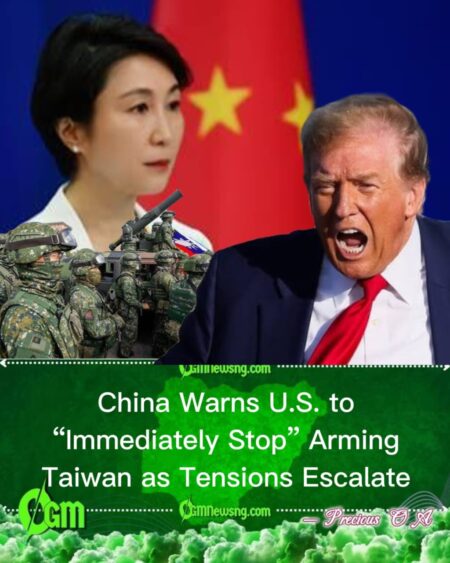
China issued a sharp warning to the United States, demanding that Washington immediately stop arming Taiwan, framing the issue as a direct threat to regional stability and a violation of long-standing diplomatic understandings between the two powers. The statement marked one of the strongest public rebukes in recent months and underscored Beijing’s growing frustration with continued U.S. military support for Taipei.
China emphasized that Taiwan remains the most sensitive and consequential issue in its relationship with the United States, arguing that arms sales undermine trust and encourage separatist sentiment on the island. Officials portrayed the latest weapons transfers as crossing a red line, insisting that the matter concerns China’s core national interests and sovereignty.
Diplomatic observers note that the language used reflects a broader hardening of tone as strategic competition between Beijing and Washington deepens. Rather than limiting its response to routine objections, the warning signaled an effort to elevate the issue onto a more confrontational diplomatic footing.
Taiwan at the Center of Tensions
China reiterated its long-held position that Taiwan is an inalienable part of its territory and that any foreign military involvement constitutes interference in internal affairs. The warning accused the United States of hollowing out the foundations of bilateral relations by continuing defense cooperation with Taipei.
China argued that U.S. arms deliveries send the wrong signal to pro-independence forces in Taiwan, emboldening political actors who favor formal separation. According to Beijing, such actions increase the risk of miscalculation and instability across the Taiwan Strait.
Analysts suggest that Taiwan’s strategic importance has become even more pronounced amid shifting global power dynamics. As competition intensifies in the Indo-Pacific, the island has emerged as both a symbolic and practical focal point for broader geopolitical rivalry.
U.S. Arms Sales Under Scrutiny
China condemned recent and proposed arms packages as destabilizing, claiming they violate commitments made under previous diplomatic agreements. Beijing maintains that these sales contradict the spirit of mutual restraint that once governed U.S.–China relations on the Taiwan issue.
China warned that continued military support could provoke consequences that neither side desires, hinting at possible countermeasures without specifying details. The message appeared designed to deter future sales while leaving room for diplomatic maneuvering.
From Washington’s perspective, arms sales are framed as defensive in nature and consistent with existing policy frameworks. U.S. officials have repeatedly stated that such support is intended to maintain balance and deter unilateral changes to the status quo.
Strategic Messaging and Power Signals
China used the warning not only to address Washington but also to send a broader signal to the international community about its resolve. By elevating the rhetoric, Beijing appeared intent on demonstrating that it will not tolerate what it views as incremental challenges to its sovereignty claims.
China framed the issue as one of international law and historical legitimacy, asserting that foreign interference threatens peace rather than preserving it. This narrative aligns with Beijing’s efforts to rally diplomatic support among countries wary of U.S. military influence.
Regional partners are closely watching how the situation evolves, aware that escalating rhetoric can quickly translate into heightened military activity. The balance between deterrence and provocation remains delicate, particularly in an area where multiple powers operate in close proximity.
Implications for Regional Stability
China warned that continued arms transfers could undermine peace in the Asia-Pacific, arguing that militarization increases the likelihood of confrontation. The statement suggested that stability depends on respect for China’s sovereignty claims rather than expanded security cooperation with Taiwan.
China portrayed itself as committed to peaceful reunification while reserving the right to respond forcefully to external interference. This dual messaging reflects Beijing’s attempt to project restraint while maintaining leverage.
Security experts caution that repeated warnings, if ignored, risk normalizing confrontation. Over time, such exchanges can harden positions and reduce diplomatic flexibility, making crisis management more difficult should tensions spike unexpectedly.
The Future of U.S.–China Relations
China concluded its warning by urging the United States to return to dialogue based on mutual respect and non-interference. Officials stressed that the direction of bilateral relations hinges on Washington’s actions regarding Taiwan.
China suggested that failure to heed the warning would further erode trust, complicating cooperation on global issues where both nations share interests. Climate change, economic stability, and international security were implicitly framed as areas that could suffer from worsening ties.
As both powers navigate an increasingly competitive relationship, the Taiwan issue continues to loom as the most volatile flashpoint. Whether diplomatic channels can temper escalating rhetoric remains uncertain, but the warning makes clear that Beijing views U.S. arms sales not as a peripheral concern, but as a defining test of the relationship.
Table of Contents
Discover more from OGM News NG
Subscribe to get the latest posts sent to your email.