








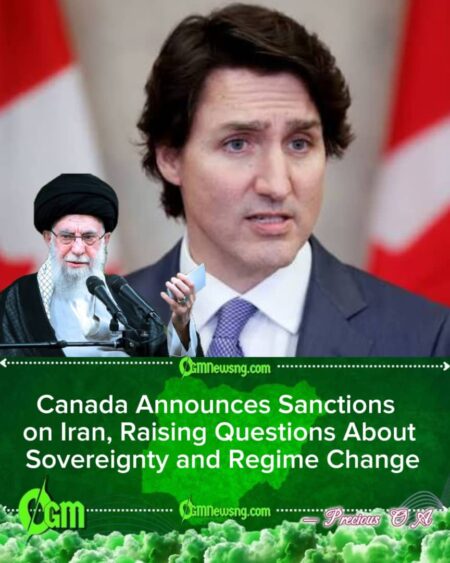
Canada has announced a new round of sanctions against Iran, stating that diplomatic relations will not be restored without what officials described as meaningful regime change. The declaration marks a significant escalation in Ottawa’s posture and raises complex questions about the limits of foreign policy leverage.
Canada’s foreign ministry framed the sanctions as a response to ongoing human rights concerns and regional security issues. Officials emphasized alignment with international partners while underscoring that reopening formal diplomatic channels would require substantial political transformation in Tehran.
The announcement has reignited debate among legal scholars and diplomats about whether one nation can legitimately call for regime change in another sovereign state. It also places Canada’s stance within a broader global discussion about sanctions, sovereignty, and international norms.
The Scope of the New Measures
Canada indicated that the sanctions target specific Iranian officials, financial entities, and sectors linked to security operations. Such measures often include asset freezes, travel bans, and restrictions on commercial transactions.
Canada officials argued that sanctions are intended to pressure governing authorities rather than the general population. However, critics of sanctions policy frequently note that broader economic impacts can ripple through civilian sectors.
Sanctions are a common tool of international diplomacy, used to signal disapproval and attempt to alter state behavior without resorting to military intervention. Their effectiveness, however, varies depending on enforcement, global coordination, and the targeted state’s economic resilience.
Canada’s Position on Regime Change
Canada’s assertion that diplomatic relations will not resume absent regime change has prompted scrutiny over how such conditions align with established diplomatic practice. Traditionally, states maintain relations even amid deep disagreements, using diplomacy as a channel for negotiation.
Canada policymakers maintain that engagement without reform could legitimize policies they oppose. They argue that withholding diplomatic normalization is a principled stance grounded in human rights advocacy.
International law scholars point out that while nations may express political preferences, direct interference in another country’s governance structure raises sovereignty concerns under the United Nations Charter. The distinction between advocacy and intervention remains a point of contention.
Sovereignty and International Law
Canada’s position intersects with longstanding principles of non-interference in domestic affairs. Sovereignty has been a foundational concept in international relations, designed to prevent external coercion over internal political systems.
Canada supporters argue that defending global values, including human rights and democratic governance, sometimes necessitates firm stances. They contend that sanctions and diplomatic conditions fall within permissible foreign policy tools.
Opponents caution that explicit calls for regime change risk setting precedents that other nations could invoke. The debate underscores tension between moral diplomacy and strict adherence to non-intervention norms.
Diplomatic and Economic Implications
Canada’s decision may influence its broader diplomatic relationships, particularly with countries that prioritize non-interference principles. Allies may align with Ottawa’s stance, while others may view it as overreach.
Canada also faces economic considerations. Sanctions can limit trade opportunities and complicate multinational business operations, especially if other countries adopt divergent policies toward Iran.
Geopolitical analysts observe that sanctions and diplomatic freezes often reshape regional alignments. The effectiveness of such measures frequently depends on coordination among multiple states.
Drawing the Line
The broader question remains: where is the line between defending global values and interfering in another nation’s sovereignty? International norms evolve through precedent, debate, and institutional interpretation.
Calls for regime change can be symbolic or strategic, but their implementation is constrained by legal frameworks and geopolitical realities. The balance between principle and pragmatism is rarely straightforward.
As Canada’s policy unfolds, its impact will likely extend beyond bilateral relations. The episode highlights enduring tensions in global governance: how nations advocate for values abroad while respecting the sovereignty that underpins the international system.
Table of Contents
Discover more from OGM News NG
Subscribe to get the latest posts sent to your email.