








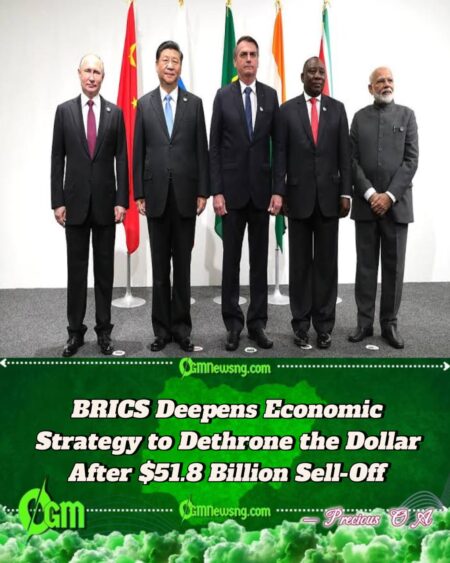
The BRICS alliance—comprising Brazil, Russia, India, China, and South Africa—has taken another decisive step in its strategy to reduce dependence on the U.S. dollar. Recent data shows that Chinese firms alone have offloaded nearly $51.8 billion in U.S. dollar assets, a move analysts view as part of a broader global rebalancing effort.
Global economists say this surge in dollar offloading is a clear reflection of changing financial tides. Many emerging economies are increasingly seeking ways to minimize their exposure to U.S. sanctions, inflationary risks, and interest rate fluctuations. The shift also reveals growing confidence in regional financial cooperation and alternative reserve currencies like the yuan and the rupee. The growing determination of BRICS members to strengthen local currencies has sent a strong message across the global economy that the alliance intends to redefine how trade and finance operate beyond Western structures.
The BRICS has been working systematically to strengthen financial partnerships that bypass traditional Western-dominated systems. The increase in yuan-based transactions among member states demonstrates that this movement is not merely symbolic—it is economic strategy in motion. Experts believe this ongoing shift could eventually alter how countries approach trade, savings, and investment across borders. With more nations joining the discussion on regional currency settlements, the world is beginning to see tangible progress toward what economists describe as the gradual “de-dollarization” of the global economy.
The BRICS has further reinforced its long-term vision through high-level policy coordination, with finance ministers and central banks exploring shared payment systems and reserve pools. These developments represent the early foundations of a multipolar global economy, where financial power is no longer concentrated in a single currency or region. Such coordination marks a significant milestone in international cooperation among developing economies that are determined to chart their own independent financial course.
The BRICS has made it clear that its members are determined to redefine the balance of international finance. What began as scattered national efforts to reduce dollar reliance is now evolving into a unified global agenda that challenges decades of U.S. monetary dominance. Analysts argue that this movement, if sustained, could transform how nations store wealth, conduct trade, and settle debts on a global scale—signaling the start of a more balanced and diversified financial era.
China Leads the Push for De-Dollarization
China’s economic leadership within the alliance has become the driving force of this new monetary chapter. Its corporations and financial institutions are spearheading the reduction of U.S. dollar exposure. The recent offloading of $51.8 billion in dollar-denominated assets by Chinese firms marks one of the largest single-quarter adjustments in recent history. This move not only highlights Beijing’s growing confidence in the yuan but also reflects its strategic intent to strengthen BRICS financial integration. For years, Chinese policymakers have emphasized the need for economic sovereignty, and this bold action demonstrates a decisive step toward achieving that vision.
The BRICS has benefited from China’s deliberate effort to redirect funds into gold, critical infrastructure, and alternative reserve assets. By investing heavily in domestic industries and South-South trade networks, China has ensured that the capital leaving U.S. assets continues to circulate within friendly economic blocs. Analysts view this as a calculated maneuver—one that enhances the resilience of BRICS economies against external shocks such as sanctions or interest rate volatility. The nation’s policymakers have also been promoting the yuan’s use in energy transactions and raw material imports, strengthening its role as a viable trade currency.
The BRICS has also seen growing participation from smaller economies seeking to join its trade and investment frameworks. Through currency-swap agreements, bilateral trade deals, and expanded membership discussions, the alliance is creating a financial ecosystem that increasingly operates outside the reach of Western financial oversight. This makes BRICS not just an economic club, but a strategic counterweight to traditional Western-led institutions like the IMF and World Bank. Observers point out that the alliance’s efforts are setting a precedent for countries eager to escape the constraints of dollar dependency and chart a more self-determined path.
The BRICS has accelerated its de-dollarization goals through digital currency innovation. China’s digital yuan and similar initiatives from other members are being tested in cross-border payment systems designed to reduce transaction costs and enhance transparency. These pilot projects signal the emergence of a new digital financial order—one that relies less on intermediaries and more on direct state-to-state exchange. The potential success of these projects could revolutionize global finance by allowing nations to trade freely without navigating the complexities of Western banking frameworks.
The BRICS has used this momentum to encourage non-member nations to explore alternative payment systems. Countries such as Saudi Arabia, Indonesia, and Egypt have expressed interest in conducting trade using local currencies, illustrating that the movement is no longer confined to BRICS nations but is becoming a global financial reformation. The alliance’s growing influence demonstrates that its model resonates widely, especially among nations that have long felt economically constrained by Western monetary policies.
Ripple Effects Across Global Markets
Financial analysts warn that this sweeping realignment could have lasting consequences for global markets. As BRICS nations continue selling off U.S. dollar holdings, investors are watching bond yields, trade settlements, and commodity pricing with renewed caution. The ripple effect has already begun influencing investment strategies, prompting central banks worldwide to reassess their foreign reserve portfolios. The implications stretch far beyond finance—politically, it signals a quiet but powerful shift in global influence as more nations reconsider their economic alliances.
The BRICS has simultaneously encouraged emerging economies to pursue more localized trade mechanisms. Nations in Africa, Latin America, and the Middle East are increasingly using regional currencies for trade settlement, following the example set by BRICS leaders. This shift represents not just economic pragmatism but also a form of geopolitical alignment, as nations seek greater autonomy from U.S. economic influence. As the number of trade agreements conducted outside the dollar grows, the notion of a single, dominant global currency continues to weaken.
The BRICS has also used its New Development Bank (NDB) to champion loans and investments in local currencies, reducing exposure to foreign exchange fluctuations. This policy has provided financial flexibility to member nations while boosting domestic capital markets. The NDB’s success demonstrates that a large-scale financial institution can operate effectively without relying on the U.S. dollar as its core currency base. The bank’s projects—from renewable energy to transportation—highlight the potential of locally funded development as a sustainable model for the future.
Investors around the world are paying close attention to this transformation. Global fund managers and corporate treasurers are beginning to incorporate alternative currencies into their portfolios, viewing the BRICS strategy as a potential signal of long-term structural change. The result is a slow but steady diversification that could redefine the concept of financial security and global monetary balance. If BRICS nations maintain this pace, experts predict that within a decade, the dollar’s share of global reserves could fall to its lowest level in modern history.
The BRICS has ultimately signaled that the transformation of the global monetary system is well underway. While the dollar remains the world’s most widely used reserve currency, the alliance’s actions show that its supremacy is not inevitable. The growing momentum behind de-dollarization, fueled by BRICS’ cooperation and China’s determination, is quietly reshaping the architecture of international finance—ushering in what many now call the dawn of a post-dollar world. The movement may take years to fully mature, but its direction is clear: global finance is evolving, and BRICS is leading that evolution.
Table of Contents
Discover more from OGM News NG
Subscribe to get the latest posts sent to your email.