









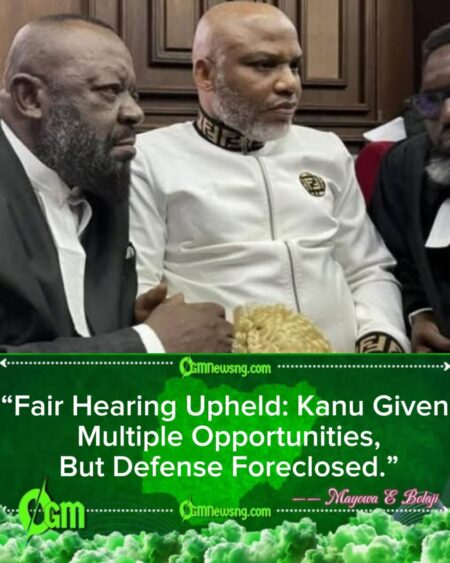
Barrister Sunny Ezeh has issued a detailed legal analysis regarding the ongoing trial of Nnamdi Kanu, leader of the Indigenous People of Biafra (IPOB), seeking to dispel misconceptions circulating online and in the media. Sunny Ezeh emphasized that the Supreme Court did not order the amendment of charges against Kanu, countering claims suggesting otherwise. According to him, the apex court merely remitted the matter back to the Federal High Court for trial after confirming the court’s jurisdiction.
Sunny Ezeh explained that had the Supreme Court found the trial defective or unlawful, it would have struck out the case entirely. Instead, the court held that procedural irregularities during Kanu’s rendition did not deprive the Federal High Court of jurisdiction. In essence, the Supreme Court’s judgment revalidated the trial process rather than nullifying it, allowing the prosecution to continue within the proper legal framework.
The legal expert’s clarification comes amid widespread public debates fueled by misinformation. Many observers had claimed that the Supreme Court had intervened to amend charges or halt the trial, but Ezeh notes that such assertions lack any basis in law or official court documents. The clarification reinforces the independence and authority of the judiciary in Nigeria’s legal system.
Ongoing Trial Valid Despite Repealed Legislation
Another misconception addressed by Barrister Sunny Ezeh is the claim that Kanu’s trial is based on a repealed law. The trial, he explained, was initially brought under the Terrorism Prevention (Amendment) Act 2013, which was replaced by the Terrorism (Prevention and Prohibition) Act 2022. However, the 2022 Act contains a saving clause under Section 70, which ensures that charges commenced under the previous law remain valid.
This means that the enactment of the new law does not render ongoing proceedings invalid. Courts apply relevant provisions of the updated legislation where necessary, ensuring that legal continuity is maintained. According to Ezeh, this principle is widely recognized in Nigerian law and ensures that defendants cannot exploit legislative changes to evade trial.
Legal analysts note that such saving clauses are standard practice in statutory reforms, allowing the justice system to proceed seamlessly. In Kanu’s case, this provision ensures that the trial remains valid, procedural, and consistent with constitutional guarantees.
Jurisdiction and Fair Hearing Upheld
Sunny Ezeh further clarified that the question of jurisdiction has been conclusively settled through multiple levels of the judiciary. The Federal High Court’s authority to try Kanu was affirmed by Justice Binta Nyako, the Court of Appeal, and ultimately the Supreme Court. In legal terms, this is res judicata — a matter that has been judicially decided and cannot be reopened in the same case.
On procedural fairness, Sunny Ezeh noted that Kanu was given multiple opportunities to present his defense in compliance with Section 36 of the Constitution, which guarantees fair hearing. Kanu, however, repeatedly attempted to reargue settled issues. Consequently, the presiding judge had no choice but to foreclose the defense and proceed to judgment.
In summary, the Supreme Court did not direct any amendment of charges, the law under which Kanu is tried remains valid, and jurisdiction has been conclusively established. The next step is for the court to deliver judgment based on the evidence before it, ensuring that justice is served for both the defendant and victims linked to the offenses under trial.
Table of Contents
Discover more from OGM News NG
Subscribe to get the latest posts sent to your email.