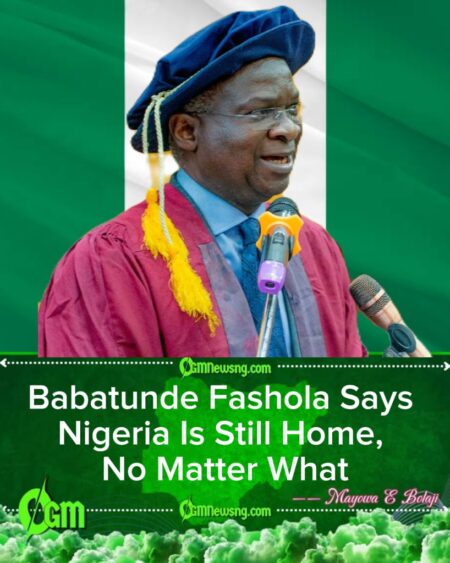
Babatunde Raji Fashola (SAN), former Minister of Works, Power and Housing, has sparked widespread public debate after bluntly declaring himself an “arrogant Nigerian” with no interest in dual citizenship. The statement, delivered with characteristic candour, has reignited national conversations around patriotism, identity, and elite migration.
Fashola’s remark comes at a time when issues of brain drain, foreign citizenship, and national loyalty dominate public discourse. His words stood out not just for their content but for their unapologetic tone, resonating strongly across social and traditional media platforms.
Supporters have praised the statement as refreshing honesty, while critics argue it oversimplifies complex socio-economic realities. Regardless of opinion, the declaration has placed Fashola firmly at the centre of a renewed debate about what it means to believe in Nigeria.
Fashola’s Patriotism and Rejection of Dual Citizenship
Fashola stated clearly that he does not hold, nor seek, citizenship of any other country besides Nigeria. He described his stance as “arrogant” in the sense of being unapologetically confident in his Nigerian identity, regardless of the country’s challenges.
According to him, national progress cannot be achieved if those privileged with influence and opportunity mentally relocate elsewhere.
He argued that true leadership requires staying committed to fixing problems at home rather than securing escape routes abroad.
Fashola’s position contrasts sharply with a growing trend among political elites and professionals who quietly acquire second passports. His declaration has therefore been interpreted by many as a direct moral challenge to Nigeria’s ruling and professional class.
Public Reaction and National Debate on Identity
The former Lagos State governor’s comments have triggered intense reactions nationwide. Many Nigerians applauded the boldness of his stance, describing it as rare political sincerity in a climate where national pride is often privately abandoned.
Others, however, questioned whether patriotism should be framed as a badge of superiority. Critics argue that holding dual citizenship does not automatically translate to disloyalty and that systemic failures often push citizens to seek security elsewhere.
The debate has since expanded beyond Fashola himself, evolving into a broader national conversation about governance, trust in institutions, and whether love for country must necessarily exclude practical self-preservation.
Broader Implications for Leadership and National Confidence
Political analysts note that Fashola’s comment touches a sensitive nerve in Nigeria’s leadership culture. At a time when many citizens feel abandoned by the state, declarations of unwavering national loyalty from public figures carry symbolic weight.
The statement also raises questions about leadership by example. Observers argue that when leaders publicly commit to Nigeria without alternatives, it sends a strong signal of confidence in the country’s future and institutions.
Whether seen as principled patriotism or provocative rhetoric, Fashola’s declaration has succeeded in shifting attention back to national responsibility. It underscores a lingering question for Nigeria’s elite: can the country truly be fixed by those already planning their exit?
Table of Contents
Discover more from OGM News NG
Subscribe to get the latest posts sent to your email.