


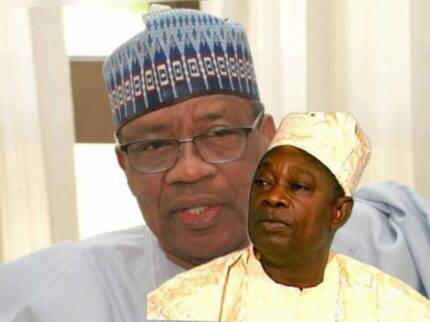
Former Nigerian military Head of State, General Ibrahim Babangida (retd.), on Thursday, expressed regret over the annulment of the June 12, 1993, presidential election. He admitted that the poll, widely regarded as Nigeria’s freest and fairest, was won by the Social Democratic Party (SDP) candidate, Chief Moshood Kashimawo Olawale (MKO) Abiola.
Babangida’s admission was made in the concluding section of the 12th chapter of his autobiography, A Journey In Service, launched in Abuja. He described the annulment as an “accident of history” and acknowledged that credible elections were conducted but not finalized. According to him, after reviewing the original election results, it was evident that Abiola met all constitutional requirements for victory, securing 8,128,720 votes against National Republican Convention (NRC) candidate Bashir Tofa’s 5,848,247 votes.
Despite this admission, Babangida justified the annulment by stating that powerful forces were against Abiola’s presidency. “Unfortunately, the forces gathered against him after the June 12 elections were so formidable that I was convinced that if he became President, he would be quickly eliminated by the same very forces who pretended to be his friends,” he claimed.
Political Leaders and Groups React to Babangida’s Remorse
Babangida’s admission triggered mixed reactions from various political leaders, pro-democracy groups, and citizens. While some dismissed his statement as belated and insufficient, others commended him for finally acknowledging the truth.
The pan-Yoruba socio-political group, Afenifere, dismissed Babangida’s regret, calling it long overdue. In a statement by its Organising Secretary, Kole Omololu, Afenifere insisted that his acknowledgment did not absolve him of the “monumental betrayal inflicted upon the nation.” The group argued that the annulment led to the persecution and assassination of pro-democracy figures, including Kudirat Abiola and Alfred Rewane, and set Nigeria’s democratic progress back by years.
Former Ogun State Governor, Chief Segun Osoba, also criticized Babangida’s remarks, stating that acknowledging the truth three decades later did little to undo the harm caused. Similarly, human rights lawyer Mike Ozekhome (SAN) argued that Babangida’s justification of national security concerns was weak, as the annulment plunged the nation into chaos rather than preventing instability.
Silence from Abiola’s Family Amid Public Debate
While Babangida’s admission sparked a flurry of reactions across Nigeria’s political and civil society circles, the Abiola family remained silent. Efforts to obtain comments from Abiola’s children, including Hafsat Abiola-Costello, proved unsuccessful, as they declined to respond to calls and messages.
This silence has been interpreted in different ways. Some believe the Abiola family has moved on from the tragic events, while others speculate that they might still be dissatisfied with how the Nigerian government has handled the legacy of June 12. Despite former President Muhammadu Buhari’s 2018 declaration of June 12 as Nigeria’s Democracy Day and the posthumous award of Grand Commander of the Federal Republic (GCFR) to Abiola, some activists argue that full justice has yet to be served.
The June 12 election is considered a watershed moment in Nigeria’s political history, as it represented a significant step toward democracy before being derailed. Many Nigerians continue to view Abiola as the rightful winner whose mandate was stolen.
IBB’s Leadership and Controversies Highlighted in New Book
Babangida’s autobiography also revisits other controversial moments in Nigerian history, including the 1976 coup that led to the assassination of General Murtala Muhammed and the 1986 letter bomb that killed investigative journalist Dele Giwa.
Denying involvement in Giwa’s death, Babangida expressed hope that the truth would eventually emerge. He recalled how former President Olusegun Obasanjo’s administration reopened the case at the Oputa Panel but failed to produce new evidence. “Like all mysterious murders, the Giwa case remains unsolved. I keep hoping it will be uncovered in our lifetime or after us,” he said.
The book launch, which doubled as a fundraiser for the proposed IBB Presidential Library, attracted prominent leaders, including former Vice President Yemi Osinbajo, former Ghanaian President Nana Akufo-Addo, and President Bola Tinubu. Tinubu praised Babangida’s role in Nigeria’s history but reminded leaders of their responsibility to make difficult decisions in the national interest.
Calls for National Reconciliation and Justice for June 12
In the wake of Babangida’s confession, fresh calls have emerged for the Nigerian government to take further steps in addressing the injustices of June 12. Afenifere reiterated its demand for full posthumous presidential recognition for Abiola, while other activists called for reparations to families affected by the struggle for democracy.
The Coalition of Northern Groups (CNG) took a different stance, praising Babangida for having the courage to admit his mistake. In a statement, the CNG noted that acknowledging errors is a critical step toward healing national wounds and fostering reconciliation.
As the debate continues, Babangida’s admission serves as a reminder of Nigeria’s turbulent journey to democracy. While his remorse may not undo the past, it reinforces the enduring significance of June 12 in the country’s collective memory.
Table of Contents
Discover more from OGM News NG
Subscribe to get the latest posts sent to your email.