







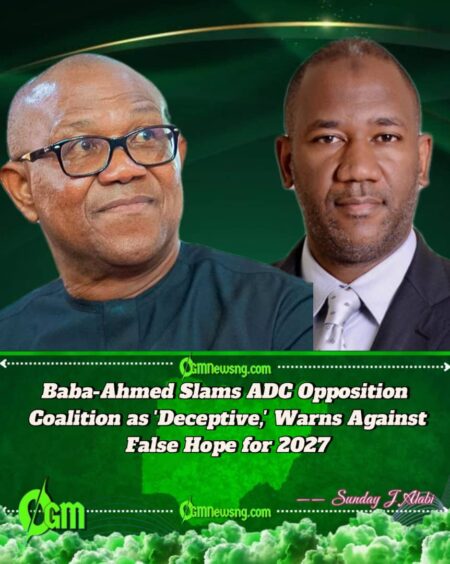
“Datti Baba-Ahmed Reaffirms Loyalty to Peter Obi, Urges Return to Labour Party for 2027 Presidential Bid” ::Former Labour Party vice-presidential candidate Datti Baba-Ahmed has strongly criticized the opposition coalition formed under the African Democratic Congress (ADC) platform, describing it as a deceptive scheme that cannot deliver Nigeria from underdevelopment. In a candid television interview, Baba-Ahmed reaffirmed his commitment to Peter Obi and expressed his desire for the former Anambra governor to remain within the Labour Party for the 2027 presidential race.
ADC Coalition Politics Under Fire: Baba-Ahmed’s Scathing Assessment
Datti Baba-Ahmed delivered a withering critique of the ADC-led opposition coalition during his appearance on Channels Television’s Politics Today programme on Friday, declaring unequivocally that “they are deceiving us.” The former banker and politician argued that the coalition lacks the genuine capacity to rescue Nigeria from what he termed “the cesspool of underdevelopment” that currently characterizes the nation’s political and economic landscape.
The criticism comes at a time when various opposition figures are exploring different coalition arrangements ahead of the 2027 elections, seeking to consolidate their strength against the ruling All Progressives Congress (APC). Baba-Ahmed’s pointed remarks suggest growing tensions within opposition circles about the most effective strategy for challenging President Bola Tinubu’s administration. His dismissal of the ADC coalition indicates a preference for more focused, ideologically aligned political partnerships rather than broad-based coalitions that may lack coherent policy frameworks.
The former LP vice-presidential candidate’s assessment reflects deeper concerns about the authenticity and commitment of political coalitions in Nigeria, where temporary alliances often dissolve under the weight of personal ambitions and conflicting interests. His skepticism toward the ADC platform appears rooted in a belief that meaningful political change requires more than just aggregating opposition forces—it demands genuine ideological coherence and shared vision for national transformation.
Unwavering Loyalty: The Obi-Baba-Ahmed Political Partnership
Despite Peter Obi’s apparent openness to working with members of the ADC coalition, including prominent figures such as former Senate President David Mark, ex-Vice President Atiku Abubakar, and former governors Nasir el-Rufai, Rotimi Amaechi, and Rauf Aregbesola, Baba-Ahmed remains steadfast in his loyalty to his former running mate. The former LP vice-presidential candidate made clear his preference for Obi to remain within the Labour Party structure, emphasizing the importance of maintaining their established political partnership.
“I’m in the Labour Party. I’m a Peter Obi man. I still want Peter Obi to come back to the Labour Party and contest the 2027 election,” Baba-Ahmed stated emphatically during the television interview. This declaration underscores the personal and political bond that developed between the two men during their 2023 presidential campaign, which, while unsuccessful in securing victory, managed to significantly disrupt Nigeria’s traditional two-party dominance and mobilized considerable youth support.
The relationship between Obi and Baba-Ahmed represents more than mere political convenience; it embodies a shared vision for Nigeria’s future that transcends party politics. Baba-Ahmed’s continued association with Obi, despite the latter’s apparent willingness to explore coalition possibilities, demonstrates a level of political loyalty that is increasingly rare in Nigerian politics, where politicians frequently switch allegiances based on perceived advantages.
2027 Electoral Ambitions: A Conditional Commitment to Service
When pressed about his own political ambitions for the 2027 election cycle, Baba-Ahmed provided a measured but telling response that reveals both his pragmatic approach to politics and his deep concerns about Nigeria’s electoral system. “If Nigeria is still around and there is an electoral system to follow. My love for Nigeria is undying, and I would appropriately associate the group and individuals that are like-minded to restore Nigeria,” he said, introducing an element of uncertainty about the country’s democratic trajectory.
This conditional framing of his political participation reflects broader concerns within opposition circles about the integrity of Nigeria’s electoral processes and the sustainability of democratic governance. Baba-Ahmed’s reference to Nigeria being “still around” suggests awareness of the various security, economic, and political challenges that could potentially threaten the country’s stability before the next electoral cycle. His mention of “an electoral system to follow” indicates skepticism about whether free and fair elections will be possible in 2027.
The former vice-presidential candidate’s approach to the 2027 elections appears to be guided by principles rather than mere political opportunism. His emphasis on associating with “like-minded” individuals focused on “restoring Nigeria” suggests that any political alliance he enters will be evaluated based on shared commitment to national transformation rather than electoral convenience. This principled stance distinguishes him from politicians who frequently change allegiances based solely on winning prospects.
The Obi Factor: Navigating Coalition Pressures and Party Loyalty
Peter Obi’s position within the current political landscape presents a complex challenge for both himself and his supporters like Baba-Ahmed. While the former Anambra governor has shown interest in engaging with various opposition figures through the ADC coalition, his core supporters, including Baba-Ahmed, prefer that he maintain his independence within the Labour Party structure. This tension reflects the broader challenge facing opposition politicians who must balance the desire for broader coalitions with the need to maintain ideological coherence.
Baba-Ahmed’s revelation that he would be willing to serve as running mate to only two individuals—with Obi being the openly acknowledged candidate—demonstrates his selective approach to political partnerships. “The first one has not said anything. The second one is Peter Obi. I’m always with Peter Obi until he decides not to,” he stated, maintaining both mystery about the unnamed candidate and absolute clarity about his commitment to Obi. This approach suggests that Baba-Ahmed’s political calculations are based on personal trust and shared vision rather than party affiliation alone.
The dynamic between Obi and Baba-Ahmed also reflects the evolving nature of Nigerian opposition politics, where personal relationships and ideological alignment often matter more than formal party structures. Their partnership, forged during the intense campaign period of 2023, appears to have created bonds that transcend immediate political calculations. However, the pressure of coalition politics and the practical requirements of mounting a successful presidential campaign in 2027 may test the durability of this relationship.
Implications for Nigeria’s Political Landscape: Opposition Strategy and Democratic Consolidation
Baba-Ahmed’s statements have significant implications for Nigeria’s evolving political landscape, particularly regarding opposition strategy and the potential for democratic consolidation. His criticism of the ADC coalition and preference for Labour Party-based politics suggests that the opposition may remain fragmented heading into 2027, potentially benefiting the ruling APC. However, his principled stance also indicates that any opposition alliance that does emerge may be more ideologically coherent and focused on genuine governance issues rather than mere power acquisition.
The former vice-presidential candidate’s conditional approach to political participation also highlights the fragility of Nigeria’s democratic institutions and processes. His concerns about whether Nigeria will “still be around” and whether there will be “an electoral system to follow” reflect deeper anxieties about democratic backsliding and institutional decay. These concerns are shared by many Nigerians who have witnessed increasing challenges to democratic governance, including security threats, economic instability, and questions about electoral integrity.
Looking toward 2027, Baba-Ahmed’s positioning suggests that the election may feature multiple opposition candidates rather than a unified challenge to the APC. While this could theoretically weaken opposition chances, it may also provide voters with clearer ideological choices and force all parties to articulate more coherent policy platforms. The success of any opposition strategy will ultimately depend on the ability of leaders like Obi and Baba-Ahmed to maintain their principled approach while building sufficient electoral coalitions to challenge the ruling party effectively.
Discover more from OGM News NG
Subscribe to get the latest posts sent to your email.