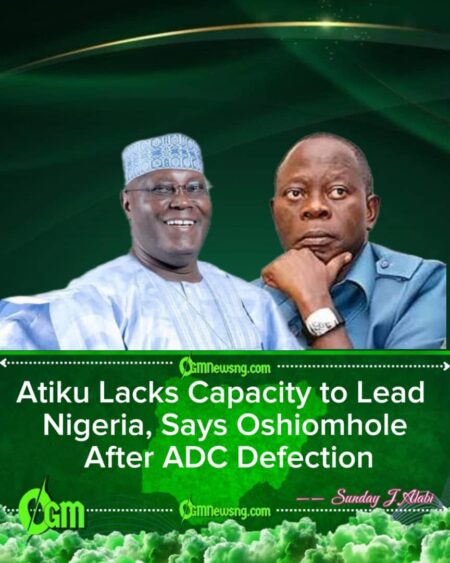
Senator Adams Oshiomhole, former National Chairman of the All Progressives Congress (APC) and current lawmaker representing Edo North, has argued that former Vice President Atiku Abubakar lacks the political capacity required to govern Nigeria. Speaking during an interview on Channels Television’s Politics Today, Oshiomhole stated that Atiku’s inability to stabilise or strengthen the Peoples Democratic Party (PDP) — a party that once made him vice president — raises questions about his claim that he can fix Nigeria.
Oshiomhole Questions Atiku Abubakar’s Leadership Capacity
Oshiomhole criticised Atiku Abubakar’s long political journey, noting that despite his considerable influence within the PDP, he failed to provide cohesion or direction during the party’s prolonged internal struggles. According to him, Atiku’s record within his former party does not support his public assurances that he can restore order and development at the national level.
He questioned how a politician unable to “reconstruct” the PDP could take on the complex task of managing a diverse country like Nigeria. Oshiomhole maintained that political leadership begins within one’s party, and Atiku’s alleged shortcomings at that level imply a broader deficiency in governance capacity.
The Edo North senator stressed that leadership requires consistency and organisational strength — qualities he claimed Atiku did not demonstrate during his time in the PDP.
Defection to ADC and Renewed Political Debate
Oshiomhole’s remarks came shortly after Atiku formally joined the African Democratic Congress (ADC), a coalition-backed party he is expected to work with ahead of the 2027 general elections. Atiku publicly confirmed his new affiliation by posting a photo of himself on X, raising his ADC membership card with the caption, “It’s official.”
Reacting to this development, Oshiomhole recalled Atiku’s exit from the APC years earlier, asserting that the former vice president left primarily because he failed to clinch the ruling party’s presidential ticket. He argued that Atiku’s frequent shifts between parties show a pattern driven by personal ambition rather than institutional development.
The senator added that Atiku’s resignation from the PDP in July, following extended internal tensions, further underscores his inability to stabilise a political organisation — a factor he insists should inform Nigerians’ evaluation of Atiku’s 2027 aspirations.
Political Implications Ahead of 2027
Atiku Abubakar’s alignment with the ADC introduces a new dimension to pre-election politics, potentially reshaping alliances and strategies among opposition blocs. His decision has triggered renewed debate within political circles, with critics like Oshiomhole casting doubt on his national leadership credentials.
As Nigeria approaches another electoral cycle, the exchange reflects deeper conversations about party ideology, political consistency, and the qualities required to lead Africa’s most populous nation.
Table of Contents
Discover more from OGM News NG
Subscribe to get the latest posts sent to your email.