






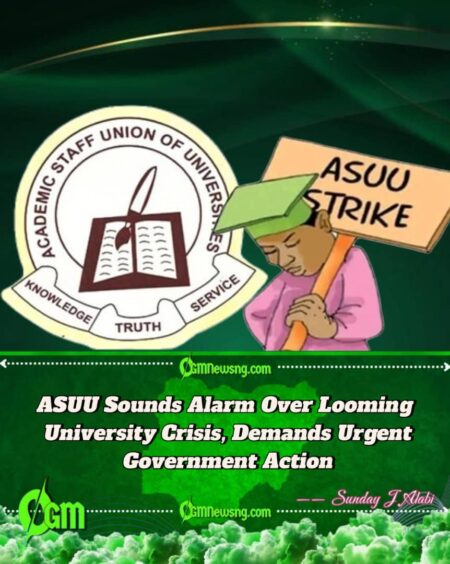
The Academic Staff Union of Universities (ASUU) has issued a stern warning to both Federal and State Governments, calling for urgent intervention to avert what it describes as an “impending industrial crisis” in Nigeria’s public universities.
In a press release signed by its president, Christopher Piwuna, the union decried years of neglect, inadequate funding, and unfulfilled agreements that have left lecturers “forgotten, shamed, and demoralised.” The ASUU leader noted that members across the country continue to endure poor welfare conditions, with many forced to teach on empty stomachs while struggling to conduct research without access to essential resources such as academic journals, books, chemicals, and reagents.
Piwuna also criticised the prevailing narrative that universities are producing unemployable graduates, insisting such criticism is unfair given the dire circumstances under which lecturers operate. “Past and present governments have failed to create an enabling environment for quality teaching and research, yet they blame the very institutions they neglect,” he said.
Minister’s Optimism Meets ASUU’s Skepticism
The union’s warning follows a recent declaration by the Minister of Education, Dr. Tunji Alausa, who stated that “not again ever in this country will ASUU or tertiary institutions… go on strike,” assuring that dialogue and fulfilling union demands would prevent future disruptions.
While acknowledging the minister’s optimism, ASUU insisted that the government must match its words with concrete action. “Dialogue is important, but without genuine commitment to resolving outstanding issues, optimism will be meaningless,” the statement read.
The union emphasised that repeated government pledges have often been followed by inaction, leaving unresolved the critical welfare, funding, and infrastructural gaps in the Nigerian University System. ASUU warned that if these shortcomings are not addressed promptly, the country could witness yet another prolonged shutdown of academic activities.
Unfulfilled Agreements and Tokenistic Governance
Central to ASUU’s grievances is the government’s failure to honour the renegotiation of the 2009 FGN-ASUU Agreement. Piwuna accused government agents at both state and federal levels of cherry-picking aspects of the agreement to renegotiate or implement, abandoning the underlying principles of collective bargaining.
“For over eight years, we have been kept talking over the renegotiation of the 2009 Agreement. Governments have piled up Memoranda of Understanding and Memoranda of Action from 2013, 2017, 2019, and 2020, yet these documents have done nothing to improve staff welfare or the academic environment,” he lamented.
The ASUU president further condemned what he described as hypocritical government initiatives such as the “Diaspora Bridge,” which, in his view, treat academics seeking better working conditions as volunteers rather than professionals deserving of decent work environments and fair pay.
Political Interference in University Governance
Beyond funding and welfare issues, ASUU also raised concerns about political interference in the governance of public universities. The union cited the recent controversy surrounding the Acting Vice Chancellor of Alvan Ikoku University of Education, alleging that the appointment process was fraught with contradictions and lacked transparency.
ASUU stressed that such political meddling undermines meritocracy and erodes public trust in the higher education system. It called on government authorities to ensure that leadership appointments in universities are conducted in line with established laws and traditions, free from undue political influence.
The union argued that stable, transparent, and merit-based governance is critical to maintaining the integrity and academic excellence of Nigeria’s public universities.
A Call for Immediate Action to Prevent Strike
Reiterating its commitment to dialogue, ASUU nonetheless urged Nigerian leaders and stakeholders to move beyond discussions and take decisive action. “No memorandum or ‘discussion’ can take the place of a Collective Bargaining Agreement that fully addresses staff welfare issues and the requisite environment for productive academic work,” Piwuna stated.
The union called on “all genuine patriots” to prevail upon the Federal and State Governments to urgently address the lingering labour disputes in the university system. Failure to act, ASUU warned, would almost certainly lead to another round of industrial action—an outcome that would further disrupt the academic calendar and harm students’ futures.
“The time to act is now,” the union concluded, stressing that Nigerian academics are tired of repeated excuses that have done little to improve their working conditions or restore dignity to the country’s higher education sector
Table of Contents
Discover more from OGM News NG
Subscribe to get the latest posts sent to your email.