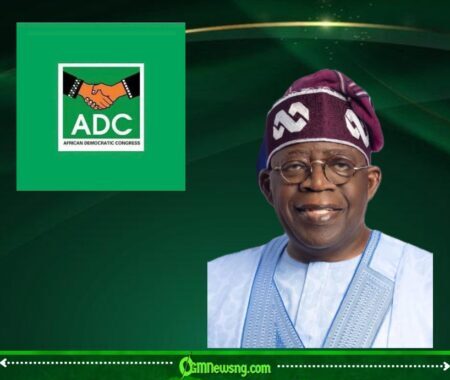







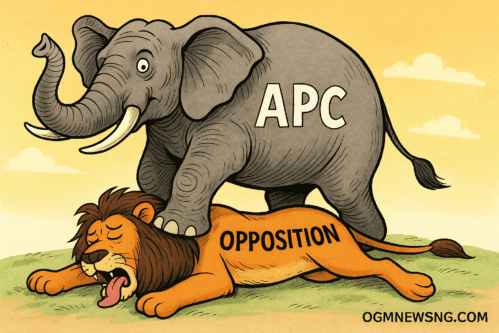
APC Smells Blood — In a clear display of political dominance, the All Progressives Congress (APC) is charging ahead toward 2027, emboldened by the disintegration of Nigeria’s major opposition parties. At a symbolic dinner hosted by the Progressive Governors’ Forum in March 2025, Senate President Godswill Akpabio openly threw his weight behind President Bola Tinubu’s re-election bid. The event, which combined Iftar and Lenten observances, offered a dramatic stage for APC’s assertion of unity and electoral confidence.
With Tinubu now officially declared the party’s sole candidate for 2027 and major opposition parties engulfed in internal warfare, APC is consolidating power with little visible resistance. The party’s strategic maneuvers and calculated messaging have exposed the deep cracks in the opposition, raising serious concerns about the future of competitive democracy in Nigeria.
APC Smells Blood And Strengthens Projects Strength: One Voice, One Candidate
APC Smells Blood — During the Progressive Governors’ Forum’s special Iftar/Lenten dinner, Senate President Godswill Akpabio’s remarks left little doubt about the APC’s game plan. “We will offer prayers for our party, that yes, indeed, victory shall be ours in 2027,” he declared confidently, calling for unity among party ranks to secure President Tinubu’s return to Aso Rock.
This public show of solidarity was not an isolated gesture. Just weeks later, at a high-profile summit in Abuja marking Tinubu’s two-year anniversary in office, APC National Chairman Abdullahi Ganduje officially endorsed Tinubu as the party’s sole candidate. Ganduje credited Tinubu’s economic reforms for Nigeria’s gradual fiscal recovery and underscored the need for continuity.
What is evident is a deliberate effort by the APC to eliminate internal dissent and project an image of cohesion—especially in contrast to the fractured state of their rivals.
APC Smells Blood as PDP Gears in Freefall of Factionalism, Feuds, and Fatigue
APC Smells Blood — Nigeria’s main opposition, the People’s Democratic Party (PDP), is embroiled in a prolonged identity crisis. The bitter fallout from the 2023 presidential primaries has split the party into warring factions. The feud between Nyesom Wike and Atiku Abubakar continues to be a political cancer, with Wike now a minister in Tinubu’s cabinet—a move that many in the PDP consider betrayal.
The G-5 Governors—once a power bloc within the PDP—remain unreconciled and unmoved by calls for party unity. Their defiance, rooted in regional interests and personal grievances, has further diluted the PDP’s national relevance.
Meanwhile, the leadership vacuum persists. With Iyorchia Ayu suspended and no consensus on a credible replacement, the party has been left rudderless. The absence of charismatic and strategic leadership has crippled its rebranding efforts and stalled grassroots mobilization. The PDP, once Nigeria’s dominant party, is now a house divided and politically adrift.
Labour Party’s Post-Obi Hangover
APC Smells Blood — The Labour Party (LP), which surged to prominence during the 2023 elections under Peter Obi, is now a textbook case of post-electoral collapse. A fierce power tussle between Julius Abure and Lamidi Apapa has split the party in two, leading to competing conventions, lawsuits, and accusations of financial misconduct.
The party’s failure to build enduring political structures beyond Obi’s personality cult has left it vulnerable. Unlike the APC and even the fragmented PDP, the LP lacks a national footprint, strategic alliances, or institutional depth. Its presence across Nigeria’s 36 states remains skeletal at best.
Equally concerning is the waning enthusiasm of the #Obidient movement, once hailed as a generational political awakening. Frustrated by internal chaos and disillusioned by the political system, many young supporters have disengaged, weakening what was once the LP’s most potent asset.
APC’s Calculated Advance: Exploiting Every Weakness
APC Smells Blood — In stark contrast to the flailing opposition, the APC has refined its playbook. Its communication strategy paints the party as the only stable and nationally viable option, reinforcing the idea of inevitability around Tinubu’s second term.
The ruling party has also been strategic in poaching key figures from rival parties. Wike’s appointment was not an accident but a masterstroke of co-optation. Several PDP lawmakers and LP sympathizers have also quietly shifted loyalties, further blurring the lines of opposition identity and purpose.
Moreover, APC’s control of political machinery—governorships, state assemblies, and access to federal resources—grants it a significant structural advantage. Its regional alliances in the North and Southwest remain robust, ensuring a wide electoral base.
Denials and Distractions: The Akpabio-El-Rufai Rumors
APC Smells Blood — Amid rising speculations about a possible Akpabio/El-Rufai 2027 ticket, the Senate President’s office has issued a firm denial. A statement from his Special Adviser on Media and Publicity labeled the viral campaign posters as “the handiwork of mischief makers.”
This move appeared designed to shut down distractions and refocus public attention on Akpabio’s loyalty to Tinubu. The Senate President has continued to publicly express support for the administration, reiterating that his role is to strengthen legislative backing for the president—not to prepare for a personal bid.
By swiftly squashing rumors, APC is demonstrating internal discipline—something both PDP and LP sorely lack.
A One-Horse Race in the Making?
APC Smells Blood — With the opposition in utter disarray, the APC is scripting what could be a near-uncontested race for 2027. The PDP is paralyzed by infighting and leadership voids, while the LP is trapped in internal squabbles and an existential crisis. APC’s moves are not just political—they are psychological, projecting power while demoralizing opposition ranks.
Unless Nigeria’s opposition forces urgently regroup, reconcile, and re-strategize, the 2027 elections may not be decided at the ballot box but in backrooms and defections. For now, the ruling party marches on, smelling blood and crushing what remains of a once-vibrant multiparty democracy.
Table of Contents
Discover more from OGM News NG
Subscribe to get the latest posts sent to your email.