




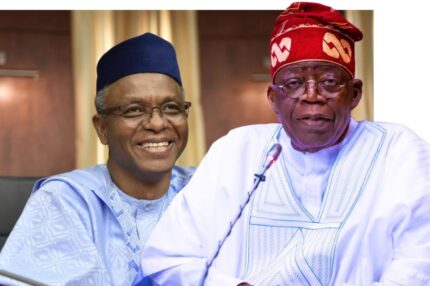
The former Governor of Kaduna State, Nasir El-Rufai’s, has set off a political firestorm within the All Progressives Congress (APC) as he actively engages with opposition figures ahead of the 2027 presidential election. Once a staunch ally of President Bola Tinubu, El-Rufai’s relationship with the APC leadership soured following his failure to secure a ministerial appointment.
Despite being nominated by President Tinubu, El-Rufai’s ministerial bid was rejected by the National Assembly on security grounds. In recent weeks, he has intensified his political maneuvering by meeting with key opposition figures, including the 2023 presidential candidate of the Peoples Democratic Party (PDP), Atiku Abubakar. The two politicians were recently seen together at a condolence visit to the family of Niger Delta elder statesman, Chief Edwin Clark, further fueling speculations about a possible alliance.
Adding to the intrigue, El-Rufai also attended a Juma’at prayer session with Atiku, reinforcing the perception of a growing political partnership. A day later, he met with the Kaduna State PDP executive committee, in what was widely interpreted as a potential defection move or, at the very least, an attempt to rally opposition against Tinubu’s re-election bid.
APC Condemns El-Rufai’s Actions, Labels Him an Ethnic Champion
The APC has strongly condemned El-Rufai’s political realignment, accusing him of playing an ethnic card to undermine Tinubu’s administration. The party’s National Secretary, Ajibola Basiru, dismissed the former governor as an “overrated ethnic champion” who seeks to pit northern politicians against their southern counterparts.
Basiru criticized El-Rufai’s growing criticisms of the APC, particularly his claims that the party lacks internal democracy. The former governor recently shared an opinion piece that warned of a potential northern backlash against Tinubu similar to the treatment meted out to former President Goodluck Jonathan in 2015. According to Basiru, El-Rufai’s grievances stem from his inability to secure a federal appointment rather than genuine concerns for Nigeria’s political stability.
The APC also reaffirmed its confidence in Tinubu’s leadership, insisting that his “Renewed Hope Agenda” is beginning to yield results. Basiru pointed to the recent strengthening of the naira and the slight reduction in fuel and food prices as indicators that the administration is on the right track. He dismissed El-Rufai’s recent activities, emphasizing that the APC remains strong and will not be distracted by political defections or alliances.
PDP Welcomes El-Rufai, Suggests Possible Collaboration
In contrast to the APC’s hostility, the PDP has responded warmly to El-Rufai’s overtures, signaling a willingness to work with him. The PDP’s National Publicity Secretary, Debo Ologunagba, acknowledged El-Rufai’s past experience in both parties and suggested that he now understands where true democracy thrives.
Ologunagba reiterated that the PDP remains open to any Nigerian who aligns with its principles of democracy, the rule of law, and national unity. While he did not confirm whether El-Rufai has formally indicated an interest in joining the party, he emphasized that the PDP welcomes all those who are dissatisfied with the APC’s governance.
The PDP spokesperson also took a swipe at the APC, stating that under its rule, Nigerians have suffered economic hardship, insecurity, and a lack of internal party cohesion. He positioned the PDP as the only political platform capable of rescuing Nigeria and restoring democratic values.
Implications for the 2027 Presidential Election
El-Rufai’s moves have significant implications for the 2027 election, particularly in northern Nigeria, where he retains considerable influence. If his criticisms of the APC resonate with northern voters, it could weaken Tinubu’s chances of securing re-election. Analysts believe that El-Rufai’s outreach to opposition figures, particularly Atiku, could signal an effort to form a formidable coalition against the ruling party.
The political realignment comes at a time when President Tinubu faces growing discontent within the APC, particularly among northern power brokers. The rejection of Abdullahi Adamu, a former APC National Chairman, and other influential northern politicians has fueled concerns that Tinubu’s support in the region is waning. El-Rufai’s recent meeting with Adamu further suggests an effort to consolidate disenchanted APC members ahead of the next election cycle.
What Next for El-Rufai?
Despite the APC’s public dismissal of El-Rufai’s actions, the former governor remains a significant political force in northern Nigeria. His history of strategic political positioning suggests that his recent moves are calculated and could lead to a major political shift in the coming years.
While he has not officially declared an intention to leave the APC, his frequent criticisms of the party and engagement with the opposition indicate a deepening rift. If he eventually defects to the PDP or forms a new coalition, it could pose a serious challenge to Tinubu’s 2027 aspirations.
As the political landscape continues to evolve, El-Rufai’s next moves will be closely watched, with potential consequences for both the APC and the broader Nigerian political arena.
Table of Contents
Discover more from OGM News NG
Subscribe to get the latest posts sent to your email.