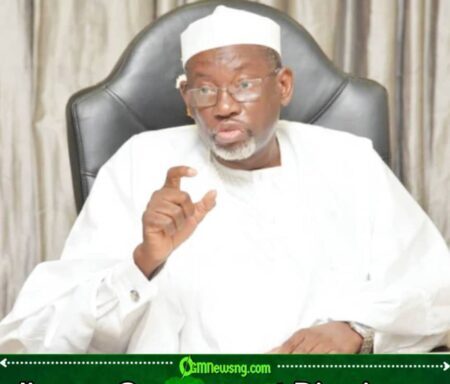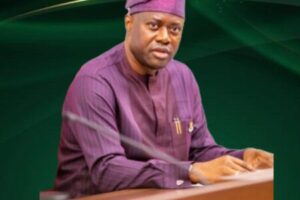





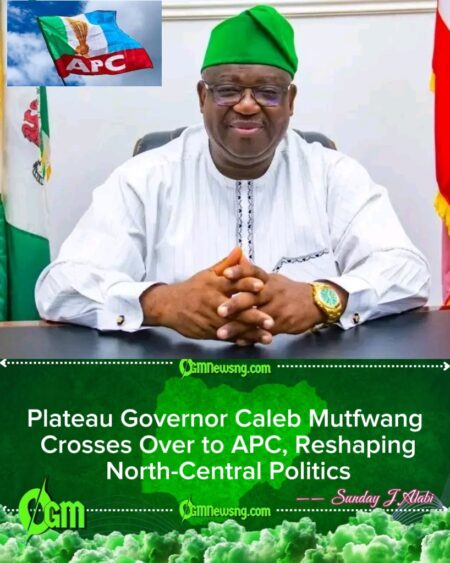
Plateau State Governor, Caleb Mutfwang, has formally defected from the Peoples Democratic Party (PDP) to the ruling All Progressives Congress (APC), a development that marks a significant shift in Nigeria’s political dynamics, particularly within the North-Central geopolitical zone. The move was officially announced on Thursday in Abuja and has since drawn national attention due to its wider political implications.
The defection, confirmed during the APC’s 14th National Caucus meeting at the State House Conference Centre, signals a major realignment in Plateau State politics, where the PDP has traditionally enjoyed strong grassroots support. With this development, the APC further consolidates its control across the North-Central region, reinforcing its dominance ahead of future electoral contests.
Defection Announced at APC National Caucus Meeting
The announcement of Governor Mutfwang’s defection was made by the National Chairman of the APC, Nentawe Yilwatda, while addressing party leaders at the high-level caucus meeting in Abuja. Mr Yilwatda, who is also a native of Plateau State, described the governor’s decision as a strategic milestone for the ruling party’s national expansion efforts.
According to the APC chairman, the governor’s entry into the party strengthens its organisational structure and enhances its electoral prospects, particularly in a region often regarded as politically competitive. He emphasised that the defection reflects the growing appeal of the APC across different parts of the country.
“With the defection of Governor Mutfwang, the entire North-Central region is now governed by the APC,” Mr Yilwatda stated, noting that the development represents a turning point for the party’s influence in the zone.
Implications for Plateau State and the North-Central Region
Governor Mutfwang’s move represents a significant political shift in Plateau State, a state where the PDP has historically maintained a firm grip on power. His defection is expected to alter local political alignments and could influence future electoral outcomes within the state.
Analysts note that the governor’s decision may reshape political loyalties at the grassroots level, particularly as the APC seeks to consolidate its position across the North-Central region. The development could also trigger further defections among political office holders and party stakeholders within the state.
Beyond Plateau State, the defection strengthens the APC’s narrative of national spread and cohesion, especially in regions that have traditionally alternated between major political parties. The ruling party is now better positioned to project itself as a truly nationwide political platform.
Part of a Broader Wave of Political Realignments
Governor Mutfwang’s defection adds to a growing list of high-profile political realignments to the APC in recent times. Other governors who have moved to the ruling party include Siminalayi Fubara of Rivers State, Peter Mbah of Enugu, Sheriff Oborevwori of Delta, Douye Diri of Bayelsa, Umo Eno of Akwa Ibom, and Agbu Kefas of Taraba.
Collectively, these defections have significantly boosted the APC’s national profile and political clout ahead of upcoming elections. Observers believe the trend underscores shifting political calculations among key actors as parties position themselves for future contests.
Although Governor Mutfwang is yet to publicly explain his reasons for leaving the PDP, political watchers widely interpret his decision as aligning with the APC’s growing influence and its stated agenda of political cohesion. Notably, Mr Yilwatda, who announced the defection, was Governor Mutfwang’s main opponent in the 2023 Plateau State governorship election.
Table of Contents
Discover more from OGM News NG
Subscribe to get the latest posts sent to your email.