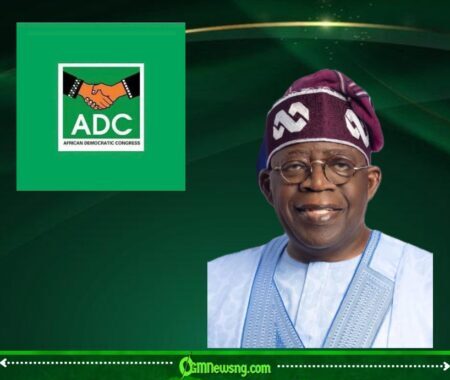






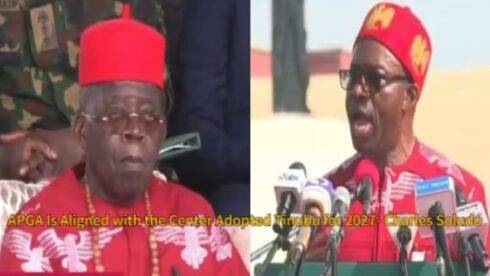
Governor Charles Soludo of Anambra State ignited political ripples nationwide on Thursday by announcing that the All Progressives Grand Alliance (APGA) has officially adopted President Bola Ahmed Tinubu as its candidate for the 2027 presidential election. According to Charles Soludo, “APGA is ideologically and strategically aligned with the center,” a statement that immediately stirred controversy across party lines and within APGA’s traditional base.
This unprecedented endorsement by a regional party known for its southeastern identity and opposition legacy has raised serious questions about party autonomy, internal democracy, and long-standing political values. Many political observers believe the move marks a tectonic shift in the alignment of Nigeria’s political chessboard, potentially fracturing opposition unity ahead of 2027.
APGA’s Legacy at Stake: From Ojukwu’s Dream to Tinubu’s Camp
Charles Soludo’s declaration places the legacy of Dim Chukwuemeka Odumegwu Ojukwu, APGA’s founding father, under intense scrutiny. APGA has historically stood as the voice of the Igbo people and a counterweight to the dominance of national parties. This pivot toward Tinubu, a southwestern political titan, is being interpreted by critics as a betrayal of the ideological foundation upon which APGA was built.
Internal party chieftains have expressed dismay, with some vowing to resist what they term a “forced realignment without consultation.” The ideological incongruity between APGA’s traditional grassroots nationalism and Tinubu’s All Progressives Congress (APC) neoliberal tendencies adds to the tension. Analysts say the endorsement could lead to a wave of defections and create factional crises within the party.
Strategic Alliance or Political Subjugation?
Charles Soludo defended the decision by framing it as a tactical move to ensure the Southeast is no longer marginalized in national politics. “We must negotiate our future from the center, not from the fringes,” he said, emphasizing pragmatism over sentimentalism. He argued that aligning with Tinubu ensures infrastructural development, economic integration, and federal appointments for the region.
However, critics contend that such a move amounts to political subjugation rather than strategic integration. They argue that surrendering APGA’s presidential ambition undermines the push for Igbo presidency and entrenches a unitary political culture. To them, the alliance with Tinubu is not collaboration but capitulation, with long-term consequences for regional identity and representation.
Grassroots Reactions: Betrayal or Bold Leadership?
Across Anambra and other southeastern states, the grassroots reaction to Charles Soludo’s statement has been polarized. Some see it as a betrayal of the Igbo cause and a deviation from APGA’s pro-Biafra-rooted ethos. “It’s a slap in the face of Ojukwu’s memory,” said a prominent youth leader in Awka, echoing the sentiments of disillusioned supporters who feel blindsided.
Yet, others hail Charles Soludo’s move as bold and forward-thinking. To this faction, the politics of isolation must end if the Southeast is to claim its place in Nigeria’s power structure. They argue that building alliances, even controversial ones, is essential for political relevance. These divergent views are setting the stage for a deep internal conflict within the party’s rank and file.
APC’s Reaction: Quiet Triumph or Calculated Silence?
The ruling APC has responded with muted enthusiasm, issuing only a terse statement acknowledging APGA’s endorsement. Sources within the Presidency suggest that Tinubu’s inner circle views the endorsement as a major political win, one that broadens his reach in the Southeast—a region where he performed poorly in 2023.
Nonetheless, the APC’s reluctance to fully embrace the endorsement signals caution. Analysts suggest that Tinubu may not wish to alienate existing allies or inflame internal rivalries by openly courting a party with conflicting ideologies. Moreover, integrating APGA support without disrupting APC’s internal balance will require deft political engineering.
What This Means for 2027: A New Electoral Equation?
With APGA’s surprising endorsement of President Tinubu, the 2027 presidential race could see a recalibration of electoral dynamics. APGA may no longer field its own presidential candidate, essentially reducing the number of opposition contenders and increasing Tinubu’s chances for re-election through a fragmented opposition front.
Charles Soludo’s announcement may also embolden other regional parties to seek alliances with the ruling party, potentially ushering in a new era of pan-national coalitions. However, this shift could dilute ideological clarity, leading to a politics of expediency rather than principle. As 2027 approaches, the enduring question remains: has APGA signed a masterstroke or its own political obituary?
Table of Contents
Discover more from OGM News NG
Subscribe to get the latest posts sent to your email.