







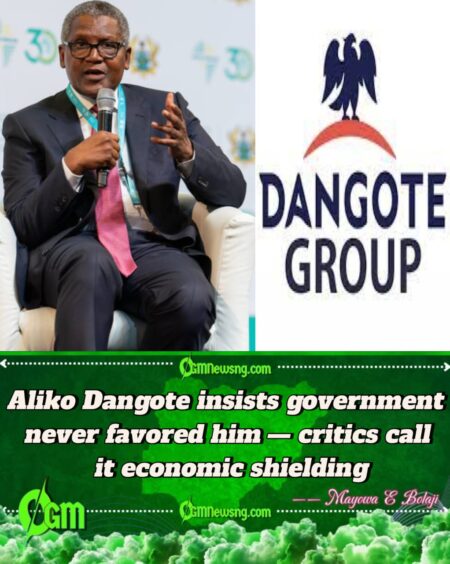
Aliko Dangote has pushed back against recurring claims that his conglomerate thrives on monopolistic control, insisting that what critics call monopoly is simply the result of strategic foresight and first-mover advantage. According to him, his empire was built through calculated risks and pioneering investments, not by shutting out competition.
The billionaire industrialist argued that labeling his success as monopoly is a lazy attempt to dismiss decades of consistent innovation, courage, and resilience. He maintained that his business empire continues to operate within the frameworks of Nigerian and global market regulations, emphasizing that market dominance does not equate to unfair play.
Cement and Sugar Wars Fuel the Debate
Aliko Dangote pointed out that the loudest accusations of monopoly often center around his cement and sugar businesses. These sectors, he explained, were long ignored by investors until his companies demonstrated their profitability and transformative impact on the Nigerian economy. He added that instead of joining the race, competitors chose to criticize his dominance.
Industry observers have argued that the sheer size of the Dangote Group creates an uneven playing field, making it nearly impossible for smaller players to compete. Aliko Dangote, however, insists that any serious investor willing to take risks, build infrastructure, and endure the initial pains of production could achieve similar results without blaming him for their failures.
Infrastructure as a Barrier or a Breakthrough?
Aliko Dangote stated that his decision to invest billions in building factories, ports, and energy infrastructure was not just for personal profit but to strengthen Nigeria’s industrial backbone. He noted that infrastructure is the biggest barrier to entry, and while critics see this as a shield for his empire, he views it as a necessity to even start competing at a global level.
Critics argue that while Aliko Dangote’s infrastructural footprint is commendable, it also serves as a chokehold on potential competitors who cannot raise similar capital. Some analysts believe this deepens the perception of monopoly, as only those with extraordinary resources can challenge the dominance of Dangote Group in multiple sectors.
Dangote Petroleum Refinery Sparks New Arguments
Aliko Dangote stressed that the launch of his multi-billion-dollar petroleum refinery is another example of bold initiative rather than monopoly ambition. He said the refinery was conceived at a time when Nigeria was bleeding foreign exchange on fuel imports and international oil giants had no interest in solving the crisis.
Opponents, however, claim the refinery has positioned Dangote as a gatekeeper of Nigeria’s fuel supply chain, giving him unprecedented leverage over the economy. The debate continues to polarize stakeholders, with some praising him as a nation-builder while others fear a dangerous concentration of power in one man’s hands.
Government Policies Under the Microscope
Aliko Dangote defended the notion that his companies are favored by government policies, insisting that the Nigerian state has not handed him any privileges unavailable to others. He argued that the Group’s growth has been sustained by reinvestment of profits, not political handouts.
Nonetheless, critics argue that subtle policy frameworks — from import restrictions to foreign exchange access — seem to tilt the market in his favor. Many see this as a symbiotic relationship where government leans on Dangote’s empire for stability, while he benefits from regulatory shields that inadvertently discourage healthy competition.
The Thin Line Between Legacy and Monopoly
Aliko Dangote concluded that history will judge him not as a monopolist but as a visionary who believed in Africa’s potential. He emphasized that his mission has always been to prove that Africans can build globally competitive companies without relying on imports or foreign corporations.
Yet, the controversy persists: is Dangote building an unshakable legacy or tightening a monopolistic grip on Nigeria’s economy? While his defenders hail him as a trailblazer, detractors fear his dominance may eventually stifle innovation and entrench dependency on a single conglomerate. The answer, it seems, lies in the balance between competition, regulation, and visionary enterprise.
Table of Contents
Discover more from OGM News NG
Subscribe to get the latest posts sent to your email.