




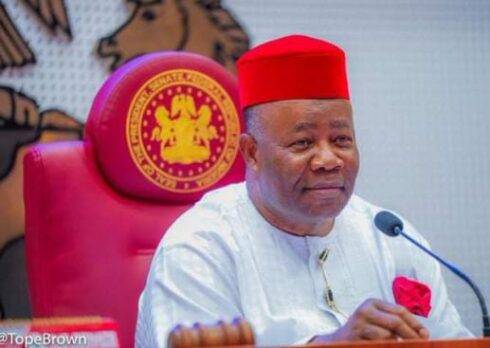
Senate President Godswill Akpabio has issued a strong caution to second-term governors against selecting their successors based on superficial displays of loyalty, such as kneeling or subservience. He urged leaders to prioritise vision and competence over patronage politics, warning that poor choices can lead to betrayal and failed leadership.
Akpabio Warns Against Patronage Politics in Succession Planning
Speaking on Saturday during the commissioning of the first 30 kilometres of the Lagos-Calabar Coastal Highway in the Lekki area of Lagos, Akpabio advised second-term governors, especially within the ruling All Progressives Congress (APC), to critically assess the readiness and vision of potential successors rather than rely on emotional loyalty or sycophantic gestures.
“We have a president who has both sight and vision,” Akpabio said, referring to President Bola Tinubu who was present at the event. “And this for me is something I must advise our governors, particularly those of them who are in their second term. Do not give power to anybody who is not looking for power. Don’t give power to anybody who is not prepared.”
In a clear critique of godfatherism, Akpabio described the risks of mistaking flattery for leadership potential. “Don’t go hiding in your heart that this boy is very subservient; he is always kneeling when he is talking to me, his wife is always rolling on the floor. If you do that, you are giving power to somebody who is not prepared for governance, and they will disappoint you.”
Event Graced by Key Figures, Visionary Message Echoed
The commissioning ceremony, a significant milestone in the Lagos-Calabar Coastal Highway project, was attended by high-profile dignitaries, including President Tinubu, Nobel Laureate Wole Soyinka, Minister of Finance Wale Edun, Minister of Works Dave Umahi, and several second-term governors such as Hope Uzodimma (Imo), Dapo Abiodun (Ogun), and Babajide Sanwo-Olu (Lagos).
Akpabio’s message came as a timely intervention in Nigeria’s political climate where outgoing governors often handpick successors with little regard for long-term governance goals. His warning, though diplomatically couched, appeared targeted at political players seeking to extend influence through pliable successors rather than statesmen.
“For the progressive governors, I believe that all of you are doing well because you are being led by a man who has both sight and vision,” Akpabio added, further emphasising the importance of foresight in governance at both federal and state levels.
The Dangers of Political Subservience Over Vision
Akpabio’s warning taps into a recurrent theme in Nigeria’s democracy—the culture of godfatherism. Many governors nearing the end of their constitutionally allowed two-term limit have historically attempted to install loyalists as successors. These loyalists are often selected not based on their capacity to lead, but because of perceived loyalty and willingness to obey their benefactor.
However, this model has yielded mixed outcomes. While some former governors have successfully entrenched loyalists in office, the political relationships often deteriorate, with successors eventually asserting independence or even turning against their predecessors. Such fallouts have led to political instability, policy reversals, and stalled development in several states.
Critics argue that this practice undermines democratic values and governance effectiveness. It promotes a system where leadership is transactional and rooted in patronage rather than merit, denying citizens the opportunity to be governed by competent and visionary individuals.
Reactions Trail Akpabio’s Bold Commentary
Political observers and analysts have praised Akpabio’s comments as courageous and timely. Dr. Aisha Bello, a political analyst based in Abuja, remarked that “this is one of the clearest indictments yet of the godfather syndrome that has gripped Nigerian politics. Akpabio is right—loyalty is no substitute for capacity.”
Others note that his remarks may ruffle feathers among governors and political kingmakers who see the power to anoint successors as a reward for loyalty and service. Yet, some insiders say Akpabio’s own experience as a former governor and political leader gives his warning added weight and credibility.
“The relationship between predecessors and successors is often riddled with unspoken expectations,” said Lagos-based commentator Femi Adebayo. “Akpabio is reminding governors that leadership is not about kneeling or flattery, but about the vision to serve and lead people.”
Call to Action for Progressive Leadership
As Nigeria continues to grapple with developmental challenges and evolving democratic practices, Akpabio’s remarks serve as a call to action for political elites to reconsider how leadership is transferred. The emphasis on vision, preparation, and competence is particularly urgent given the increasingly complex needs of Nigeria’s diverse states.
Akpabio’s comments also align with President Tinubu’s often-repeated mantra about governance being a serious task that requires foresight and technical know-how. By advocating for visionary succession, Akpabio positions himself as a voice of reform within the APC and the larger political sphere.
Whether or not his advice is heeded remains to be seen, but one thing is clear: the debate over how governors choose their successors—based on loyalty or leadership potential—is far from over. And with Nigeria’s future hanging in the balance, the stakes couldn’t be higher.
Table of Contents
Discover more from OGM News NG
Subscribe to get the latest posts sent to your email.