







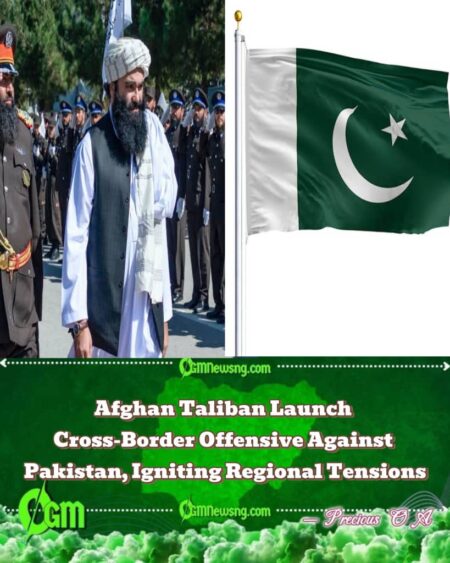
The Afghan Taliban, an Islamist militant and political movement that took full control of Afghanistan in 2021 after the withdrawal of U.S. forces, has launched a series of cross-border attacks on Pakistan. Emerging in the 1990s from religious seminaries in southern Afghanistan, the group enforces a strict interpretation of Islamic law and has been accused of harboring militants involved in regional conflicts. Now the ruling power in Kabul, the Afghan Taliban faces mounting pressure to assert dominance against perceived external threats — and Pakistan has become their latest target.
The Afghan Taliban reportedly stormed several Pakistani military outposts late Saturday night, focusing their assaults along the Durand Line near Kunar, Nangarhar, and Paktia provinces. According to Taliban sources, the operation was a “measured retaliation” for recent Pakistani drone and air strikes that allegedly targeted Afghan border towns. Witnesses described fierce firefights lasting several hours, with explosions lighting up the night sky and hundreds of residents fleeing to safer areas.
Pakistani security officials confirmed their forces responded with “proportionate firepower,” destroying Taliban installations and neutralizing “multiple hostile elements.” Military spokespersons warned that Pakistan “will not allow any violation of its territory,” accusing Kabul of deliberate provocation. Meanwhile, humanitarian agencies reported that border markets, transport routes, and medical outposts were shut down as civilians fled the escalating violence.
The Afghan Taliban leadership maintains that the attacks were defensive, claiming Pakistan had carried out unprovoked air raids inside Afghan territory earlier in the week. Tensions have been simmering for months, but this latest exchange marks the most severe confrontation since 2021. Analysts fear that if the situation continues to deteriorate, both sides may slide into a prolonged border conflict that could destabilize an already volatile region.
The border, which runs through harsh mountainous terrain, has long been disputed. Tribal loyalties straddle both sides, creating an environment where national boundaries blur and militant movements thrive. Experts say the current violence underscores not only a political rift but also deep-seated mistrust that has festered between the two neighbours since the Taliban’s return to power.
Escalation and Denial: Airstrikes, Retaliation, and the TTP Connection
The Afghan Taliban accused Pakistan of conducting recent air and drone strikes in Kabul, Paktika, and Khost provinces, killing civilians and damaging infrastructure. Pakistani officials have neither confirmed nor denied the operations but insisted they were targeting members of the Tehrik-e-Taliban Pakistan (TTP) — an outlawed militant faction that has orchestrated deadly attacks inside Pakistan.
Security sources suggest that the alleged strikes aimed at top TTP commanders, including the group’s elusive leader Noor Wali Mehsud. Two militants were reportedly killed in drone fire near Abdul Haq Square in Kabul, though Pakistan has remained silent on the incident. The Afghan Taliban condemned the actions as “aggression against Afghan sovereignty,” warning Islamabad that continued provocations would lead to “unavoidable consequences.”
For years, Islamabad has accused the Afghan Taliban of harboring the TTP and allowing its fighters to use Afghan territory as a base for cross-border terrorism. Kabul, however, rejects the claims, insisting that it does not interfere in Pakistan’s internal affairs. Despite denials, intelligence analysts confirm that the TTP and Afghan Taliban share ideological and tribal ties that make it difficult for the Kabul government to fully sever connections.
What began as isolated border incidents has now expanded into a multifront confrontation. The Afghan Taliban reportedly deployed elite units known as the “Badri 313” battalion to reinforce positions along the border. Pakistani forces, in turn, have increased aerial surveillance and artillery readiness across the northwestern frontier. Both sides insist their actions are defensive, yet each retaliatory strike deepens mistrust and heightens the risk of full-scale warfare.
Experts warn that the conflict is gradually evolving from covert proxy operations into direct military engagement. With both nations armed and entrenched, and no visible diplomatic dialogue, the potential for miscalculation remains dangerously high.
Global Reactions and the Looming Diplomatic Fallout
The Afghan Taliban’s cross-border campaign has triggered alarm in regional and global capitals. China, which has maintained strong ties with both Kabul and Islamabad, has urged restraint and offered to mediate. Beijing’s foreign ministry emphasized that “stability in Afghanistan and Pakistan is vital to regional peace.” India’s growing diplomatic contact with the Taliban government adds another layer of complexity, with Islamabad accusing New Delhi of exploiting the situation to gain strategic leverage in the region.
In Washington, President Trump’s administration has expressed concern over the escalating crisis. U.S. officials have called on both nations to exercise caution and engage in direct dialogue to prevent wider conflict. Analysts at the Pentagon warn that a deteriorating Afghan-Pakistani relationship could undermine counterterrorism efforts and create new safe havens for extremist groups across South Asia.
Economic repercussions are already unfolding. The Afghan Taliban have closed several key border crossings, halting trade and supply routes essential for both countries’ economies. Markets in Chaman and Torkham have fallen silent as traders flee the area. The humanitarian toll is rising, with aid agencies reporting shortages of food, fuel, and medicine in nearby towns. Thousands of families have fled from the conflict zone, many seeking refuge deeper inside Afghanistan or in Pakistan’s Khyber Pakhtunkhwa province.
Diplomatic observers believe the Afghan Taliban face a precarious balancing act — projecting strength to domestic supporters while avoiding total isolation from international partners. For Pakistan, the confrontation raises difficult questions about security, diplomacy, and control over militant groups operating within its borders.
The Afghan Taliban now stand at a crossroads. Continued military action may consolidate their nationalist image among Afghans but could also invite economic sanctions and deepen their global isolation. For Islamabad, striking too aggressively risks inflaming public opinion and provoking retaliation beyond the border.
With both sides entrenched and rhetoric hardening, the path to peace appears increasingly uncertain. What began as a border skirmish has morphed into a regional flashpoint, testing diplomatic patience, military limits, and the fragile stability of South Asia.
Table of Contents
Discover more from OGM News NG
Subscribe to get the latest posts sent to your email.