






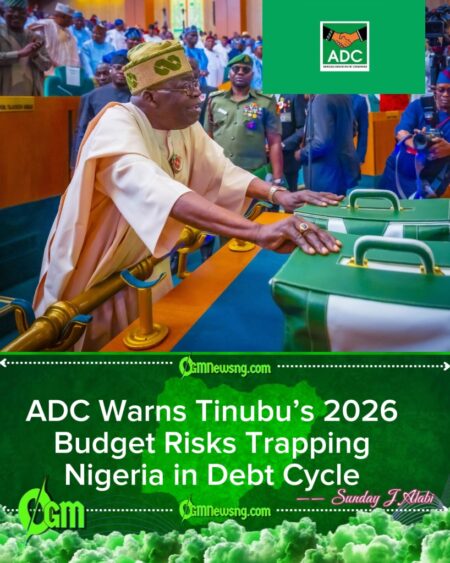
The African Democratic Congress (ADC) has sharply criticised President Bola Ahmed Tinubu’s 2026 budget proposal, describing it as a dangerous fiscal gamble that risks mortgaging Nigeria’s future and trapping the next generation under an unsustainable burden of debt. In a preliminary review of the proposal presented to the National Assembly, the opposition party warned that the budget reflects worsening fiscal recklessness, weak revenue credibility and a disturbing disregard for long-term economic stability.
According to the ADC, the budget—officially tagged a “Budget of Consolidation, Renewed Resilience and Shared Prosperity”—fails to address Nigeria’s structural fiscal problems and instead perpetuates what it called failed practices already evident in the 2024 and 2025 budgets. The party argued that, if approved, the proposal would deepen economic hardship rather than deliver the promised consolidation or shared prosperity.
ADC Faults Budget Philosophy and Fiscal Management
In a statement signed by its National Publicity Secretary, Mallam Bolaji Abdullahi, the ADC said the 2026 budget is merely a continuation of policies that have produced little tangible improvement in Nigeria’s public finances. The party accused the Tinubu administration of consolidating fiscal recklessness and “renewed wishful thinking,” rather than introducing credible reforms.
The ADC maintained that the repeated recycling of budget templates from previous years shows an inability to learn from past failures. It noted that both the 2024 and 2025 budgets suffered from poor implementation and credibility gaps, warning that the 2026 proposal is likely to meet a similar fate, with major components deferred or abandoned.
The party also criticised what it described as administrative chaos, pointing to the practice of operating multiple national budgets simultaneously. According to the ADC, managing three or more budgets at the same time reflects weak fiscal coordination and an unprecedented approach to public finance that undermines transparency and accountability.
Revenue Projections Branded Unrealistic
A major concern raised by the ADC centres on the revenue assumptions underpinning the 2026 budget. The party recalled that federal revenues rose to about ₦20 trillion in 2024 largely due to the effects of currency devaluation, before projections were doubled to ₦40 trillion for 2025 and increased further to ₦58.57 trillion in the 2026 proposal.
Describing these figures as unrealistic, the ADC said the projections are disconnected from Nigeria’s productive capacity and current economic realities. It warned that the artificial boost provided by naira devaluation has largely evaporated, making such ambitious revenue targets difficult to achieve.
The party also questioned the oil benchmark of $64 per barrel used in the budget, arguing that weakening oil demand and softening global prices render the assumption risky. According to the ADC, the proposed ₦34 trillion revenue target fails to account for alternative scenarios and relies on conditions that may no longer exist.
Deficit, Borrowing and Rising Debt Servicing
The ADC expressed particular alarm at the scale of the proposed deficit, noting that the government plans to borrow about ₦24 trillion against projected revenues of ₦34 trillion. It described this as an implicit admission of fiscal insolvency, arguing that a deficit-to-revenue ratio of about 70 per cent would be unacceptable in any functional fiscal system.
The party warned that such borrowing would further saddle future generations with heavy obligations, especially as much of the planned capital expenditure would be financed through debt. It said this approach effectively means that infrastructure projects and government spending are being funded by high-interest loans rather than sustainable revenues.
The review also highlighted the sharp rise in debt servicing costs, which the ADC said have increased from ₦12.63 trillion in 2024 to a projected ₦15.52 trillion in 2026. According to the party, no credible fiscal doctrine supports a strategy that combines persistently high deficits with rapidly escalating debt service payments.
Table of Contents
Discover more from OGM News NG
Subscribe to get the latest posts sent to your email.