









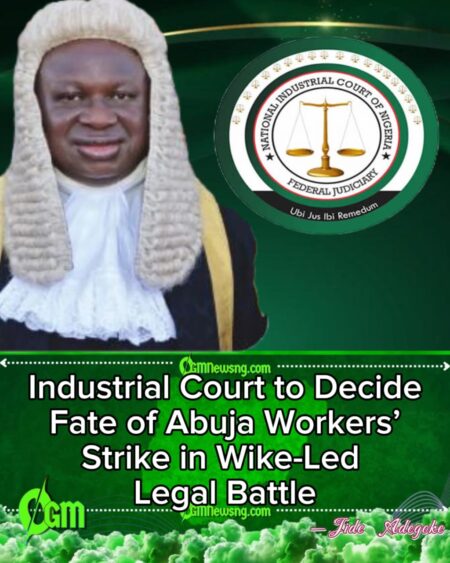
The National Industrial Court of Nigeria (NICN) is set to deliver a ruling in the legal dispute between the Minister of the Federal Capital Territory (FCT), Nyesom Wike, and a coalition of labour unions over the ongoing strike by workers in Abuja. The case, which has drawn national attention, centres on the minister’s suit challenging the legality of the joint union action that has disrupted key services across the nation’s capital. As anticipation builds ahead of the court’s decision, stakeholders from government, labour groups, and civil society are closely watching developments that could shape the future of industrial relations in the FCT.
The strike, declared by a coalition of unions representing various categories of workers in Abuja, was triggered by unresolved grievances relating to welfare, remuneration, and working conditions. The FCT Administration, led by Minister Wike, has maintained that the strike is unlawful and detrimental to public interest, prompting the legal challenge now before the Industrial Court.
Background to the Dispute
Tensions between the FCT Administration and labour unions escalated after negotiations over workers’ demands reportedly broke down. The unions accused the government of failing to honour prior agreements and of delaying the implementation of measures meant to improve staff welfare. In response, they initiated a joint strike action that led to partial shutdowns of some public offices and services within Abuja.
Minister Wike, however, contended that the strike violated established labour laws and procedures, arguing that the unions did not exhaust all statutory dispute-resolution mechanisms before embarking on industrial action. Through his legal representatives, he approached the National Industrial Court, seeking an order to restrain the unions from continuing the strike and to compel a return to work.
Proceedings at the National Industrial Court
During court proceedings, legal counsel to the FCT Administration argued that the strike posed a serious threat to governance and public service delivery in the capital territory. They maintained that essential services had been disrupted and that residents were bearing the brunt of the unions’ action. The minister’s team further submitted that the unions failed to comply with provisions of the Trade Disputes Act, which outlines steps to be taken before a lawful strike can be declared.
On their part, the unions defended their action as a last resort after prolonged engagement with the authorities yielded no meaningful results. Their counsel told the court that workers were exercising their constitutional right to protest unfair labour practices, stressing that the grievances were legitimate and long-standing. They urged the court to dismiss the minister’s suit and instead encourage renewed dialogue between the parties.
Implications and Next Steps
The ruling of the National Industrial Court is expected to have far-reaching implications for industrial relations in the FCT and beyond. If the court rules in favour of the FCT Administration, it could compel the unions to suspend the strike and return to negotiations under the supervision of the government and relevant labour agencies. Such an outcome may also set a precedent regarding the limits of joint union actions in the public sector.
Conversely, a ruling in favour of the unions could strengthen labour’s bargaining position and underscore the judiciary’s recognition of workers’ rights to collective action.
Observers note that, regardless of the outcome, both sides may still need to return to the negotiating table to prevent a recurrence of similar disputes in the future. For now, Abuja residents and public servants alike await the court’s decision, hoping it will pave the way forping resolution.
Table of Contents
Discover more from OGM News NG
Subscribe to get the latest posts sent to your email.