


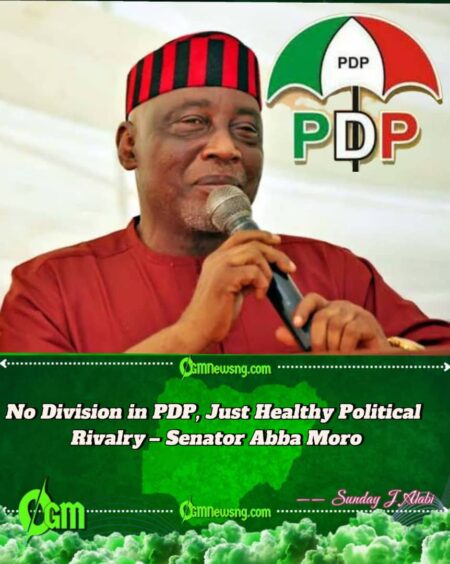
The Peoples Democratic Party (PDP), Nigeria’s main opposition force, has in recent months been embroiled in a series of internal disputes that have raised eyebrows among political observers. These challenges, largely stemming from competing political interests and power tussles among party stakeholders, have fuelled speculation about a possible breakdown in party cohesion ahead of the 2027 general elections.
While some analysts have interpreted the wrangling as a sign of deepening divisions, others believe it is a natural consequence of a large political organisation navigating leadership ambitions and strategic positioning. The stakes are high for the PDP, which hopes to reclaim power from the ruling All Progressives Congress (APC) in the next electoral cycle.
Amid the growing speculation, key figures in the party have stepped forward to clarify the nature of the disputes. One such voice is Senator Abba Moro, the Senate Minority Leader and representative of Benue South, who insists the disagreements are far from a formal split.
Abba Moro’s Clarification on PDP Leadership
Speaking on Arise Television’s Prime Time programme on Wednesday, Senator Moro categorically dismissed the notion that the PDP is experiencing a structural division. He argued that a genuine division, as defined within the context of Nigerian political practice and constitutional interpretation, would involve the existence of two parallel leaderships within the same party structure.
“There is no division in PDP. The problem in PDP is not a division in PDP,” Moro stated. “A division in a party that could lead someone to leave the party and join another in line with the constitution is where the leadership of the party is divided and there are two parallel leaderships. That is not our reality today.”
Drawing on historical precedent, Moro pointed to the 2013 emergence of the “New PDP,” which functioned with its own leadership and structures while claiming legitimacy as part of the PDP. “That was a division,” he explained. “Today’s disagreements are not of the same magnitude or nature.”
Contending Tendencies, Not Parallel Factions
For Moro, the current friction is better understood as the natural clash of political tendencies within a vibrant organisation. These tendencies, he said, represent competing ideas, strategies, and ambitions among party members, but do not amount to a constitutional or organisational rupture.
“There is no division in PDP; there are contending tendencies within the party. That’s not division,” he stressed. “The semblance of crisis, disagreement, or conflict among members does not constitute division.”
By framing the situation as a competition of interests rather than a battle between irreconcilable camps, Moro aimed to reassure party members and supporters that the PDP remains united in its fundamental structure and purpose. He maintained that such internal dynamics are common in political parties worldwide, especially those preparing for high-stakes elections.
Implications for PDP’s 2027 Election Strategy
Moro’s remarks come at a critical moment, as the PDP works to solidify its strategies ahead of 2027. The senator’s insistence on unity appears aimed at preventing defections, calming anxieties within the rank and file, and projecting stability to the Nigerian electorate.
Analysts note that public perceptions of party stability can influence voter confidence. Any sign of a real split could embolden rival parties and weaken the PDP’s negotiating power in potential alliances. Moro’s messaging, therefore, aligns with a broader effort to maintain a united public front, even as internal debates continue behind closed doors.
Despite his reassurances, some political watchers remain cautious, warning that if left unresolved, current tensions could escalate into the type of parallel leadership crisis Moro described. The coming months will likely reveal whether the PDP can reconcile its “contending tendencies” into a cohesive campaign machine.
A Call for Party Discipline and Focus
Beyond clarifying definitions, Moro’s intervention carries a subtle call to discipline among party members. He implied that the health of the Peoples Democratic Party will depend on the ability of its stakeholders to channel disagreements constructively, rather than allowing them to fester into factional wars.
In his view, the strength of the Peoples Democratic Party lies in its capacity to accommodate diverse opinions and ambitions while maintaining organisational integrity. As the party navigates its internal challenges, Moro’s emphasis on unity may serve both as a rallying cry and as a political strategy to keep the PDP competitive in Nigeria’s volatile political arena.
Whether his assurances will translate into actual harmony remains to be seen, but one thing is clear: with the 2027 elections drawing nearer, the Peoples Democratic Party can ill afford a repeat of past schisms that weakened its electoral chances.
Table of Contents
Discover more from OGM News NG
Subscribe to get the latest posts sent to your email.