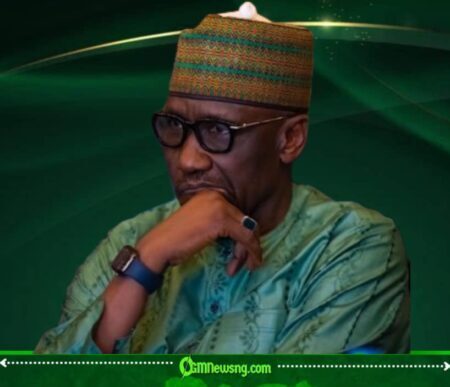





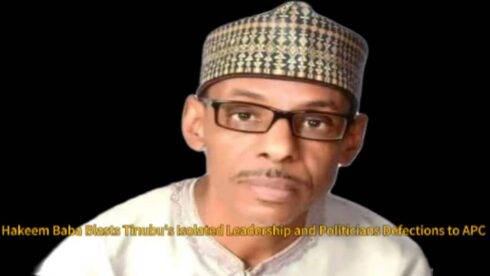
Hakeem Baba-Ahmed, a respected political analyst and public intellectual, has voiced concerns about President Bola Ahmed Tinubu’s governance style, suggesting a disturbing pattern of executive isolation. “I never had a chance to sit down with President Tinubu. The president is really genuinely isolated, whether by choice or by circumstances we don’t understand,” he declared. His words hint at a deeper dysfunction within Nigeria’s topmost leadership circle—one that may be undermining democratic accessibility and strategic collaboration at the highest levels of power.
This revelation strikes at the core of Nigeria’s political climate, where openness and stakeholder engagement are increasingly perceived as ceremonial rather than operational. Hakeem’s observations suggest a presidency ensconced in a bubble, shielded from genuine counsel and critical national discourse. For a country battling economic stagnation, social disintegration, and security nightmares, the image of a detached commander-in-chief portends grave implications for national cohesion and policy execution.
“Our Politicians Don’t Have Shame”—Hakeem Baba-Ahmed Lambasts Rampant Party Defections
In an unfiltered critique of Nigeria’s political elite, Hakeem Baba-Ahmed denounced the culture of indiscriminate party switching. “Our politicians don’t have shame. You leave this party today, and tomorrow you are moving to another one. If someone were to ask you what has changed, the only thing that has changed is your party; you are the same person,” he stated emphatically. This scathing commentary exposes the ideological vacuum and moral bankruptcy that characterize Nigeria’s political class.
The revolving-door politics have turned party loyalty into a strategic tool for personal gain rather than a commitment to values or national progress. Baba-Ahmed’s insight lays bare a decaying political system where public trust is traded for opportunistic alliances. His words come at a time when Nigeria is in dire need of principled leadership and ideological consistency—a commodity in short supply.
Hakeem Baba-Ahmed Dismisses Rumors of Joining the New Political Coalition
Amid rising speculation about a mega-coalition to challenge the ruling All Progressives Congress (APC) and Peoples Democratic Party (PDP), Hakeem Baba-Ahmed has made his stance unequivocally clear: he’s not joining. “At this stage, no, and I hope even in the future I doubt it. I have very serious misgivings about all this talk about coalitions and all this jumping from one place to another,” he said.
His refusal reflects a deep-seated skepticism about the integrity and sustainability of political coalitions in Nigeria. Baba-Ahmed sees such movements as band-aid solutions to systemic rot—unprincipled mergers that often lack coherent ideology and long-term vision. His viewpoint raises fundamental questions about whether any political coalition built on recycled politicians can offer real change.
Tinubu Presidency Faces Accusations of Internal Fractures—VP Shettima’s Position Questioned
There have been murmurs from inner circles alleging that Vice President Kashim Shettima is being systematically sidelined by the so-called “Tinubu clique” in Aso Rock. When questioned on this, Hakeem Baba-Ahmed swiftly dismissed the rumors: “No, I didn’t see any evidence of that. The personal chemistry between the president and the VP is excellent.”
Despite Hakeem’s dismissal, these claims reflect deeper suspicions within Nigeria’s fragmented leadership. The idea that the presidency may be split into factions is a symptom of internal distrust and unhealthy rivalries. While Hakeem’s remarks offer a diplomatic dismissal, the recurring nature of these reports hints at underlying tensions that could erupt if left unaddressed.
Governance Without Accountability: Is Tinubu’s Isolation a National Security Risk?
Hakeem Baba-Ahmed’s observation about the president’s isolation carries ominous undertones for national stability. A president cut off from dissenting voices and honest brokers risks falling into an echo chamber that distorts reality. In a country as fragile as Nigeria, this could translate into poor policy choices, disjointed security strategies, and escalating public discontent.
Tinubu’s alleged isolation may be fostering an imperial presidency—one that is guided more by the whims of an inner circle than by the pressing needs of over 200 million citizens. When national governance becomes insulated from transparency and public accountability, the consequences are usually tragic. Nigeria’s past is littered with examples of leaders who lost touch—and power—by refusing to engage beyond their comfort zones.
The Moral Void in Nigerian Politics: Can Integrity Still Win Elections?
Baba-Ahmed’s damning critique of political promiscuity in Nigeria highlights a sobering reality: the absence of ideological discipline and ethical commitment. The Nigerian voter, often left with no credible choices, is forced to pick between opportunists masquerading as reformers. “They change parties like shirts, but they remain the same—unprincipled and power-hungry,” he lamented.
This erosion of public faith in electoral politics is breeding apathy and cynicism, particularly among the youth. Yet, in this darkness, Baba-Ahmed’s stance offers a sliver of hope—a call to integrity, to principled resistance, and to a reimagining of Nigerian politics. The future may yet belong to those who refuse to compromise ethics on the altar of expedience.
Table of Contents
Discover more from OGM News NG
Subscribe to get the latest posts sent to your email.