





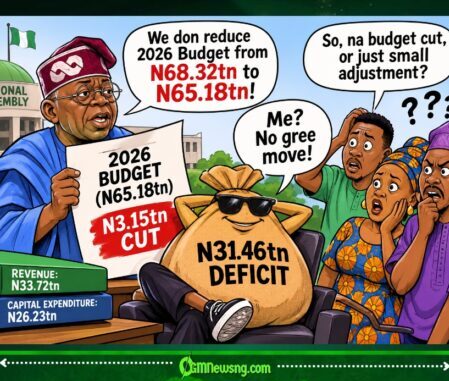
As Nigerians still dey hope for better economic condition, President Bola Ahmed Tinubu don introduce another major adjustment to Nigeria 2026 national budget. The President don send fresh bill go House of Representatives, asking lawmakers to cancel and bring out another version of the 2026 Appropriation Act, with government spending expected to drop from N68.32 trillion to N65.18 trillion. But as government dey prepare to remove more than N3 trillion from the budget, one financial matter refuse to change: the N31.46 trillion fiscal deficit. This development don raise serious questions about government spending, borrowing plans and how Nigeria wan manage its financial responsibilities. Government fit reduce budget figures, but the question be say, e go also reduce the pressure wey dey the country pocket?
BUDGET CUT: TINUBU SEEKS FRESH APPROVAL AS N3.15 TRILLION DISAPPEAR FROM SPENDING PLAN
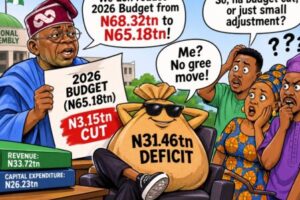
According to the information contained inside the President Tinubu letter, wey carry November 20, 2026 date and address to the Speaker of House of Representatives, Tajudeen Abbas, the proposed amendment na to adjust the existing 2026 budget and make provision for important government obligations. The letter enter public attention after dem read am during Tuesday, November 24, plenary. Under the new proposal, total government expenditure go reduce from approximately N68.32 trillion to N65.18 trillion. This adjustment represent about N3.15 trillion reduction. Government also project say e go generate N33.72 trillion revenue, including money wey government-owned companies go contribute, while capital expenditure go stand at N26.23 trillion.
President Tinubu explain say the adjustment go help government settle some existing financial responsibilities, including expenses wey Nigerian National Petroleum Company Limited (NNPCL) don make on behalf of the Federation, debt-service obligations wey no receive enough provision and refunds wey government suppose pay to Ministries, Departments and Agencies. The revised budget also make provision for important projects, including road construction, agricultural development, improvement of farm production and better access to markets.
In simple language, government dey try rearrange its financial priorities and make room for obligations wey need attention. However, Nigerians go still want know exactly which projects go benefit from this adjustment and whether some ongoing projects go experience reduction in funding. After all, when government remove billions and trillions from one side, people naturally go ask where the money suppose come out from and which area go feel the impact.
BUDGET CUT: N31.46 TRILLION DEFICIT AND N29.22 TRILLION BORROWING STILL REMAIN
One major part of this development wey deserve serious attention na the decision to maintain the N31.46 trillion fiscal deficit, even after government don propose to reduce its total expenditure. The revised deficit still represent approximately 5.64 per cent of Nigeria Gross Domestic Product (GDP). Government also maintain its planned new borrowing of about N29.22 trillion, with approximately N18.43 trillion expected from domestic borrowing and N10.79 trillion from foreign borrowing. The proposed external borrowing of $7.7 billion dey intended to finance the foreign borrowing provision already included in the financial plan. This means say even though government wan spend less money, the gap between expected revenue and expenditure still remain very large. Na here the financial mathematics begin give Nigerians serious homework!
To understand how Nigeria reach this point, e important to remember say Tinubu originally presented a N58.47 trillion 2026 budget proposal in December 2025. Government later introduced an additional N9.81 trillion adjustment in March 2026, bringing the approved budget to approximately N68.32 trillion. The President eventually signed the N68.32 trillion Appropriation Act into law in April 2026. The original arrangement included approximately N32.29 trillion for capital expenditure and N15.81 trillion for debt servicing. Now, government don return to the National Assembly with another proposal to adjust the same budget.
Although changing an approved budget no automatically mean say government don fail, the decision to maintain the huge deficit and borrowing plan still raise important questions. Lawmakers need carefully examine the new allocations, identify the projects wey go experience changes and ensure say public funds no go disappear inside unnecessary spending. Nigerians also deserve to know how government wan generate the projected revenue and how borrowed money go translate into visible development. If government dey borrow heavily, citizens suppose see the results through better roads, improved infrastructure, stronger agriculture and other essential public services.
As the proposal dey wait for legislative consideration, the real test no be just how government manage to reduce the figures on paper, but whether the adjustment go bring meaningful improvement to the lives of ordinary Nigerians. Reducing N3.15 trillion from the budget fit look like serious financial discipline, but maintaining N31.46 trillion deficit and N29.22 trillion borrowing plan means say plenty questions still dey ground. Government need explain its spending priorities, show Nigerians how e wan manage the financial gap and ensure say public money dey produce results. Because at the end of the day, Nigerians no just need budget wey dey reduce for paper; dem need economy wey go reduce the financial pressure wey dey their everyday lives. OGM News Pidgin go continue to monitor the National Assembly proceedings and bring una further updates as the matter dey unfold.
Table of Contents
Discover more from OGM News NG
Subscribe to get the latest posts sent to your email.